Nov 4 Chapter 9 Patterns of
Inheritance (continued)
Mendel’s Principles (continued)
monohybrid cross – Cross
of parents differ in only one characteristics (traits)
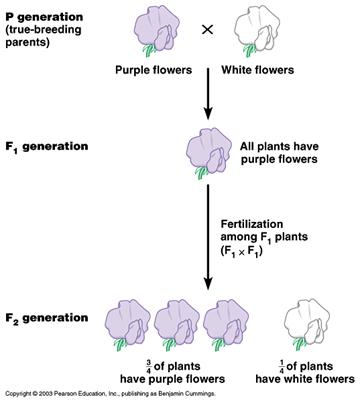
Why did the white color trait disappeared in F1 generation and
reappeared in F2 generation?
The following is Mendel’s explanation.
2)
Mendel’s principle of segregation
(Mendel’s first law of genetics)
i.
Alleles-alternative forms of genes
eg. Purple allele, white allele
ii.
An organism has two alleles, one from each parent.
The two alleles may identical or
different.
iii. Meiosis separates (segregates) two alleles.
Each gamete contains only one allele
of each gene. Fertilization pairs two
alleles once again.
iv. Dominant vs. Recessive
Dominant alleles can override traits from recessive alleles.
eg. Purple allele – dominant
white allele –
recessive
Dominant alleles are represented by uppercase letters.
Recessive alleles are represented by lowercase letters.
eg. Purple allele – P
White allele – p
v.
Genotype vs. Phenotype
Genotype – genetic makeup
Phenotype – actual characteristics (traits)
eg. Purple flower
is phenotype.
Genotype of purple flower can be either
PP or Pp.
White flower is phenotype.
Genotype of white flower is pp.
vi. Homozygote vs. Heterozygote
homozygous (n. homozygote) – two alleles are identical
eg. PP or pp
heterozygous (n. heterozygote) – two alleles are different
eg. Pp
Recessive traits are expressed only when they are homozygous.
eg. pp (homozygous) – white flower
Dominant traits are expressed when they are homozygous and heterozygous.
e.g.
PP (homozygous) – purple flower
Pp (heterozygous) – purple flower
Example 1 - Mendel’s monohybrid
cross Fig 9.3 B, p158
Genotype of parental purple flower plant is PP.
Genotype
of gametes produced by PP flower is ______.
Genotype
of parental white flower plant is pp.
Genotype
of gametes produced by pp flower is _______.
Fertilization
of these gametes results in F1 generation of ______ genotype. The characteristic (phenotype) of F1 generation
plants is ________.
Genotypes of gametes produced by F1 generation is ____________.
Fertilization of F1 gametes
|
|
P |
p |
|
P |
PP |
Pp |
|
p |
Pp |
pp |
Punnett square – table
showing possible combination of gametes.
Fertilization
of F1 gametes results in
Genotypic ratio PP : Pp : pp = 1 : 2 : 1
Phenotypic ratio purple flower :
white flower = 3 : 1
Mendel’s principle of segregation
summary
1. Individuals have two alleles for
each gene.
2. When gametes form by meiosis, the
two alleles separate (segregate), each resulting gamete with only one allele of
each gene.
3. Fertilization pairs two alleles once
again.
Expample2
In the
Figure 9.2D, p157, round seed shape is dominant allele R and wrinkled seed
shape is recessive allele r. Predict the
genotypic and phenotypic ratios of the F2 generation using Punnett
square.
3) Dominant and recessive human traits Fig 9.8A, p163; table in p165
Dominant
Freckles Widows
peak
Free earlobe Brown
eyes
Dominant disorders
Huntinton’s disease 1/25,000
Dwarfism 1/25,000
Recessive
No freckles Straight
hair line
Attached earlobe
Recessive disorders
Deafness
Cystic fibrosis 1/1,800
Caucasians
Phenylketonuria (PKU) 1/10,000
Tay-Sachs disease 1/3,500
Jews
Genetics of autosomal
dominant traits
-
They
don’t skip generation.
-
If
one parent is homozygous for a dominant trait, the probability of their child getting
the same trait is ________.
-
If
both parents are heterozygous for a dominant trait, the probability of their
child getting the same trait is _______.
-
If
one parent is heterozygous for a dominant trait and the other parent don’t have
the trait, the probability of their child getting the same trait is _______.
Genetics of autosomal
recessive traits
-
They
can skip generation.
-
Carriers – Individuals
who do not show the recessive traits, but carry recessive allele (gene). They are heterozygous.
-
If
one parent is heterozygous for a dominant trait and the other parent is
homozygous for a recessive trait, the probability of their child getting the
recessive trait is __________.
-
If
both parents are homozygous for a recessive trait, the probability of their
child getting the same trait is _______.
Work on these problems before the
next lecture. Make pedigrees (family
trees) if necessary.
1. Dwarfism is a dominant trait. If one parent is dwarf and the other parent
is normal height, the probability of their child being dwarf is ________ .
2. Deafness is a recessive trait. One parent is deaf and the other parent is
normal. If their first child is deaf,
what is the probability of the next child being deaf.
3. Cystic fibrosis is a recessive
trait. Neither parents have cystic
fibrosis but their child has cystic fibrosis.
What are the genotypes of the parents?
Use lowercase letter c for the cystic fibrosis allele and uppercase
letter C for normal allele.
What is the probability of the next child having cystic fibrosis?
4. Huntington’s disease is a dominant
trait. One grandmother had Huntington’s
disease but neither parents had Huntington’s disease. What is the probability of the child having
the disease?