Nov 29 Chapter 11 (continued)
3. Therapeutic and reproductive
cloning
A. Cloning
Clones: genetically identical organisms
<Clones
in nature>
-
Organisms produced via asexual reproduction are clones.
Examples: bacteria, plants
-
Identical twins are clones.
Cloning: process of generating genetically
identical organisms (reproductive
cloning) or cells (therapeutic
cloning).
B. Reproductive cloning
- Reproductive
cloning of non-human species has potential to commercially produce clones with
desirable traits.
- Cloning
is a critical step for genetic engineering.
- Other
hypothetical uses include: cloning of endangered species, cloning from extinct
species???
<Clonal
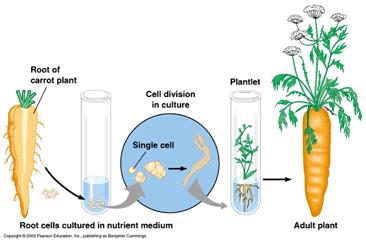
propagation of plants>
- When
placed in appropriate conditions, differentiated plant cells can dedifferentiate
and redifferentiate from single cells (Fig 11.3A, p213).
- This
method is widely used for propagating plants for commercial purposes.
<Cloning
of animals>
- Most
animals do not reproduce asexually.
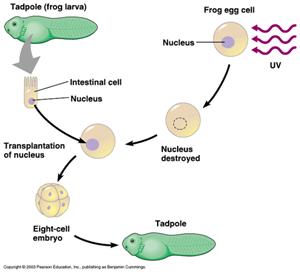
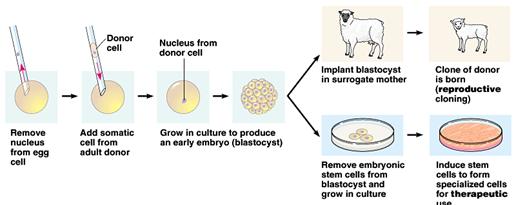
- Clones
can be produced via nuclear
transplantation. (Fig 11.3B, 213; Fig in p209)
- destroy or remove the nucleus of
an egg cell.
- take a nucleus from an adult cell
and transplant it to the egg cell.
- implant the egg in a surrogate
mother.
- First
cloning of mammal: 1997, a sheep named Dolly was produced using this method.
- Not
practical at this point because of a high failure rate.
<Human
cloning?>
- Human
cloning is theoretically possible but not practical at this point.
-
Hypothetical uses: cloning for those without a child, cloning from deceased???
genetic engineering of human???
- Ethical
problems
-
Research on human reproductive cloning is currently banned in public research
institutes. However, this does not
prevent a private company to conduct research.
B. Therapeutic cloning
-
Production of stem cells for
therapeutic use.
Stem cells: cells which are capable of
dividing and which can differentiate into many different types of cells.
- Early
embryos contain stem cells (embryonic
stem cells or ES cells).

- ES
cells can be maintained as cell cultures.
- When
placed in an appropriate condition (such as treatment with growth factors), ES
cells can differentiate into desired cell types.
-
Although it is still in the experimental stage, ES cells may provide treatments
or even cure to currently untreatable diseases.
<Ethical
problem>
- ES
cells must be obtained from human embryos.
- Should
embryos be treated as “life”?
- Each
country has a strict guideline for stem cell research.
- The
Canadian government allows the use of embryos which will be disposed otherwise
(Ex. embryos that are made for the purpose of in vitro fertilization).
- The US
government does not fund stem cell research unless they use preexisting ES cell
lines.
Adult stem cells
- Adult
bodies contain stem cells to replace cells for normal body function.
Example:
The bone marrow contains blood-forming stem cells, which give rise to different
types of blood cells.
- In
generally, it is believed that adult stem cells are capable of differentiating
into much fewer types of cells.
- Adult
stem cells would make an ideal source of stem cells if they are made capable of
differentiating into much more different cell types.
4. Genetic basis of cancer
- In
normal cells, decision to divide is made according to developmental and
environmental signals, such as growth factors.
- Tumor
cells escape from the control mechanisms of the cell cycle.
- Cancer
is caused by genetic mutations in somatic cells. (Not inherited to offspring.)
- Mutations
in either a proto-oncogene or a tumor-suppressor gene could result in
cancer.
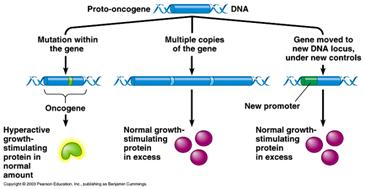
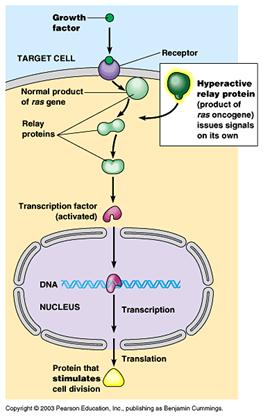
Proto-Oncogenes
- Proto-oncogenes are normal genes that
have the potential to become oncogene
(tumor-causing genes).
- Many
are genes that normally stimulate cell growth.
- When
mutated, proto-oncogenes can become oncogenes
(Fig 11.15A, p223). ® tumor induction
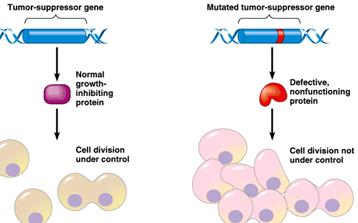
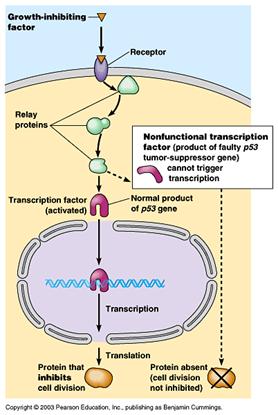
Tumor-suppressor genes
- Genes
normally inhibit cell division.
- When
mutated, they may loose control of cell division (Fig 11.15B, p223). ® tumor
induction
Signal transduction pathway and tumor induction
- Many
proto-oncogenes and tumor-suppressor genes are normally involved in signal
transduction pathway (Fig 11.16A, p224)
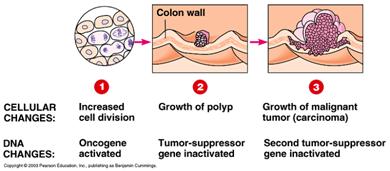
Multiple genetic changes are
required for cancer
Example:
development of colon cancer
What causes cancer?
Carcinogens: cancer causing agents
- Most
mutagens are also carcinogens.
-
Prolonged exposures to carcinogens may cause cancer.

- Viruses can cause cancer.
- When
viruses are inserted into and excised from host DNA, they may leave small
pieces of virus DNA. This may result in
mutation in host DNA.
Example: cervix cancer, liver cancer
Cancer susceptibility
- Some
individuals are more susceptible to cancer due to their genetic background.
Example
1: Heritable mutations in the BRCA1 gene
increase the risk of developing breast cancer (genetic testing available).
Example
2: The Caucasian population is more susceptible to cancer causing effects of
cigarette smoke than the oriental population.
Cancer prevention
-
Minimize exposure to carcinogen.
- Some
diets/habits are known to reduce cancer risks.