Nov 27 Chapter 11 (continued)
B. Gene regulation in eukaryotes
(continued)

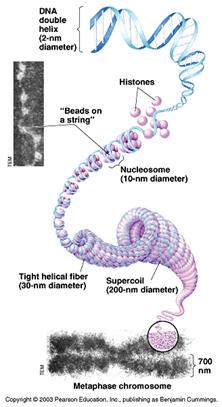
ii) Chromatin structure (Fig 11.6,
p215)
- Histones attach to DNA to make the ‘beads on a string’ structure.
- Each
‘bead’ is also called nucleosome.
-
Nucleosome consists of DNA wound around eight histone protein molecules.
- Chromatin
can be further packed to make the tight helical fiber or the supercoil
structure.
- Tight
packing of chromatin turns off gene expression because it prevents RNA
polymerase to access DNA.
Example 1: Condensed chromatins
during metaphase are inactive.
Example 2: (Fig 11.7, p217)
·
In
somatic cells of female mammals, one of the two X chromosomes is condensed all
the time (X- chromosome inactivation).
·
Patchy
fur color of a cat is due to the X chromosome inactivation.
- Chromatin
must be loosened first to turn on gene expression.
- Histones
detach from DNA to allow RNA polymerase to access DNA.
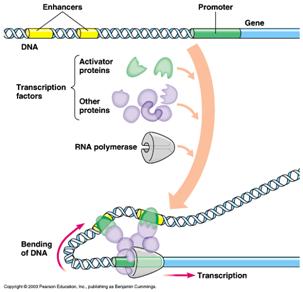
iii) Transcriptional regulation (Fig
11.8, p217)
Major
controlling point of gene expression.
Enhancers / silencers: regulatory DNA sequences (analogous
to operators in prokaryotic gene).
- One gene
is controlled by multiple enhancer / silencer elements
Transcription factors: regulatory proteins for
transcription.
- Activator proteins bind to the enhancer sequences.
- Other transcription factors interact with
activator proteins to make a protein complex.
- The
transcription factors also interact with RNA polymerase to assist the binding
of RNA polymerase to the promoter
sequence.
- Repressor proteins bind to the silencer
sequences, which inhibits the binding of RNA polymerase to the promoter
sequence.
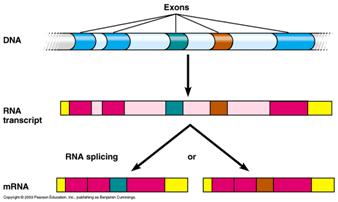
Alternative splicing
iv) Posttranscriptional regulation
a. RNA processing
- RNA
processing is critical for expression of eukaryotic genes.
- In some
cases, different polypeptides can be produced from a single gene via alternative splicing.
b. mRNA breakdown
- The rates
of mRNA breakdown vary among mRNA molecules. Some mRNAs stay in the cytoplasm much
longer than others. Example
of long lived mRNA: hemoglobin mRNAs in red blood cells
- The
breakdown of mRNA is catalyzed by RNA degrading enzymes (RNases).
c. Translation
-
Regulatory proteins may control the initiation process of translation.
d. Protein activation
- Newly
translated polypeptides are not functional until they are shaped into proper
forms.
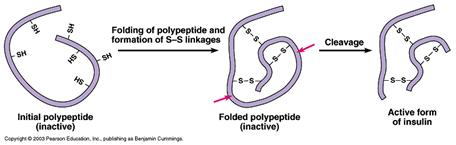
- The
process of protein activation may involve: proper protein folding, cleavage
(see example of insulin below), modification (such as adding sugar chains),
assembly to a larger protein complex, etc.
e. Protein breakdown
- The rates
of protein breakdown can vary among proteins.
- Breakdown
of proteins is important for regulating protein concentrations in the cells.
Example: The concentration of cell
cycle proteins, such as cyclins, is tightly regulated.
- Damaged
proteins are removed and replaced by new ones.
v) Mechanisms of Signal Perception
(Fig 11.13, p221)
(1) Signal molecules, such as hormones and
growth factors, are produced by signaling cells.
(2) The
signal molecule binds to the specific receptor
proteins that are embedded in the target cell’s plasma membrane.
(3) The
binding activates the signal
transduction pathway. The signal
transduction pathway consists of a series of relay proteins. Each relay protein activates another.
(4) At the
end of the signal transduction pathway,
the last relay protein activates a transcription
factor.
(5) The
transcription factor turn ON the expression of target genes.