Nov 25 Chapter 11
In this
chapter, you will learn mechanisms of gene regulation. Here are the headings:
- Gene regulation mechanisms in prokaryotes
- Gene regulation mechanisms in eukaryotes
- Therapeutic and reproductive cloning
- Genetic basis of cancer
1. Gene regulation mechanisms in
prokaryotes
A. Gene expression in prokaryotes
- Prokaryotes turn ON or OFF sets of genes according to
the environment.
Example: Escherichia coli (E. coli) is bacterium reside in the intestine. E. coli
cells turn on expression of the lactose digesting enzyme genes only when they
are bathed in solution containing lactose
(i.e. when you eat or drink milk products).
- Operon: a
cluster of genes in prokaryotes, which are controlled by a common ‘ON/OFF’ switch.
B. The lac operon
- The lac operon is a cluster of genes
involved in lactose digestion in E. coli.
- Two
control genes, promoter and operator, followed by a group of
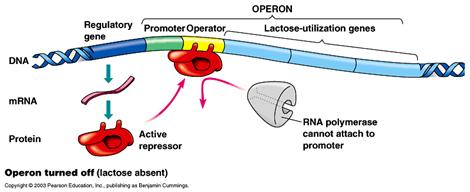
lactose-utilizing genes (Fig 11.1 top, p211).
- Promoter: the binding site of RNA
polymerase.
- Operator: regulatory sequence that act
as switch.
i) When
lactose is absent:
- A regulatory gene produces repressor all the time.
- The
repressor protein binds to the operator sequence.
- RNA
polymerase cannot attach to the promoter. ® The lac operon is turned off.
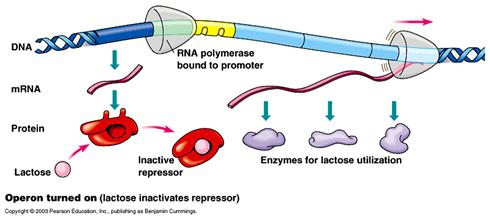
ii) When
lactose is present:
- Lactose
molecule binds to repressor protein, inactivating the repressor.
-
Repressor cannot bind to the operator.
- RNA
polymerase can now bind to the promoter. ® The lac operon is turned on.
B. The Trp Operon
- A cluster of genes involved in the synthesis of the
amino acid tryptophan (Trp).
i) When
Trp is absent:
- A
regulatory gene produces repressor proteins all the time but the repressor
cannot bind to the operon by itself. (i.e. Repressor is inactive.) Fig 11.1C, p211
- The trp operon is turned on.
ii) When
Trp is present: 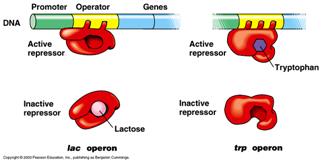
- Binding
of Trp to the repressor activates the repressor.
- The
active repressor binds to the operator.
- The trp operon is turned off.
C. The activator system
- Operons
may be controlled by an activator
instead of a repressor.
- Binding
of the activator to the operator facilitates binding of RNA polymerase to the
promoter sequence.
- An
environmental stimulus may activate or inactivate the function of the
activator.
2. Gene regulation mechanisms in
eukaryotes
A. Cell differentiation and gene
expression
- Multicellular organisms consist of specialized cells
with specialized functions.
Examples: muscle cells - muscle contraction
alpha cells in pancreas - production of glucagon (The hormone that
increases the blood sugar level.)
beta cells in pancreas - production of insulin (The hormone that
decreases the blood sugar level.)
white blood cells - defense (removal of pathogen)
red blood cells - carries oxygen
- Cell differentiation: the process of
cell specialization.
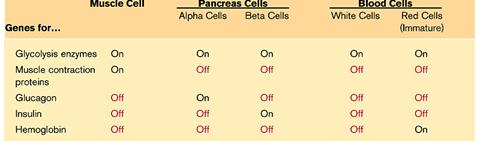
- Different
sets of genes are expressed in different types of cells (cell-specific gene expression). (Table in p212)
-
Eukaryotic genes are controlled by both developmental and environmental
signals.
Example: The insulin production is specific to
the alpha cells in pancreas (developmental control).
The insulin production
is turned on only when the blood sugar level is too high (environmental
control).
B. Gene regulation in eukaryotes
i) Overview
- The strength
of eukaryotic gene expression is controlled at different levels (Fig 11.11,
p219).
- The flow
of gene expression is similar to water flowing through pipes.
- There are
at least nine ‘valves’ (control mechanisms) to control gene expression.
ii) Chromatin structure
iii) Transcriptional regulation
iv) Posttranscriptional regulation