Nov 22 Chapter 10 (continued)
ii) Deletion or insertion of base (continued)
Reading frame – grouping of triplets
Deletion
or insertion of a nucleotide within the coding sequence will result in the
shift in the reading frame and will change the amino acid sequence after the
mutation. This is also known as frame-shift
mutation.
Mutagenesis – creation of mutation
Mutagens – agents that induce mutagenesis
Examples:
UV light, X-rays, cigarette smoke, etc.
Most
mutagens are also carcinogens (cancer causing agents).
3.
Virus
-
Genes in packages
- Virus DNAs are packed in coat protein.
- Requires materials from host for its survival.
- Not considered as living organisms.
- Can become part of the host chromosome.
- May have derived from the host DNA originally.
a. Bacterial phage
- Viruses that infect bacteria.
- Two types of reproductive cycles: lytic and
lysogenic cycles (Fig 10.17, p202)
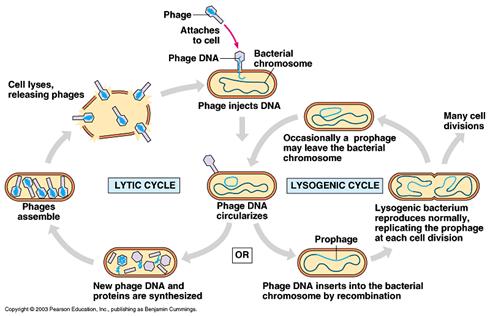
Lytic
cycle – break open bacteria (kills
bacteria)
Lysogenic
cycle – Phage DNA becomes a part of host
chromosome and thus becomes prophage.
Prophage DNA does not kill bacteria.
- Bacteria phages are used commonly as a genetic
tool to produce many copies of genes via recombinant DNA technology.
b. Viruses that cause human disease
cold virus, influenza virus, polio, chicken pox, herpesvirus,
HIV (AIDS virus), Evola virus, hantavirus, West Nile virus, etc.
Features of disease causing viruses
enveloped virus
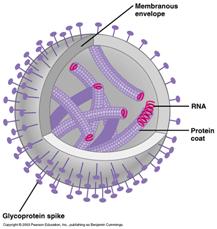
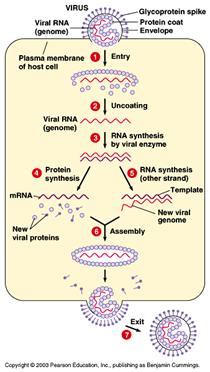
- Surrounded by a membrane envelope (enveloped
virus), which allows its entry to animal cells.
- Genetic information may be coded in RNA instead of
DNA.
- Can become a part of host chromosome (provirus). Provirus is a latent form of virus.
- Some viruses evolve rapidly, making it difficult
to develop vaccines.
Examples:
flu virus, HIV
- Virus that is harmless in one organism can be
harmful to another organism. Therefore,
other organisms can serve as carriers of harmful viruses.
Example:
Hantavirus is common to rodents and does not kill the animals. On the other hand, the infection of
hantavirus to human can be fatal.
(This is one of the criticisms against
xenotransplantation.)
- Retrovirus carries RNA as genetic
information when they infect. Once virus
RNA is in a host cell, DNA is synthesized from RNA (reverse transcription),
which is catalyzed by reverse transcriptase.
- HIV is an example of retrovirus.