Nov 20 Chapter 10 (continued)
2. Mechanism
of gene expression (continued)
d. Translation
i)
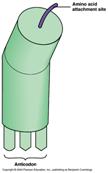
transfer
RNA (tRNA) (See the figure below.)
-
Small RNAs that deliver amino acids to the translation machinery.
-
Anticodon
at one end and an amino acid
attachment site at the other end.
-
Anticodons are
complementary to codons on mRNA.
Example: The anticodon
of the codon UAG is AUC.
-
An enzyme
attaches specific amino acids to specific tRNA. (This reaction requires ATP.) (Fig 10.15, p199)
Example:
The tRNA with the anticodon
AUC carries the amino acid Tyr (tyrosine).
Which amino acid is attached to the tRNA molecule with the anticodon
UCC?
ii)
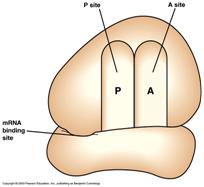
Ribosome
-
Site of
protein synthesis.
-
Found in
the cytoplasm (may or may not be attached to ER). Assembled in the nucleous.
-
Protein –
RNA complex.
-
Protein
components: two subunits (small and large), each consisting of multiple
proteins.
-
RNA
components: ribosomal RNA (rRNAs)
-
Binds to
mRNA and tRNA.
-
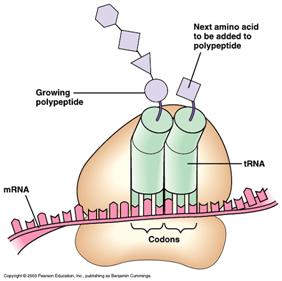
Two tRNA binding sites
o P
site – holds tRNA
carrying growing polypeptide.
o A
site – holds tRNA
carrying the next amino acid to be added.
iii) Coding
sequence
–
The
sequence that codes for a polypeptide.
–
From the
start codon to a stop codon.
(Fig 10.13A).
iv) Stages of translation
Three stages of translation: initiation, elongation and termination
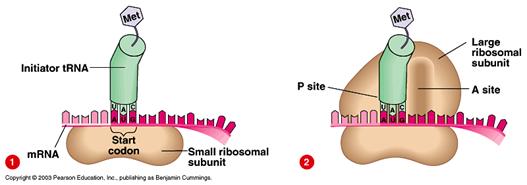
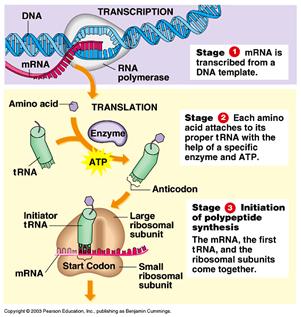
(1) Initiation (Fig 10.13B, 199)
Step1: An mRNA molecule binds to a small ribosomal
subunit. The initiator tRNA, carrying methionine (Met),
binds to the start codon.
Step 2: A large ribosomal unit binds to the small
one. The initiator tRNA
fits into the P site on the ribosome.
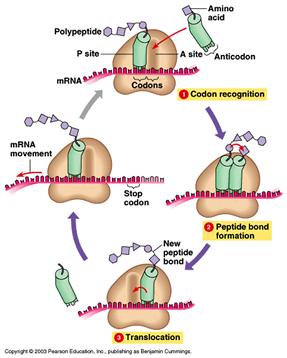
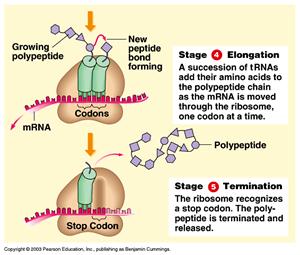
(2) Elongation (Fig 10.14, p199)
Step 1 Codon
recognition: The anticodon of tRNA
pairs with the corresponding mRNA codon in the A site
of the ribosome.
Step 2 Peptide bond formation: The
polypeptide at the P site separates from tRNA and
attaches to the amino acid at the A site.
The ribosome catalyses the peptide bond formation.
Step 3 Translocation: The P site tRNA leaves the ribosome and the ribosome moves the A site tRNA to the P site.
The ribosome is now ready to accept another tRNA
at the A site.
(3)
Termination
- The ribosome reaches a stop codon
(UAA, UAG or UGA). Completed polypeptide
is released from the last tRNA. The ribosome splits into its subunits.
e. Gene
expression review (Fig 10.15, p 200)
Stage
1: transcription –
initiation, elongation, termination
Additional
stage for eukaryotes: RNA
processing – CAP, TAIL and splicing
Stage
2: Attachment of amino acids to
the corresponding tRNAs.
Stages
3 – 5: translation –
initiation, elongation (codon recognition, peptide
bond formation and translocation), termination
f.
Mutation - Change in the nucleotide
sequence.
i)
Substitution
of base
-
Replacement
of a nucleotide with another.
-
Does not
always result in change in amino acids because of the redundancy in the
code.
Example:
The codon CAG codes for Gln (glutamine). The
base substitution of G to A would not change the meaning because the CAA also
codes for Gln.
However, the base substitution of C to A would result in the amino acid Lys (lysine) instead.
-
Base
substitution of a single nucleotide could cause harmful effects.
Example: The sickle cell disease results from a
single mutation. (Fig 10.16A)
- Not all mutations are harmful.
ii) Deletion or insertion of base
-
Often
have harmful effects.
Translate the three mRNA sequences shown below and
think of the reason why deletion or insertion causes more serious effects.
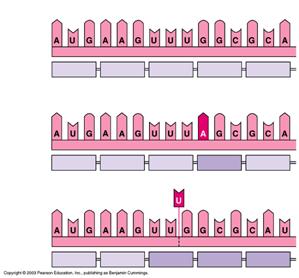
Reading frame – grouping of triplets
Deletion
or insertion of a nucleotide within the coding sequence will result in the
shift in the reading frame and will change the amino acid sequence after the
mutation. This is also known as frame-shift
mutation.
Mutagenesis – creation of mutation
Mutagens – agents that induce mutagenesis
Examples:
UV light, X-rays, cigarette smoke, etc.
Most
mutagens are also carcinogens (cancer causing agents).