Nov 15 Chapter
9 Patterns of Inheritance (continued)
Carlos
and Mollie Can Have a Perfectly Healthy Baby (or can they?)
Carlos and Mollie want to have children. However,
they haven’t tried to start a family yet because they disagree on something important.
Carlos wants Mollie to get tested to see if she is a carrier for cystic
fibrosis (CF). Mollie doesn’t want to do it. People with CF have mutations in
one or more genes. These mutated genes give faulty instructions for the
production of proteins that help move salt in the body. One result is that the lungs
become clogged with mucus, making it hard to breathe. Another result is that
the body has a hard time digesting food. The disease can be painful and lead to
an early death. Carlos had a brother with CF. He hated seeing his brother suffer so much. His parents struggled with the hardship and
expense of caring for a sick child who never made it to adulthood. Carlos
doesn’t want to repeat that experience in his own life. That’s why he had himself
tested for CF. Unfortunately, he found out that he is
a carrier. CF is a recessive disorder. That means his children will have the disease
only if they inherit the mutated gene from both parents. Mollie can get tested
to see if she carries the CF mutation. If she does, then when she gets pregnant
they can have the fetus tested to make sure it does not have two CF genes and
is therefore free of the disease. Mollie would prefer simply not knowing what
the risks are. She figures that once a baby is in their arms, they will be glad
they had it, no matter what. If you were Mollie or Carlos, what would you do?
<Cystic fibrosis (CF)>
-
Autosomal
recessive
o
If both
parents are carrier, the chance of their child getting CF is 25 %.
-
Most
common fatal genetic disorder
-
Children
with CF have difficulty breathing or digesting food.
-
Vulnerable
to infections
-
The
affected children may or may not make to the adulthood.
Carrier
testing – Genetic testing to determine
whether the person is a carrier of a
recessive
genetic disorder.
If Mollie turns out to be a carrier of the CF
allele, what are their options?
-
They may
decide not to get married.
-
They may
decide not to have children. They may
want to adopt children instead.
-
They may
decide to have fetus tested while Mollie is pregnant (Prenatal testing).
-
If the
fetus has CF, they may decide to terminate pregnancy.
-
They may
consider in vitro fertilization. Sperms and eggs are fertilized in a petri dish. Obtained
embryos can be tested for presence of the CF allele. The embryos that do not carry the CF allele
are implanted to mother’s uterus. Very
expensive procedure. High failure rate.
Even if they try everything to avoid a child with
CF, they may still be end up with a sick child.
Even if they have a child with CF, advancement of
medical research may provide him/her a better quality of life.
Howard’s
Health Is Up to Him (or is it?)
Howard will turn 50 soon, and it worries him. His
grandfather died of a heart attack in his fifties, and so did his father and uncle.
Several years ago, a doctor told Howard that he was at high risk for heart
disease because of his family history. But the doctor said that Howard could
improve his chances if he lost some weight, stopped smoking, and exercised. The
doctor also told Howard to come back every year for a checkup. Howard hasn’t
gone on a diet, and he hasn’t given up his cigarettes or taken up exercise. He
also hasn’t been back to the doctor. He’s afraid of what the doctor might find.
Howard can’t make up his mind. Sometimes he thinks he should try to take better
care of his health. Other times, he thinks that he should just accept the fact
that he won’t live much longer and should get as much fun out of life while he
can. If you were Howard, what would you do?
Genes vs.
environment (Nature vs. Nurture)
-
Most
illness is caused by many factors.
-
While
genes may play a role in many disorders, so do the conditions and circumstances
of your life.
-
Very few
disorders are triggered by a single gene.
-
Chances
are that everyone has at least a handful of “problem” genes but they may never cause you trouble.
-
Genetic determinism is a misguided idea that everything is determined by
genes.
-
The idea
is also the basis of ‘eugenetics’ that was
prevalent during early 20th century.
-
Eugenetics is the effort to control the genetic makeup of
human populations, which created many controversial programs such as racial
segregation, sterilization program and, in extreme case, racial elimination
(holocaust, ethnic cleansing).
-
Human
characteristics, such as temperament, intelligence, social behavior and
physical and artistic skill, are influenced by both genes and environment.
Genetic
discrimination
-
The
genetic information could easily be misused by employers and insurance
companies.
-
An increasing
number of insurance companies (health, life and disability insurances) are
making genetic testing as prerequisite for joining the policy.
-
They may
force genetic testing even to those who do not wish to know their genetic
status. (Shouldn’t we have the right not
to know our genetic status?)
-
These
issues need to be solved at the government level.
Chapter 10 Molecular
biology of the gene
Pre-chapter review
- ________
serves as genetic blueprints in living organisms.
- The
process which the information in DNA is transferred to RNA is called
________.
- The
process which the information in RNA is used to make polypeptides is
called ________.
- Monomer
units of nucleic acid are _______, which consists of nitrogenous base,
sugar and ________ group.
- The
four nitrogenous bases found in DNA are ________.
- The
four nitrogenous bases found in RNA are ________.
- Double
helix refers to the structure of ________.
In this chapter, you will learn gene structures
and functions at the molecular level. Here are the headings:
- Mechanism of DNA
replication
- Mechanism of gene
expression
- Overview of gene
expression
- Transcription
- RNA processing
- Translation
- Viruses
1. Mechanism of
DNA replication
i) Structure of DNA
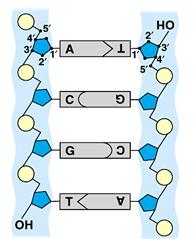
- Complementary base pairing
A only pairs with T
C only pairs with G
- The
opposing strand is also ‘backwards’. (Fig 10.5B, p191)
- One
strand of DNA serves as a template for the daughter strand being synthesized.
- DNA is
always synthesized from the 5’ end to the 3’ end. (5’ ® 3’)
ii) Steps
of DNA replication
-
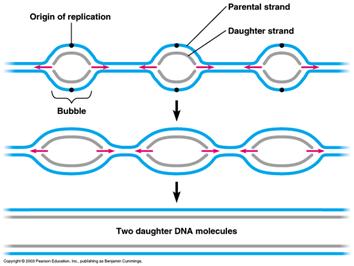
Origin of replication – double helix opens up to prepare
for DNA synthesis. (Fig 10.5A, C, p191)
-
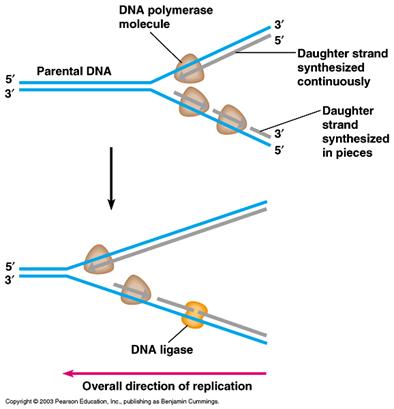
DNA polymerase adds nucleotides to the 3’ end.
-
One
daughter strand is synthesized in one continuous piece.
-
The
other daughter strand first produces as short pieces. They are then put together by DNA ligase. (Fig 10.5C)