IMPORTANT! The following is one of the write-up questions in the final
exam. Do not hand in the answers before
the exam. You will need to write the
answers in the exam question book.
Choose one
of the following terms: genetic testing, therapeutic cloning, reproductive
cloning, gene therapy. Answer the
questions using no more than three sentences.
1. Explain
the term/technology (1 point).
2. Describe its potential benefit(s)
to our lives (2 points).
3. Describe
the social or ethical problem(s) associated with the term/technology (2
points).
Chapter 12 DNA technology and the human genome
1. Recombinant DNA technology
- Combines
different pieces of DNA (recombinant DNA)
to manufacture genes and gene products.
A. Gene cloning
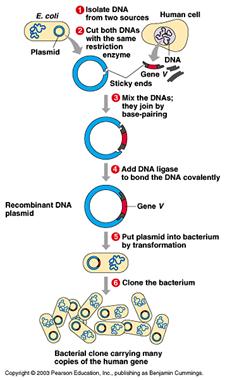
Gene cloning is the process of producing multiple
copies of a gene, using recombinant DNA.
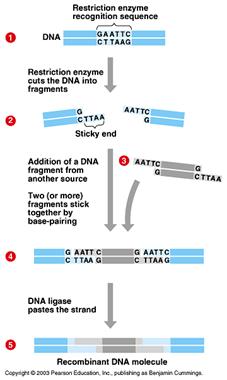
Recombinant DNA is generated by the process of ‘cut
and paste’, in which restriction enzymes
work as scissors and DNA ligase as
glue. (Fig 12.4, p235)
Restriction enzymes are bacterial enzymes that cut DNA
at specific sites.
- Recognize
a short nucleotide sequence.
Example: The restriction enzyme in Fig 12.4 recognizes the
DNA sequence GAATTC.
- Hundreds
of restriction enzymes have been isolated.
- There are
over a hundred different recognition sequences.
- Some
restriction enzymes produce ‘sticky ends’ to the target DNA molecules after
digestion.
DNA ligase joins DNA fragments together. ‘Sticky ends’ assist the joining of DNA
fragments.
Plasmids are small circular DNA molecules in bacteria cells.
- In
nature, a plasmid serves as a vector,
which transfers genetic information from one bacterium to another.
- Plasmids are used as tools to manufacture
multiple copies of recombinant DNA
in bacteria (typically E. coli cells).
Creation of recombinant DNA Process of gene cloning (Fig 12.5, p236)
B. Polymerase Chain Reaction (PCR) (Fig 12.12, p242)
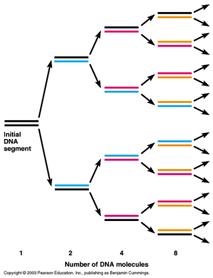
- Amplification
of DNA molecule in test tubes.
- Amplifies
trace amount of DNA molecule.
- The DNA
fragments are duplicated during each cycle of PCR reaction. (Each cycle
typically lasts for a few minutes.)
- The
amount of DNA after n cycles of PCR reaction should be 2n.
Examples:
After 10 cycles of PCR reaction, single DNA molecule should amplify to about a
thousand molecules (210=1024).
After 20 cycles of PCR reaction, single DNA molecule should amplify to
about a million molecules (220).
Different applications
of PCR include:
- Gene
cloning.
- Gene
cloning from fossils.
- DNA
detection in crime scenes.
- Virus
detection.
C. Application of
recombinant DNA technology (Genetic engineering)
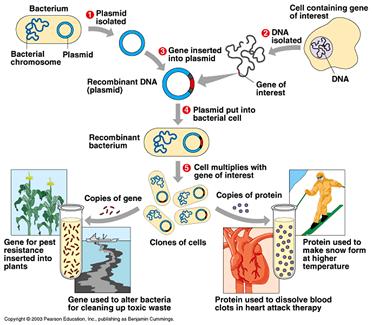
i) Production of
protein products
-
Manufacture of proteins for medical and/or industrial purposes.
- Proteins
may be produced in a variety of organisms, such as E. coli, yeast, animal or
plant cells.
- Each
organism has advantages and disadvantages.
Examples: insulin production in E.
coli, production of vaccines in yeast
ii) Genetically
modified (GM) organisms in agriculture
- Organisms
may be genetically modified for the purpose of enhancing the organism’s value.
- Genetic
engineering is a more direct way of improving crop traits than traditional
breeding.
-
Genetically modified organisms are also called transgenic organisms.
Examples of GM organisms:
Transgenic potatoes carrying toxin (Bt toxin) to insects ®
minimize use of insecticides
‘Golden rice’ ® Vitamin A enriched rice
Transgenic plants/animals with enhanced growth.
- GM plants
are becoming common, whereas commercialization of GM animals has been much
slower.
Safety Concerns
-
Recombinant microbes may escape to the nature to create new pathogens.
® Scientists must follow a strict
guideline to prevent the microbes from leaving the laboratory.
- Effects
of GM plants and animals on human health?
® Rigorous safety testing before
commercialization.
- GM plants
may cross with wild relatives. If the
herbicide resistance gene escapes to wild plant population, this may create
‘superweeds’.
® Guideline to prevent
‘escapes’.
® ‘Escape’ can be prevented by making
GM plants sterile
- Insect
resistant GM plants may have unintended effects on other insects.
® This has not been confirmed in the
field.
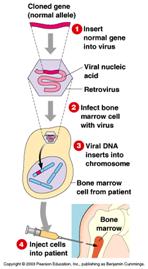
iii) Gene therapy
- Introduction
of recombinant DNA to human cells/tissues.
- Gene
therapy has potential for treating a variety of disease.
cancer, arthritis, heart disease,
etc.
- However,
attempts to correct genetic defects via gene therapy have not been successful
because of short lived activity of introduced genes.
Example of gene therapy strategy (Fig 12.9, p249):
Social and ethical questions
- Who
should have access to the procedures?
- Should
gene therapy be reserved for serious disease?
- Should we
allow gene therapy for altering other traits?