Review
question Nov. 29
1. In
eukaryotes, the structures consisting of associations of histones and DNA are
called _____.
A. histosomes B. ribosomes C. nucleosomes D. dinasomes E. genetosomes
2. A
genetic defect in humans results in the absence of sweat glands in the skin.
Some men have this defect all over their bodies, but in women it is usually
expressed in a peculiar way: A woman with this defect typically has small
patches of skin with sweat glands and other patches without sweat glands. In
women, the pattern of sweat-gland distribution can best be explained by _____.
A. mutation
B. X-chromosome inactivation
C. operon
D. enhancer
E. alternative splicing
3. In a
eukaryote, a repressor protein may block gene expression by binding to a DNA
site called a(n) _____.
A. operon B. promoter C.
terminator D. enhancer E. silencer
4. An enhancer
of an eukaryotic gene is _______.
A.
DNA sequence that assists RNA polymerase’s binding to the promoter
B.
DNA sequence to which RNA polymerase binds
C. a protein that assists RNA
polymerase’s binding to the promoter
D. a protein that binds to RNA
polymerase
E. a protein that enhance cells’
survival
5. Which of
the following is true of gene regulation in both eukaryotes and prokaryotes?
A. elaborate packing of DNA in chromosomes
B. transcription is the usual point at which gene expression
is regulated
C. the addition of a cap and a tail to mRNA
D. lac and trp operons
E. the removal of noncoding portions of RNA in the making of
mRNA
6. Which
one of the following is NOT a means (or level) of controlling eukaryotic gene
expression?
A. DNA packing
B. transcriptional regulation
C. mRNA processing
D. requiring many protein factors in transcription
E. inhibition of enzyme activity via an competitive
inhibitor.
7. The
cellular response of a signal-transduction pathway that activates a
transcription factor would be _____.
A. the synthesis of mRNA
B. the activation of an inactive enzyme
C. alteration of the cytoskeleton
D. a change in the chemical composition of the cytosolic
environment
E. the activation of a metabolic pathway
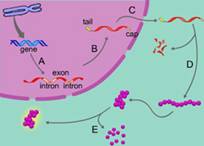
8. Label A
– E in the diagram using the following terms: RNA processing, translation,
transcription, protein breakdown.