Review questions, Nov 22
- _______ of tRNA pairs with mRNA and the amino acid
attachment site bind to an amino acid.
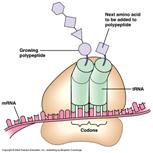
________ of the ribosome holds tRNA carrying the next amino acid to be added. _______ of the ribosome holds tRNA
carrying a growing polypeptide.
- Codon
.............The A site .............The P site
- Anticodon
........The A site .............The P site
- Codon
............. The P site ............The R site
- Anticodon .......
The P site ............ The A site
- Codon
............ The R site.............The
R site
- Anticodon
......... The R site...........The A site
- The below is a
diagram of the translation machinery during _______ of translation. The ribosome moves ________ .
- initiation
.............right
- initiation..............left
- elongation...........right
- elongation...........left
- termination..........right
- termination..........left
3. Find
the start codon in the following mRNA sequence (Use the codon table):
GUGGAUGAAGAAUUGGUGUUGAAAGC
4. Find the stop codon in the
above sequence.
5. How many tRNAs does it require
to translate the above sequence?
6. List the anticodons for
the tRNA needed for translation of the above sequence.
7. Translate the above
sequence.
8. The base substitution at
the nucleotide position 19 U ® C would result in
_______.
a. no change in the amino acid sequence
b. substitution of
the amino acid
c. premature
introduction of a stop codon
d. frame-shift
mutation
9. The deletion of the
nucleotide 10 G would result in ________.
a. no change in the amino acid sequence
b. substitution of
the amino acid
c. premature
introduction of a stop codon
d. frame-shift
mutation
10. The initiator tRNA contains anticodon _______
at one end and the amino acid _______ at the other end.
a. AUG ..........Met
b. ATG .......... Phe
c. TAC .......... Phe
d. UAC ..........Met
e. UAA .......... Phe
11. The diagrams below are different steps of translation. Label each step using the following terms:
translocation, peptide bond formation,
codon recognition, initiation, termination
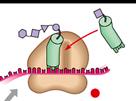

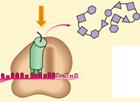
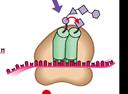

12. Place the above steps in the right order.
13. The function of tRNA during protein synthesis is to
_____.
a. deliver amino acids to their proper site during
protein synthesis
b. guide ribosome subunits out of the nucleus through
nuclear pores
c. attach mRNA to the small subunit of the ribosome
d. process mRNA
e. transcribe mRNA
14.
The P site of a ribosome does which one of the following?
a. It holds the tRNA that is carrying the next amino acid
to be added to the growing polypeptide chain.
b. It holds the growing polypeptide chain.
c. It helps "unzip" DNA during
transcription.
d. It catalyzes the addition of amino acids to the
polypeptide chain of adjacent amino acids.
e. It recognizes the promoter during transcription
initiation.
15.
Which one of the following processes does NOT take place in the nucleus?
a. transcription
b. translation
c. DNA replication
d. RNA processing
e. assembly of ribosomes
16.
Ultraviolet (UV) radiation is damaging because it ____________.
a. prevents DNA transcription
b. prevents DNA translation
c. causes mutations in the DNA
d. deactivates the enzymes needed for DNA replication
e. inhibits protein synthesis
17.
A particular ____ carry the information for making a specific polypeptide, but
____ can be used to make any polypeptide.
a. gene and ribosome _________ mRNA
and tRNA
b. gene and mRNA __________ ribosome
and tRNA
c. ribosome and mRNA __________ tRNA
and gene
d. mRNA and tRNA __________ gene and
ribosome
e. ribosome and tRNA _________ mRNA
and gene
18.
Which of the followings is always true for the nucleotide contents in a DNA
molecule?
a. A + T > C+ G
b. A + T = C + G
c. A + C > T + G
d. A + C = T + G