Review
Questions Dec 04
1. Plasmids are ______.
A. repeating sequences that protect DNA from digestion when
it is inserted into a foreign cell
B. small circlets of DNA found in bacteria
C. segments of RNA that must be attached to DNA before the
DNA can replicate
D. ends of cut DNA molecules that are "sticky"
because they have unpaired base sequences
E. infectious proteins
2. DNA used in recombinant DNA techniques is first cut into
fragments by _____. The DNA fragments
are then joined together by ______.
A. restriction enzyme........a DNA polymerase
B. a DNA ligase.................restriction enzymes
C. a reverse transriptase...a DNA ligase
D. restriction enzymes.......a DNA ligase
E. UV irradiation................a DNA polymerase
3. Which of the following techniques are useful in identifying
DNAs from traces of blood in a crime scene?
A.
polymerase chain reaction (PCR)
B. genetic
transformation
C. gene
cloning
D. reverse
transcription
E. signal
transduction
4. Which of
the followings is an example of genetically modified organisms?
A. a human
treated with insulin produced by E. coli bacteria
B. a
disease resistant rice variety produced via traditional breeding
C. a carrot
plant regenerated from a single somatic cell.
D. an
insect resistant potato variety carrying the bacterial Bt toxin gene
E. a human
who received a corrected cystic fibrosis gene via gene therapy
5. A human
cell contains about 1000 times more DNA than an E. coli cell. However, the number of genes in the human
genome is only 40 times more than the E. coli genome. Why?
A. Because
human cells are much larger than E. coli cells.
B. Because
human body consists of many cells.
C. Because
human cells differentiate into many different types of cells.
D. Because
a majority of the human genome consists of ‘junk’ sequences.
6. The
figure below is DNA fingerprint patterns from a murder victim, suspect 1,
suspect 2 and a mixed blood sample from the crime scene. Which suspect is more likely to have
committed the crime?
Victim Suspect 1
Suspect 2 Crime scene

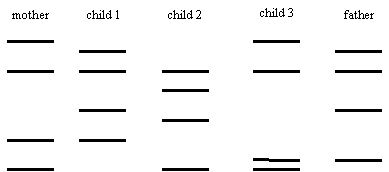 7. The figure below is a DNA
fingerprint analysis to determine paternity of children. Which child is NOT genetically related to the
father shown here?
7. The figure below is a DNA
fingerprint analysis to determine paternity of children. Which child is NOT genetically related to the
father shown here?
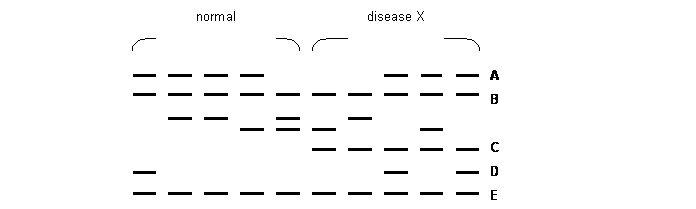
8. Identify a genetic marker that are inherited together
with the disease X in the figure above.