Marcia Angell of
the prestigious New England Journal of Medicine
has said, “As a general rule of thumb we are looking for a
relative risk of 3 or more” before accepting a
paper for publication. Robert Temple of the Food and Drug Administration said, “My basic rule is if the
relative risk isn’t at least 3 or 4, forget it.” The
National Cancer Institute explains, “Relative
risks of less than 2 are considered small and are usually difficult
to interpret. Such increases may be due to
chance, statistical bias, or the effect of confounding factors [other
causes] that are sometimes not
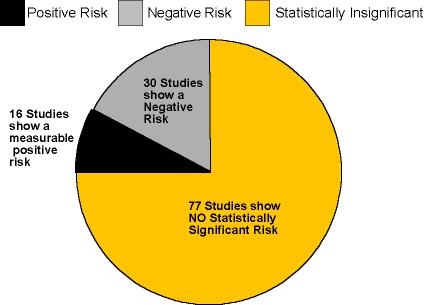
evident.” In the pie chart below those stratistically insignificant findings
are highlighted in yellow. A relative risk of less than unity (1.0) is considered by reputable researchers to be the opposite of a risk and can even signify a protective effect. These negative risks are shown below in gray. Relative risks above 2.0 are shown in black. Meta-analyses are not included in this chart because they lend themselves to selective inclusion of studies chosen just because they may prove the researcher's preconceived conclusion. \ |
|
EPIDEMIOLOGICAL STUDIES ON SHS
Wherever possible, these figures were taken directly from the US Surgeon General's Report, EPA's 1993 Report, or from the World Health Organization's published reports.
|
|
|
|