





 Get your own Free Home Page
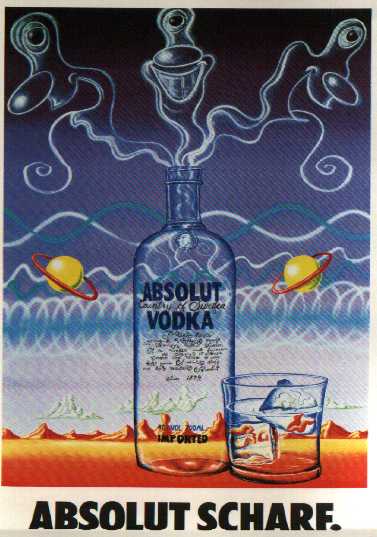
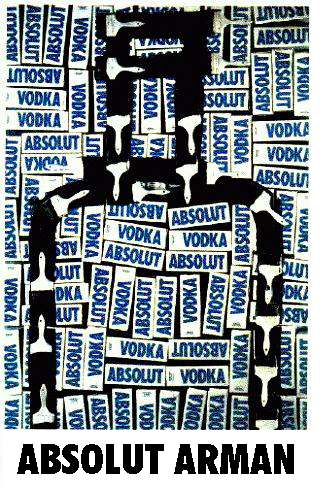
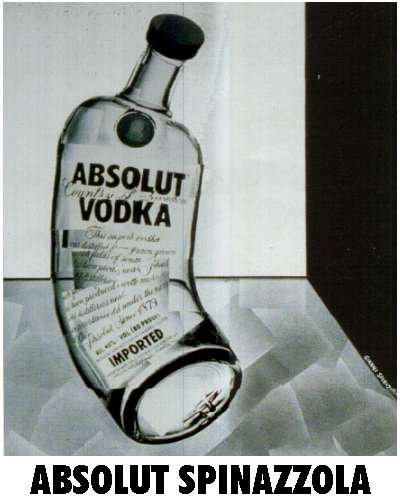
Absolut Art adventure goes on. From the success of the image painted by Andy Warhol in 1985, several international artists have entered the Absolut Vodka Collection, from Haring to Scharf, from Arman to Ruscha, from Yoo Sun Tai to Kosolapov, from Echo to Spinazzola, and many more.
Absolut Art lands now in Brera, involving a group of teachers and students with works that contribute in making the growing Absolut iconography richer. Even in this occasion we have to face the theorical question about the way of interpreting a given sign, that is, the chance of rediscovering the Absolut Vodka bottle through different codes. This common element is recreated by artists, who feel so free that they put the Absolut icon in many different visual displacements, making it unpredictable, as if the audience should see the various trends of present art through the unmistakable image of Absolut Vodka. Painters, scupltors and artists have had to interact with the shape of the bottle in three different ways: painting it, drawing it, erasing it, mimetizing it and inserting it in the work as a ready-made, combining it with other stuffs, however making its recognizability shapes bold and attractive. However, the cult for Absolut Vodka arouses several visualities linked to the taste. You feel that the Absolut bottle is seen by the artists as a limit, but it immediately becomes but a pretext to invent its famous look again.While it is true that the pleasure component is tied to all the acts of life and the capability of tasting (be it food or artwork) involves different sensorial levels, we must recognize that the images made by the artist for this exhibit in Brera succeed in communicating the idea of taste through several visual extensions.
Beppe Devalle celebrates the Absolut Vodka image using a sophisticated collage (between fashion and advertising), in which the mythical Marlene Dietrich shows the bordered portrait of the bottle. The seductive moves of the actress are bound to the worth of the advertising message, as if they were put by the artist to the duty of Absolut high quality.
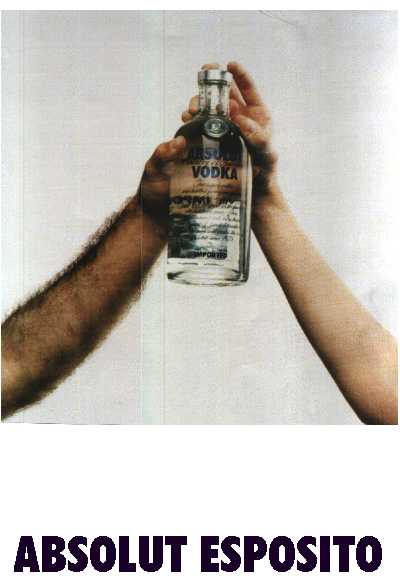
Diego Esposito works out an image in which the Absolut bottle is risen by the arms of a man and a woman. It becomes the meeting point of the feminine and masculine world, of two different energies trying to purify themselves keeping away from the idea of the mass object. Thus, the bottle is a concept, a meditation tool, an icon to be seen as a symbolic space.
Vincenzo Ferrari puts the image of the bottle in a puzzle whose colors are perfumed and light. It's a sort of game, it's childish. The Absolut image lives on the thread of memory, but also through the weapon of irony. The puzzle creates a decorative situation in which the shape of the bottle, against a light sun, looks like being born from the surrounding air or clouds or the purity of the sky, with all the different chromatic particles.
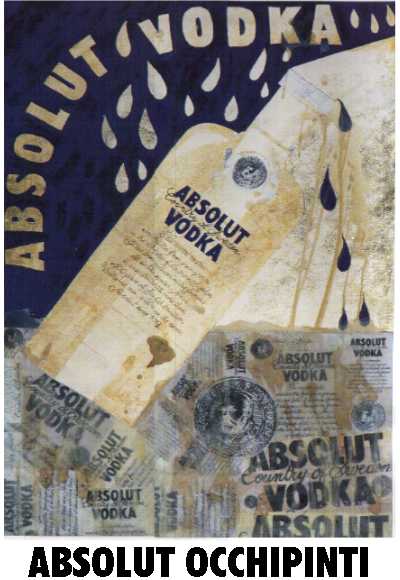
Angela Occhipinti moves between words and images bound to the Absolut myth.He uses labels as drops in the vacuum of his painting. The shape of the bottle swings in an icy landscape, on an intense and deep blue sky. It's a macig-tasted fable. It's an innocent childhood place, simple, as a visual metaphor of Absolut purity.
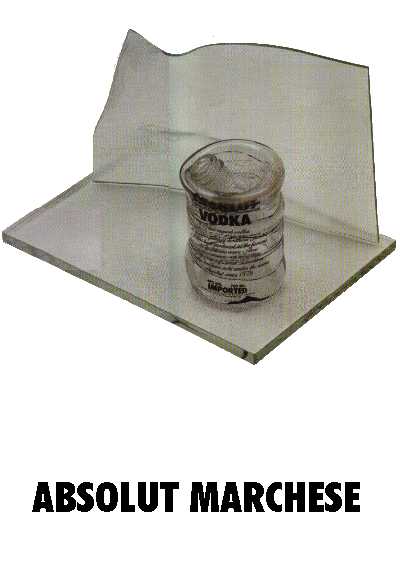
Giancarlo Marchese builds a glass threshold where he shows the melted Absolut bottle, exalting its clearness and light. We have to grasp the metamorphosis of the bottle in an unreal landscape, in a changing space.
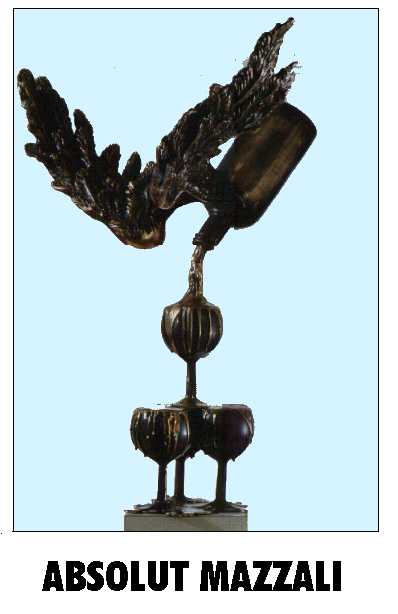
Mauro Mazzali has made out of bronze a scupltoreous dream. The bottle is taken by a strange bird shedding the spirit flooding a set of unfirm glasses. As an unreal ready-made, the bottle is jailed in the bronze, but is able to get free thanks to its energy. It's a sudden move: it shows the need for grasping different things in the same space.
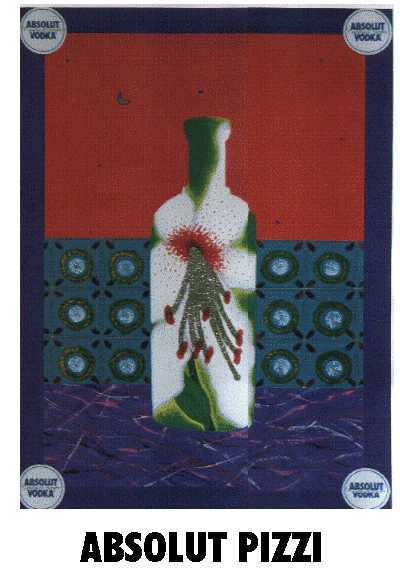
Stefano Pizzi exalts the bottle profile and puts it in the middle of his invention of lights and artificial colours, as if it were the container of unreal visions. It's ironic, humorous and full of stuffs coming from far horizons. We feel in a different universe, the Absolut labels on the corners are but a sign to remind us it's just an open-eye dream.
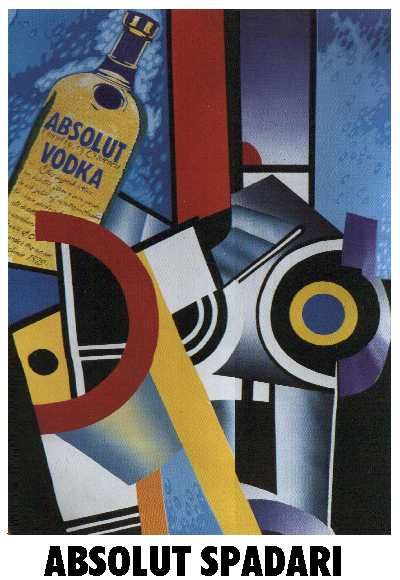
Giangiacomo Spadari inserts the Absolut bottle in a composition of abstract and figurative shapes reminding us of Fernand Leger's pure shining chromatic contrasts. From the plastic evidence of vision a visual mechanism springs out in a frantic rhythm, with elements changing from the straight line to the spline, from the two-dimensional world to the prospectic plasticism. In the geometrical landscape, the bottle is an attractive sign of life.
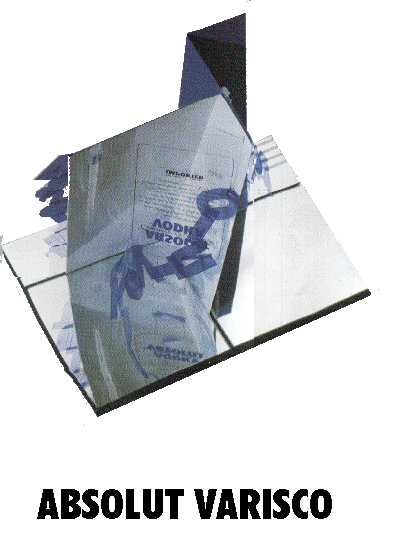
Grazia Varisco builds a little object/environment where the Absolut label is parted in reflections and mirrors. Surfaces are folded, it is an ambiguous and fleeting image, ever changing. Nonetheless, as the observer loses his milestones, he can sll build the intact shape of the bottle.
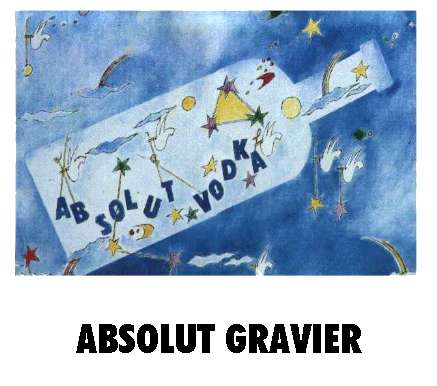
Nicole Gravier, eventually admits the presence of the bottle in a magical and astrological universe, blending the Absolut Vodka words with stars and clouds, suns and moons. It looks like a tale, told by curving lines and delicate geometries. The Absolut message swings between the blurred irony of the vision and the precise symbolical meaning requested by any sign.
In the end, we can discover many interpretations of the Absolut theme even in the works of the young students. They are different temptations of transforming the presence of the bottle into new possibilities of image. Sculpture, abstract colours, figurative expressionism, pictures, objects, photography and advertisement graphics are the tools the Brera artsist use to contribute to Absolut Art.
Claudio Cerritelli (Translated by me. 'Twas a very difficult task!)
Get your own Free Home Page