| The Veto Power |
| Subject: Examine the Veto, explain its origins, classify its actual use by type of subject, and compare that actual use with the original justification. |
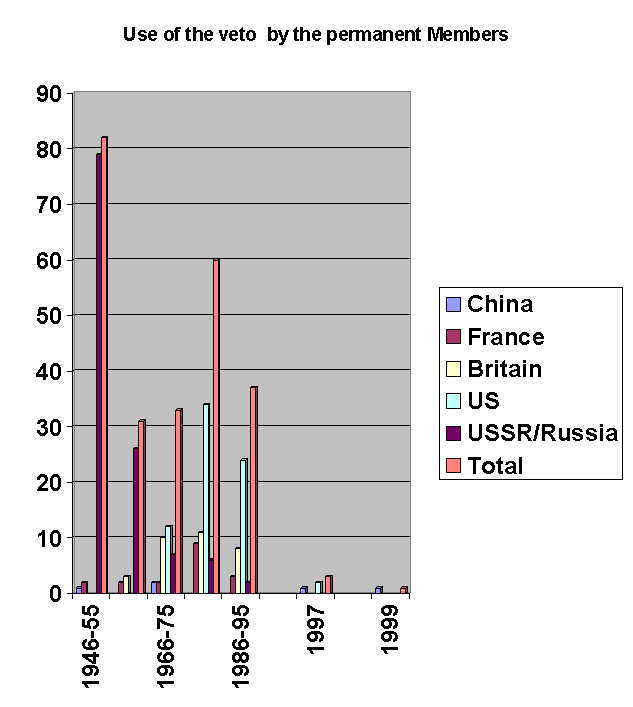
| The most powerful organ of the UN system is the Security Council. The most useful instrument in the Security Council (S.C.) is the veto power. Issues surrounding the existence of the vetoes are therefore of primary importance. This essay proposes to present, analyze, and compare the origin and the justification of the veto power, and its use. It is only from such an analysis that clear responses to the present debate could emerge. Of the 15 members of the Security Council, 5 are permanent members: China, France, Russia, United Kingdom, and United States of America. They have the veto power. If one of the permanent members cast a negative vote on a substantive matter, the proposition is automatically rejected. On a procedural question, the S.C. needs only an affirmative vote from any 9 members. However, to determine whether a question concerns a procedural rather than a substantive matter, the S.C. needs the concurring votes of the five permanent members. Why were the vetoes established? At the end of WWII, the fear of a new war led the Allied victors to create the UN whose principal mission would be to maintain International peace and security. The principle organ in charge of this matter is the Security Council. The veto was justified by two arguments. First, a veto would prevent the S.C. from taking steps against a powerful country (one of these 5 countries) and thus would prevent an eventual world war. Second, the lack of involvement and interest of great powers was considered as the major failure of the League of Nations. The veto gives responsibility and power to these five winners of the war, thus giving them a stake in the welfare of the UN. In addition to these justifications, there is a simple reason for the creation of the veto: any founder of an organization tries to obtain the most powerful position and set steps in order to protect it; That is exactly what the founding members of the UN have done. How have the P-5 used the veto from 1945? 1. The use of the vetoes has dramatically decreased since the end of the cold war: Between 1946 and 1955, 79 vetoes have been cast. Between 1996 and 2000, 4 have been used. 2.The United States (72 vetoes cast) and Russia (120) are the countries that have used the vetoes the most. China has rarely used its veto power. However both in 1997 and in 1999, China cast a veto. The veto cast in 1999 is noticeable since it has blocked a resolution on a vital security (preventive peacekeeping operation in Macedonia). See Chart 1. 3.When the vetoes cast in closed cession are included, we have the following results: Out of the 279 vetoes cast, 21% were used to block applications for membership into the UN (59), 23% were to block appointments of Secretaries General, 47% were related to different conflicts in the world (131). Only 9% were cast to block resolutions against permanent member (25). See chart 2. *** Usually, three arguments in favor of the veto are drawn from the comparison between original justification and actual use. First, the vetoes are the price to pay for having powerful countries willing to pay and implement decisions from the S.C. and the other organs. It is a kind of trade-off. Although vetoes are used for national interest, the P5 pay and implement policies within the UN. Therefore, vetoes still prevent the lack of involvement of powerful countries by giving them direct interests. The second argument comes from the original justification that vetoes prevent S.C. from undermining its own authority by having the agreement of the five permanent members. In theory, for substantive matter, when a resolution is voted, it means that the P5 support the decision. Therefore, unlike the League of Nations, the UN system has a strong and respected authority. Lastly, the veto forced powerful countries to reach a consensus. The P5 have only used 10 % of their vetoes to protect themselves from a resolution. But in reality, the awareness that the P5 have a veto power prevents countries from proposing a resolution directly aimed against one of the P5. In response to these arguments, there are many criticisms. First, the political and geographical maps of the world have changed. For example France and Britain are no longer among the five most powerful countries. The justification of the actual system of veto is therefore questioned because the original choice of the permanent members is no longer relevant. Moreover the actual P5 fail to fulfill their obligations. For instance, they have been reluctant to provide troops (France is an exception) and honor their financial participation. Therefore, many countries asked more and more insistently why they should pay the price of the system of vetoes for such outcomes. Second, the authority of the Security Council is undermined, even though the vetoes exist: When consensus can not be reached, members use the abstention to express their disagreement. In this case, the vote is considered as affirmative, but of course the dispute weakens the resolution, even though the veto is not used. In conclusion, the comparison of the actual use of the veto and its original justifications shows that there is no more relevant justification for the present system of veto. The reason why the vetoes are still existing is because it is the permanent members that have the last word on that matter. There are no justifications, there are reasons. Nobody believes that the P5 will be convinced since the present debate is only a formal one. Therefore the time to build a long-term strategy for diminish little by little the power and the scope of the vetoes has come for contesting countries. The real questions are: Does the UN need leader countries? How should the UN choose its leaders? How this leadership should be expressed? |
| Chart 1. Based on the database from www.globalpolicy.org/security/data/vetohab.htm |
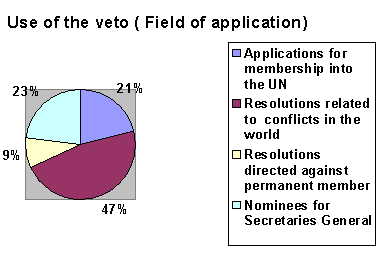 |
| Chart 2. In this chart, the vetoes cast in closed cession are included. |
 |
 |
 |