

11/05/2000
Prepared by Madina Fassassi
For Professor Ahmad Kamal
Class: International Organizations and Their Management: The United Nations System

History of the UN mission
Ethnic conflict
Rwanda has a long history of ethnic conflicts and rivalry between its two main ethnic groups, the Hutus and the Tutsis. In 1994, approximately 800 000 people were killed during the genocide in Rwanda, as a peacekeeping operation, the UNAMIR, was already launched (October 1993).
UNAMIR
The original mandate of UNAMIR included, objectives such as to monitor observance of a cease-fire (Arusha accords), to monitor security situation during the transitional government�s mandate, to investigate and report on incidents regarding the activities of the gendarmerie and police, and to monitor the process of repatriation of Rwandese refugees. The beginning of the genocide (February 1994) led to a rethinking of UNAMIR on May 1994. As a consequence, the Council, authorized the expansion of the UNAMIR force level to 5,500 troops1. An embargo on arms was also imposed.
The end of the mission
Actually, state members were reluctant to send troops. Only African countries and four non-African countries were willing to provide the troops. And by the time the authorized strength of 5,500 was reached it was November 1994, the civil war was over and the needs of the country were no longer assistance in the maintenance of security, but assistance in national reconstruction. In 1996, the mandate of UNAMIR was terminated.
Successes
Some lives have been saved
United Nations personnel within UNAMIR and in the programs and agencies did save the lives of many civilians, political leaders and United Nations staff, sometimes at the risk of their own lives. In particular the peacekeepers who remained throughout the genocide, including the Force Commander and the contingents of Ghana and Tunisia, deserve recognition for their efforts to counteract some of the worst brutality humanity has seen under extremely difficult circumstances2.
Post-war assistance
The United Nations and its family of agencies, although after some delay, did exert considerable efforts to assist the Rwandese people, particularly in the rehabilitation of the country's justice system and to alleviate the very harsh conditions of many of the roughly 60,000 detainees in the prisons. UNAMIR itself was instrumental in restoring the telecommunications capabilities of the country, doing road and bridge repairs and rehabilitating basic infrastructure. 3
It is needless to say that the failures of this peace-keeping operations are overwhelming when compared to the timid successes.
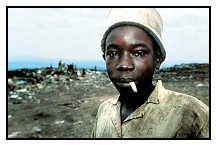
A boy at Kigali's main garbage dump, where street children pick through trash in search of items to sell.
Source : Children of Rwanda�s genocide
UNAMIR fails to protect political leaders and civilians :
The main consequence of the failure of UNAMIR was of course the massacre that occurred. Questions are raised also around some actions which are said to have brought population at higher risk. For example, when UN troops evacuated the Amahoro Stadium, they left behind a population who had sought help and which has then clearly left exposed to killers.
UNAMIR was also tasked to protect political leaders. As an example, the Prime Minister the Prime Minister, Mrs. Agathe Uwilingiyimana, the leader of the Liberal Party, Mr Landoald Ndasingwa and the former Foreign Minister Mr Boniface Ngulinzira were murdered while UNAMIR troops were on the field.
Reasons of these failures :
Within hours of the crash, UNAMIR Commander General Romeo Dallaire cabled New York, writing, �Give me the means and I can do more.�4. But eventually he has never been given the means. The major reason of the failure of UNAMIR was the insufficient resources and logistics. And the reason why there were insufficient resources and logistics was the obvious lack of involvement by the Member State.
Conclusion
The UNAMIR and its failure show the typical issues around today peace-keeping missions : lack of commitment of Member States and therefore lack of resources, questions around legitimacy of the UN, the undermined trust in the UN institutions, and the complexification of the operations. Learning from the past peacekeeping operations is therefore useless if it does not go with an increase in financial and human resources.
*REPORT OF THE INDEPENDENT INQUIRY INTO THE ACTIONS OF THE UNITED NATIONS DURING THE 1994 GENOCIDE IN RWANDA. 15 DECEMBER 1999.
*Report from` the International Panel of Eminent Personalities to Investigate the 1994 Genocide in Rwanda and the Surrounding Events `
*UN PUBLICATIONSCOMPREHENSIVE REPORT ON LESSONS LEARNED FROM UNITED NATIONS ASSISTANCE MISSION FOR RWANDA (UNAMIR) OCTOBER 1993 - APRIL 1996
* Children of Rwanda�s genocide
1.Resolution 918 taken on 17 May 1994
2. According to an internal list from UNAMIR's own archives 3,904 displaced people had been moved by UNAMIR during the fighting in Kigali between 27 May and 20 June 1994.
3 Quote from the UN PUBLICATIONSCOMPREHENSIVE REPORT ON LESSONS LEARNED FROM UNITED NATIONS ASSISTANCE MISSION FOR RWANDA (UNAMIR) OCTOBER 1993 - APRIL 1996
4.Des Forges, 598.