HR Confluence: The 4th National HR ConferenceBusiness Today, January 18th, 2004 by Suman Bhowmik Do
people making history fully realize that while achieving the feat? Not always
perhaps! As was evident during the recently held 4th Confluence, a
national HR conference organized bi-annually by the Sapphire team of XLRI,
Jamshedpur. Started off in 1997, it had ensured that the erstwhile Xavier Labour
Relations Institute continued to set the lead in this specific professional
field. While the very many bodies of HR professionals now conduct similar
conferences, seminars etc. at regular intervals all over the country, as is true
in most other areas too, much of it has over the years become staid and
unproductive. It was therefore time, as Prof.Madhkar Shukla (OB & Strategic
Management) puts it, “to introspect and see what could be improved upon and
how”. Analysis
indicated that most professionals generally wish to use these opportunities to
network with peers to share ideas, problems and plans. The standard format of
`paper reading’ by a few chosen `speakers’ is thus often neither relevant to the
situations of many `listeners’ in the audiences nor is the process flexible or
participative enough to accommodate and discuss specific nuances, thereby
enjoying very little buy-in from the gatherings. Long deliberations later it was
decided to innovate on the structure of the conference in manner that would try
and reduce those weaknesses as far as possible. The
solution generated was use of Open Space Technology – an innovative facilitation
methodology for large groups designed by Harrison Owen that enables group
participants to create their own agenda and move sharing sessions. The crucial
underlying criterion for its working being that there is a real business issue
(likely complex) to be solved, there are high levels of diversity (mostly in
terms of people) involved, there is no predetermined specific solution,
participants are passionate about the topic and decision time was yesterday.
In
taking the rigidity out of traditional meetings, discarding formalities and
incorporating simple methods OST bases itself on the premise that the most
fruitful conversations are the casual ones that happen over coffee or a pool
table. With none in specific charge to lead, with each group passionate about
and focused on the topic chosen and with `Law of Mobility’ – by the rule of two
feet any participant neither learning nor contributing to the process in any
group should move to one where he does – in force, quicker, cleaner and more
innovative resolutions happen. Guided
by the principle that whoever comes into the (group) discussion are the right
people, advantages of OST
are that it supports action planning at and beyond the meeting, enables
participation in designing agenda, ensures full sharing between those with
common interest and networking beyond meeting, helps participants focus at all
times and records a summary of the sharing for posterity. Yet,
all said and done, this had never been tried before with 80 odd industry
participants (70 outstation), and almost an equal number of faculty &
students – what better way of eliminating gaps between industry and academics –
no one knew for sure exactly how it would turn out. Prof. Shukla’s comment on
Dec.20th morning that “we shall either create history or become
history” was a clear indictor of the nervous tension every scientist suffers
before a path-breaking experiment. He
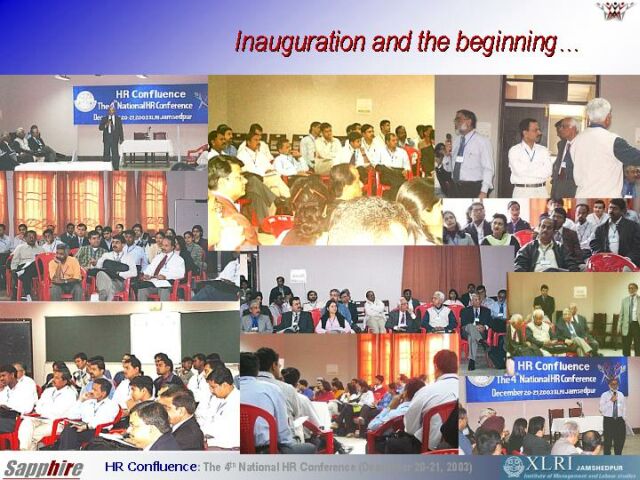
need not have bothered. Post a short, sincere, official welcome by
Fr.P.D.Thomas, Director XLRI, and with expert facilitation from Dr.Uday Pareek
(Chair – Academy of HRD) and Mr.A.S.Vasudevan (CEO – Wisdom Consulting), the
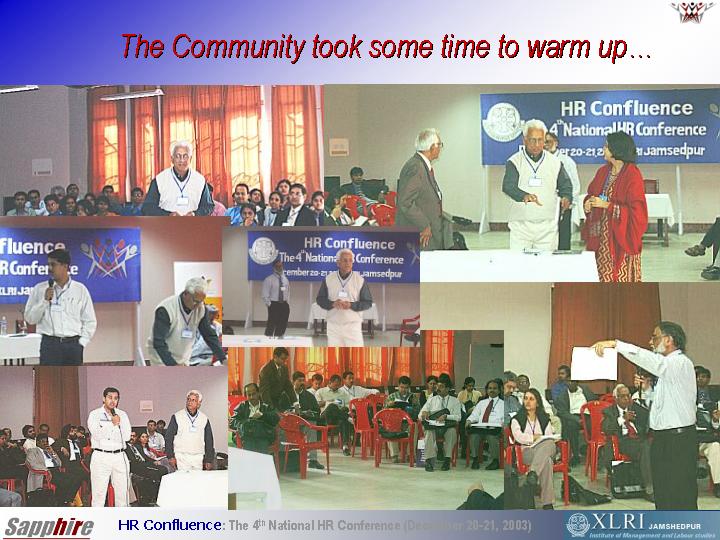
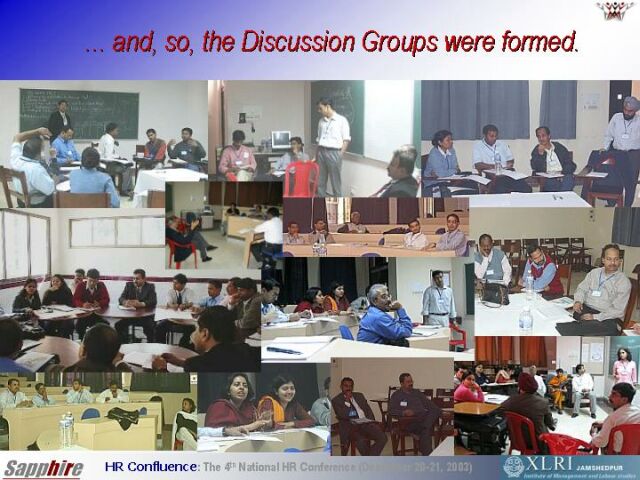
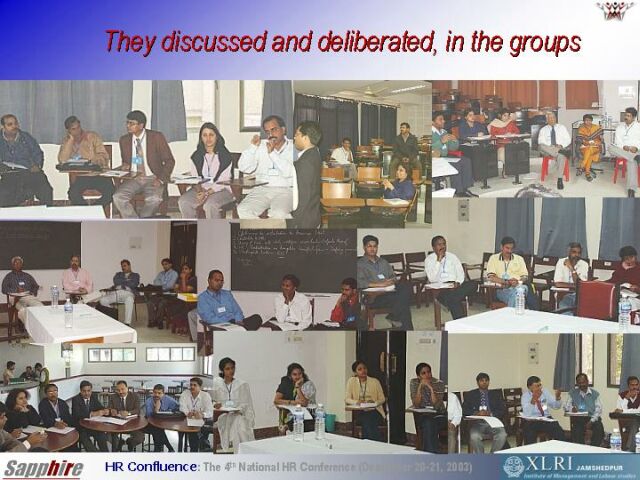
participants took to the new style as fish to water. Senior / junior
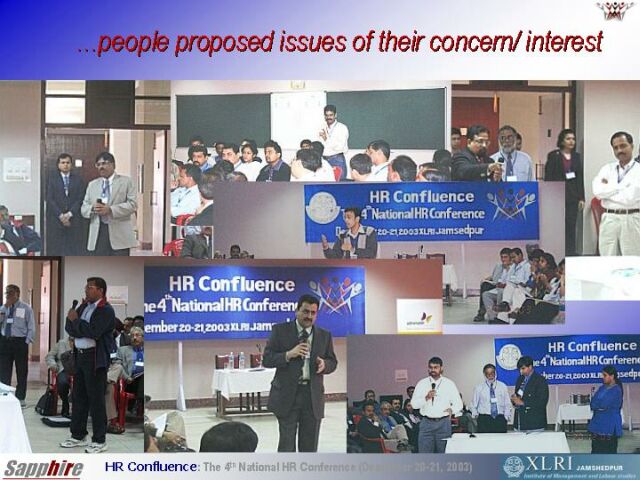
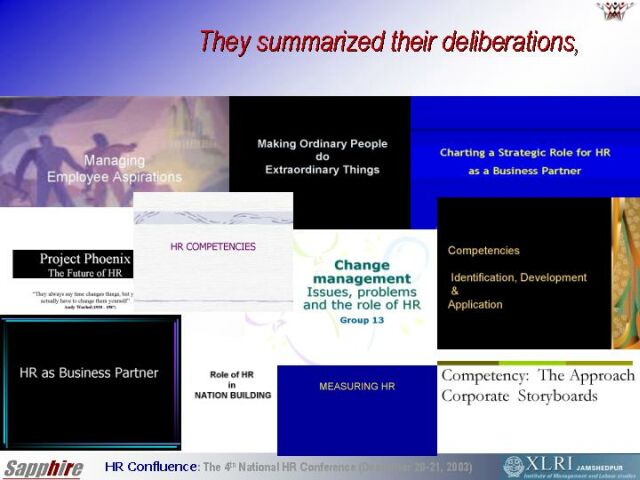
practitioners alike raised diverse issues – from expected ones as Competency
Development and Measuring HR to ones as surprising as Eliminating HR. Popular
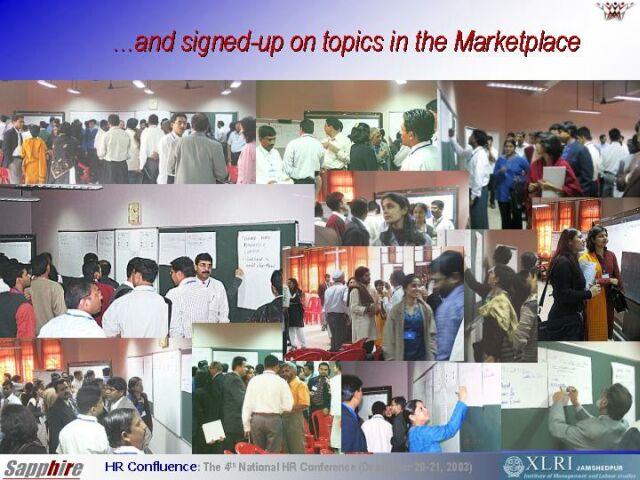
participant choice, sign-ups under displayed topics, decided which ones got
taken up for discussion.
It
is very interesting to note that while suggestions as Outsourcing HR,
Self-Accountability, Knowledge Management etc. fell through for lack of enough
interest, their various aspects were covered in relevant parts within the ambit
of ones chosen. Thus, albeit Social Responsibility not making the grade on the
first day, it was demarcated as an invaluable component of Strategic HR as much
as it was considered intrinsic to discussions on Role of HR in Nation Building
(*see box) or Capturing & Managing Aspirations. This would seem to indicate
that while practitioners of the trade realize the importance of matters as
Social Responsiveness, both at corporate and individual levels, lack of adequate
knowledge and experience about its nuances and possibilities in general,
restricts detailed discussions on the same.
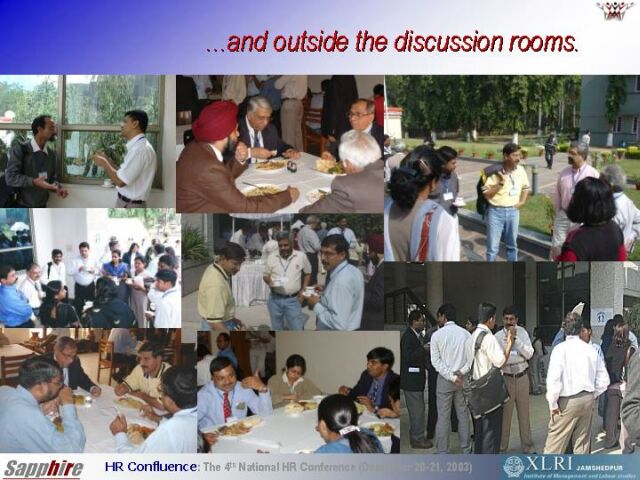
That
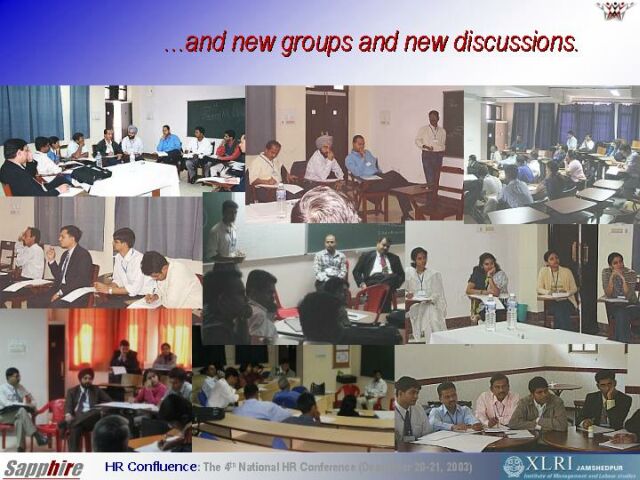
people were enjoying themselves was evident in the unanimous agreement to start
working an hour early on a Sunday. That the Law of Two Feet was working
admirably was borne out in cross movement evident on the corridors. That
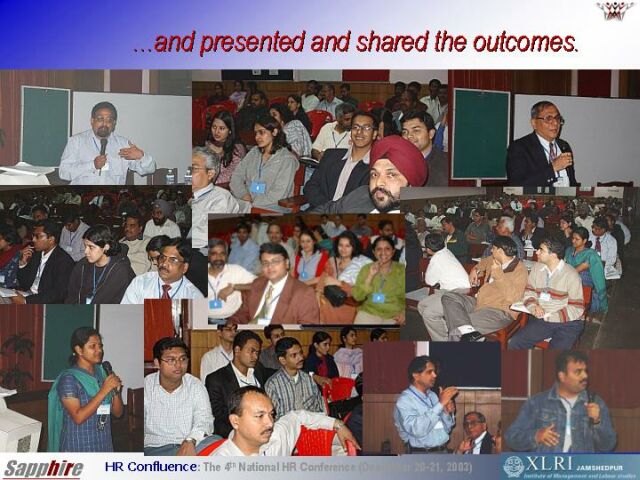
participation from industries as different as health, manufacturing, BPOs,
consultancy, IT / ITES ensured pooling of quality ideas & rich experiences
was obvious in presentations. That this experiment meant much showed in
outstation Advisory Council members (Mr.Satish Pradhan – Tata Sons and
Mr.R.Vidyasagar – Phillips Software) taking time off on Sunday to be there. And
that it had succeeded was clear in that participants felt it had been worth the
time and / or the trip! Some
general observations that came up in the course of these two days of hectic
deliberations included an oft-articulated need to develop models / systems with
specific relevance to Asian / Indian conditions, the importance of looking
beyond just figures in evaluating people, the erosion of value structure in
society in general and its effects on HR and the necessity for HR to move out of
the box and evolve with business. While
alternatives as LSIP (large scale interactive process) or Search Conference must
surely have been considered before settling on OST as the chosen format this
time, XLRI could set the trend by developing one that would be tailor-made for
similar gatherings in future. That would surely be something to write home
about!!
|