 |
|
| Race | Number | Rate* |
|---|---|---|
| All races | 2,236 | 55.1 |
| White | 1,449 | 45.6 |
| African American | 688 | 113.5 |
| American Indian | 61 | 145.7 |
| Asian/Pacific Islander | 37 | 18.5 |
| Hispanic | 232 | 27.1 |
*Per 100,000 live births by group.
Source: NCHS, 2003.
Mathews, T.J., Menacker, F., MacDorman, M.F.,. Infant Mortality Statistics from the 2001 Period Linked Birth/Infant Death Data Set. National Vital Statistics Reports; Vol. 52, No. 12. Hyattsville, Maryland: National Center for Health Statistics. September 15, 2003.
How Do Professionals Diagnose a SIDS Death?
By definition, a SIDS diagnosis requires a complete autopsy, a thorough death scene investigation, and a clinical history. A death is diagnosed as SIDS only after all probable alternatives have been eliminated-in other words, SIDS is a diagnosis of "exclusion." Often, the cause of an infant death can be determined only through a process of collecting information; conducting sometimes complex forensic tests; and by talking with parents, other caregivers, and physicians.
Medical and legal experts rely on three methods to determine a SIDS death:
- a thorough death scene investigation
- autopsy
- review of infant's and family's medical records and histories.
When a death is sudden and unexplained, investigators, including medical examiners and coroners, call on forensic experts, who apply their expertise in medicine and the law to help determine a cause of death. SIDS is no exception.
In most cases, the death investigation is led by the medical examiner or coroner for the county, district, or State in which the death occurred. Deaths suspected to be SIDS usually require law enforcement officers to conduct a thorough death scene investigation. The medical examiner/coroner gathers information from the death scene and case histories and presents this information to the pathologist (usually board certified or with credentials in forensic pathology). The pathologist conducts or supervises the autopsy and assesses results of the autopsy, death scene investigation, and case histories to determine whether a SIDS death has occurred. The pathologist issues a SIDS diagnosis when there is no other apparent cause for the infant's death (Valdes-Dapena, 1995).
-
A Thorough Death Scene Investigation
Although it may be emotionally painful for the family, a death scene investigation will help shed light on the cause of death by providing a detailed record of the location and circumstances of the death. Therefore, the investigator will attempt to learn as much as possible about the events leading up to the death, even the very moment that the death occurred.
The Centers for Disease Control and Prevention (CDC) have developed guidelines for death scene investigation of a sudden, unexplained infant death (CDC, 1996). Local jurisdictions may use these guidelines or develop their own protocols for investigating sudden unexpected infant death.
Investigators will interview the parent or other individual who was caring for the child at the time of the death, as well as any other family members or adults who were present at the time of the death or before the death occurred. The investigator will ask open-ended, neutral questions such as, "Can you tell me what happened?" "How old was the baby?" "What did the baby weigh?" "What time was the baby put to bed?" "When did the baby fall asleep?" "Who last saw the baby alive?" "Who discovered the baby, and what did that person do?" "What position was the baby in when he/she was found?" "Were there covers over the baby's head?" "Was CPR attempted?" "Did the baby share a bed with anyone else?" "What was the general health of the baby?" "Had the baby been ill recently?"
The individual investigating the death will take notes about the appearance of the room where the death occurred; condition and characteristics of the crib or sleeping environment; objects, if any, in the crib; medications at the death scene; and any unusual or dangerous items in the room, such as sharp objects or plastic bags. The investigator may make notes about the behavior of those present at the death scene. The investigator will also photograph the death scene and record the temperature of the room. It is likely that investigators will collect the infant's bedding (e.g., sheets, blankets, etc.), any objects in the crib (e.g., toys or bottles), or any unusual or dangerous items found near the death scene.
-
Autopsy
An autopsy provides evidence of the cause of death through microscopic examination of tissue samples and examination of the body and vital organs. An autopsy is particularly important when a SIDS death is suspected because a definitive diagnosis cannot be made without a thorough postmortem examination. It is estimated that in 15 percent of cases suspected to be SIDS, the autopsy identifies another cause of death, such as a disease or genetic disorder, as well as unintentional injury or unnatural death (Valdes-Dapena, 1995). Also, if a cause (or causes) of SIDS is ever to be uncovered, it is likely that the cause will be detected from evidence gathered from a thorough pathological examination.
An autopsy may help parents and other caregivers deal with the death. According to noted authority Marie Valdes-Dapena, M.D., parents whose child has died need to know why the death occurred; they need to be reassured that their baby's death could neither have been predicted nor prevented (Valdes-Dapena, 1995). Moreover, an autopsy leading to a diagnosis of SIDS will help remove the parents (or caregiver) from potential suspicion of wrongdoing by the legal system and by society in general.
Parents are usually anxious to consult with the pathologist after the autopsy. Discussing the autopsy results often helps most parents accept the reality of their infant's death. The pathologist reviews the autopsy results, explaining in terms the parents can understand how these findings point to a determination of cause of death. The pathologist should also take the time to answer parents' questions, responding with "compassion, understanding, and respect for the parents' dignity and grief" (Valdes-Dapena, 1995).
-
Review of the Infant�s and Family�s Medical Histories
A comprehensive medical history is essential for a SIDS diagnosis. Along with a death scene investigation and an autopsy, a careful review of the infant's and family's history of disease, previous illnesses, accidents, and behaviors often helps to corroborate what is detected from the death scene investigation and the autopsy.
SIDS Deaths Require Special Understanding
Any sudden, unexpected death disturbs the sense of normalcy and security for the victim's family. These deaths force family members and those around them to confront their own mortality (Corr et al., 1991). This is particularly true in the case of a sudden infant death. Simply put, babies are not supposed to die. Because the death of an infant is a disruption of the natural order, it is especially traumatic for parents, other family members, and friends (Arnold et al., 1997).
Like any sudden death, a SIDS death leaves a family with a sense of shock and loss and an urgent need to understand what happened. Lack of a discernible cause, the suddenness of the death, and possible involvement of law enforcement authorities make a SIDS death even more difficult. A SIDS death also leaves the family with a need for understanding from those close to the family-even the surrounding community.
A SIDS death is as tragic as a death from any readily definable disease or cause. Thus, investigators compiling or reviewing the case histories should be especially sensitive and recognize that the family may view this process as an intrusion, even a violation, of their grief. The interviewer should also be sensitive to the family's cultural practices and traditions. The interviewer should point out to the family that although obtaining the case histories may be stressful, this information may reveal that the death could not have been prevented, which may provide some solace to a grieving family.
Are There Ways to Reduce the Risk of SIDS?
Currently there is no known way to prevent SIDS, but there are things that parents and caregivers can do to reduce the risk of a SIDS death. For example, researchers now know that the mother's health and behavior during her pregnancy and the baby's health before birth seem to influence the occurrence of SIDS.
Scientists also know that certain environmental and behavioral influences (called risk factors) can make an individual more susceptible to disease or ill health. Although risk factors are not necessarily the cause of a condition, by studying risk factors, scientists are able to better understand a disease or condition, which often leads to detecting a cause.
SIDS researchers and clinicians continue to try to identify risk factors that can be modified or controlled to reduce an infant's risk for SIDS. For example, SIDS experts now know that the baby's sleep position, exposure to smoke, and becoming overheated while asleep can increase the infant's risk for SIDS.
Infant Sleep Position
In April 1992, the American Academy of Pediatrics (AAP) Task Force on Infant Sleep Position issued a statement recommending that infants be placed on their backs to sleep to reduce the risk of SIDS. Then, in 1994, the U.S. Public Health Service, AAP, the SIDS Alliance, and the Association of SIDS and Infant Mortality Programs cosponsored the Back to Sleep campaign, a national public service initiative to disseminate AAP's recommendation that infants be placed on their back to sleep.
Between 1992 and 1998, among U.S. infants, stomach (prone) sleeping decreased from more than 70 percent to approximately 20 percent. During that same time frame, the number of SIDS deaths declined by more than 40 percent (Willinger et al., 1998; AAP, 2000; NICHD, 2001). Not surprisingly, most researchers, policymakers, and SIDS professionals agree that this significant decline occurred largely as a result of changing sleep position (AAP, 2000).
Rates of SIDS are over twice as high among American Indians and African Americans compared with Whites. Prone sleeping was found to be a significant risk factor for SIDS in an African- American urban sample (Hauck et al., 2002). These authors recommend educational outreach to the African-American community.
Another recent study of the relationship between infant sleep position and SIDS concluded that infants placed in an unaccustomed prone or side sleeping position are at a higher risk of SIDS (Li et al., 2003). This ethnically diverse, population-based, case-controlled study was conducted in 11 counties in California. The health message from this research is that babies should be on their backs for all sleep, including naps.
Exposure to Smoke
Researchers have concluded that if a mother smokes during or after pregnancy, she is placing her infant at a greater risk for SIDS (AAP, 2000). Some studies suggest that exposure of the newborn to tobacco smoke (whether or not the mother smokes) may be associated with increased risk for SIDS. In a 1997 policy statement, AAP cautioned, "Exposure of children to environmental tobacco smoke is associated with increased rates of lower respiratory illness and increased rates of middle ear effusion, asthma, and SIDS" (AAP 1997).
Overheating
According to AAP (2000), some evidence points to an association of the amount of clothing or blankets on an infant, room temperature, and the time of the year with an increased risk for SIDS. The increased risk associated with overheating is particularly clear when infants are placed on their stomachs (prone).
AAP cautions that the possible relationship between clothing and climate as stand-alone factors (or as a cluster of environmental risk factors) is less clear. Moreover, although the number of recorded SIDS deaths has been higher in the winter months, that increase may be due to the greater frequency of colds, flu, and other infections during the winter.
Infant Bedding
Researchers and consumer safety advocates continue to look for a possible link between SIDS and soft bedding (Scheers, Dayton, and Kemp, 1998). During 2000, seven major retailers joined with the U.S. Consumer Product Safety Commission (CPSC) to kick off a nationwide campaign promoting safe bedding practices for infants. Many retailers are developing public service campaigns to spread this message to parents and other infant caregivers.
The hope is that by circulating this information, infant deaths will be reduced and that those responsible for infant care will receive one consistent message about ensuring a safe sleeping environment for babies.
In recent safety alerts, CPSC has warned parents to guard against unfounded claims from manufacturers of some infant bedding materials that the use of certain products can reduce SIDS. Parents and other caregivers need to be aware that there is no product currently available that can guarantee prevention of a SIDS death.
Other Risk Factors
Although sleep position, smoke exposure, overheating, and infant bedding have been identified as risk factors for SIDS, researchers have identified a number of other factors that may put an infant at increased risk for SIDS.
Infant Care Practices and SIDS Risk Reduction
Several studies have examined various environmental influences or child-rearing practices that may help protect an infant from SIDS (Valdes-Dapena, 1995; Hoffman et al., 1996; NICHD, 2000). It is important to point out, however, that these factors, in and of themselves, are not reliable in predicting how, when, why, or if SIDS will occur.
For example, although researchers conclude that breastfeeding is beneficial, there is no clear-cut link between breastfeeding and reduced risk of SIDS. Other studies have found a lower rate of SIDS among infants who used pacifiers compared with infants who did not use pacifiers. Although results of these studies tend to be consistent, there is still no evidence that pacifier use prevents SIDS (AAP, 2000).
Maternal Risk Factors
Still other risk factors, called maternal risk factors, are associated with how the mother's behavior and health affect the infant before and after birth.
Maternal risk factors include:
- age less than 20 at first pregnancy
- a short interval between pregnancies
- late or no prenatal care
- smoking during and/or after pregnancy
- placental abnormalities
- low weight gain during pregnancy
- anemia
- alcohol and substance abuse
- history of sexually transmitted disease or urinary tract infection (NICHD, 2001).
How to Lower Your Baby's Risk of SIDS:
Back Sleeping and Safe Bedding*
- make sure that everyone who cares for your baby puts the baby on his or her back to sleep
- use a firm, tight-fitting mattress in a crib that meets current safety standards
- remove pillows, quilts, comforters, sheepskins, stuffed toys, and other soft products from the crib
- dress your baby in sleep clothing so that you will not have to use any other covering over the baby
- place your baby so that his or her feet are at the bottom of the crib
- tuck a thin blanket around the bottom of the crib mattress, reaching only as far as the baby's chest
- make sure the baby's head remains uncovered during sleep
- keep your baby warm, but not too warm
- make sure that everyone who cares for your baby understands the dangers of soft bedding
- avoid adult beds, waterbeds, sofas, or other soft surfaces for sleep
*from AAP, CPSC, and NICHD
AAP: www.aap.org
CPSC: www.cpsc.gov
NICHD: www.nichd.nih.gov
Current Research Findings and Theories
Most scientists now believe that babies who die of SIDS are born with one or more conditions that make them especially vulnerable to the internal and external stresses that occur in the life of any infant. Currently, many researchers argue that the clue to finding the cause(s) of SIDS lies in a further understanding of the development and functions of the brain and nervous system of SIDS infants.
These scientists theorize that some babies at risk for SIDS have defects in those parts of the nervous system that control breathing and heart rate. Maturation of the brainstem may be delayed in SIDS infants. Myelin, a fatty substance that facilitates nerve signal transmission, appears to develop more slowly in SIDS infants than in other babies.
"The detection of subtle abnormalities in SIDS brains indicates that not all SIDS infants are 'normal' despite their lack of clinical abnormalities. The occurrence of brain abnormalities supports the concept that a vulnerable, and not a normal, infant is at risk for SIDS. The idea of a vulnerable infant forms a key part of a triple-risk model for the pathogenesis of SIDS" (Filiano and Kinney, 1994).
The Triple-Risk Model
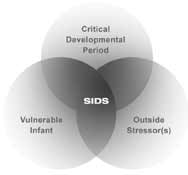
Pathology studies of SIDS infants support the view that these infants possess underlying vulnerabilities that put them at risk for sudden death, a concept advanced by the triple-risk model in describing the sequence of events leading to the death of an infant. A number of scientists are currently applying this model in their search for a cause(s) of SIDS.
Vulnerable Infant. The first key element of the triple-risk model depicts an infant with an underlying defect or abnormality, which makes the baby vulnerable. In this model, certain pathophysiological factors (e.g., defects in the parts of the brain that control respiration or heart rate, and that occur during early life) explain vulnerability to sudden infant death.
Adapted from Filiano and Kinney 1994.
Critical Developmental Period. The second element in the triple-risk model refers to the infant's first 6 months of life. During this critical developmental period, rapid growth phases occur and changes in homeostatic controls take place. These changes may be evident (e.g., sleeping and waking patterns), or they may be more subtle (e.g., variations in breathing, heart rate, blood pressure, and body temperature). It may be that some of these changes may temporarily or periodically destabilize the infant's internal systems.
Outside Stressor(s). The third element of this model involves outside stressors. These may include environmental factors (e.g., exposure to tobacco smoke, overheating, or prone sleep position) or an upper respiratory infection that most babies can experience and survive, but that an already-vulnerable infant may not be able to overcome. In and of themselves, these stressors do not cause infant deaths, but in a vulnerable infant, "may tip the balance against an infant's chances of survival" (Filiano and Kinney, 1994).
According to this model, all three elements must interact for a sudden infant death to occur-the baby's vulnerability is undetected until the infant enters the critical developmental period and is exposed to an outside stressor or stressors.
Brain Abnormalities in SIDS Infants
A team of researchers funded by the National Institute of Child Health and Human Development (NICHD) has discovered that infants who die of SIDS may have abnormalities in several parts of the brainstem. This finding builds on the results of an earlier study that identified abnormalities in the region of the brain known as the arcuate nucleus in babies who died of SIDS.
"These findings show that SIDS infants have a more global biological deficit than we previously believed -one that may originate in fetal life," explained Marian Willinger, Ph.D., of NICHD's Pregnancy and Perinatology Branch, in a May 2000 press release. In the NICHD study, SIDS infants were found to have decreased binding of serotonin in the nucleus raphe obscurus, a brain structure linked to the arcuate nucleus, as well as four other brain regions. These areas of the brain are thought to play a crucial role in regulating breathing, heart beat, body temperature, and arousal (Panigrahy et al., 2000).
Back to Sleep Campaign
Since its inception in 1994, the Back to Sleep campaign has focused on heightening awareness among parents, health care providers, and other caregivers about the benefits of putting a baby to sleep on his or her back. Over the course of the campaign, almost 80 million brochures, posters, public service announcements, and informational videos have been distributed. The Back to Sleep campaign continues as a nationwide public health effort, with NICHD having major responsibility for disseminating information and educational materials on this crucial health topic.
Back in 1994 when the Back to Sleep campaign was first initiated, there were almost twice as many SIDS deaths among African-American infants than among White infants. Despite the almost 50 percent drop in the number of SIDS deaths in both groups, a significant disparity still exists (NICHD, 2002). To continue efforts to reach minority and hard-to-reach populations about the importance of placing an infant on its back to sleep, NICHD has partnered with community groups to provide outreach to minority and underserved communities.
SIDS Deaths in Child Care Settings
Twenty percent of SIDS deaths occur in a day care setting (Moon, Patel, and Shaefer, 2000). Although media and mailings have been largely effective in communicating BTS information to many child care centers, nonprone positioning and other risk reduction measures are not universally practiced among child care providers (Moon and Biliter, 2000). To promote these messages in child care settings, the Health Resources and Services Administration's Maternal and Child Health Bureau is sponsoring the Healthy Child Care America Back to Sleep campaign. The campaign, which was officially launched in January 2003, is a nationwide effort to unite child care, health, and SIDS prevention partners to reduce the risk of deaths in child care settings (AAP, 2003).
Over the past 9 years, the Back to Sleep campaign has been extremely effective in helping reduce the number of SIDS deaths. AAP cautions, however, that while continuing to emphasize the "importance of infant positioning for sleep as an effective modifiable risk factor for SIDS," it is also important to "focus increased attention on other modifiable environmental factors, to describe complications that may have arisen from modifying risk factors, and to make recommendations about other strategies that may be effective for further reducing the risk of SIDS" (AAP, 2000).
Partners in the Back to Sleep Campaign Outreach to Underserved Populations
- Alpha Kappa Alpha Sorority
- Chi Eta Phi Sorority
- Chicago Department of Public Health
- Congress of National Black Churches
- District of Columbia Department of Public Health
- National Association for the Advancement of Colored People
- National Black Child Health Development Institute
- National Coalition of 100 Black Women
- National Medical Association
- National Association of Black Owned Broadcasters
- Pampers Parenting Institute
- Zeta Phi Beta Sorority
Acknowledgments
Review panel members
Michael Corwin, M.D.
Co-Director
Massachusetts Center for Sudden Infant Death Syndrome
Anne Harvieux, C.I.C.S.W.
Program Administrator
Infant Death Center of Wisconsin
Jeffrey Jentzen, M.D.
Medical Examiner, Milwaukee County, Milwaukee, WI
John Leggatt, M.D.
Deputy Chief Medical Examiner, Milwaukee City, Milwaukee, WI
Mary McClain, R.N., M.S.
Massachusetts Center for Sudden Infant Death Syndrome
Marian Willinger, Ph.D.
Special Assistant for SIDS
National Institute of Child Health and Human Development
This publication was produced by the
National SIDS/Infant Death Resource Center (NSIDRC)
2070 Chain Bridge Road
Suite 450
Vienna, VA 22182
Phone: (866) 866-7437, (703) 821-8955
E-mail: [email protected]
www.sidscenter.org
The NSIDRC is funded under contract to Circle Solutions, Inc., with the Maternal and Child Health Bureau (MCHB), Health Resources and Services Administration, U.S. Department of Health and Human Services. This publication is not copyrighted; it may be reproduced in whole or in part without permission. However, in accordance with accepted publishing standards, it is requested that proper credit be given to the source(s). The views in this publication do not necessarily reflect the views of the sponsoring agency.
Health Resources and Services Administration
Maternal and Child Health Bureau
SIDS/Infant Death Program
(301) 443-2115
www.hrsa.gov
Publication No. S05