 |
| Thursday, 28 December, 2000: Pressure from Western countries on the South to coerce the latter to saturate the international market with oil as means to force prices to drop could cause a worldwide confrontation, the Libyan daily "Al Zahf" predicted Tuesday in Tripoli. "The oil conflict tends to degenerate into confrontation after taking proportions that expose the security and stability of the world to serious dangers", it suggests, accusing industrialised nations of leading the world to disaster. The Libyan daily warns OPEC member countries against the oil policies of the new Republican Administration in power in the US. "There are negative indicators expressed by the new White House boss who declared that Washington and its allies will deal with the issue of crude oil in the Middle-East region on the basis of acceptable prices," it further warns. It explains that "acceptable prices" in the American logic are those that serve the interests of Washington to the detriment of the rest of the world. [PANA] """"""""""""""""""""""""""""""""""""""""""""""""""""""""""""""""""""""""""" Wednesday, 27 December, 2000: Libya has extended until mid-January a bids deadline for three oil exploration packages. Libya's state National Oil Company (NOC) has pushed back the December 31 deadline apparently to avoid a clash with Moslem festivities marking the end of the holy month of Ramadan as well as the holiday season in most parts of the world to celebrate Christmas and New Year, sources said. Beyond January 15, foreign companies taking part in the licensing round for the three oil packages remain in the dark over what the next step might be relating to negotiations and awards. Libya, which has seen U.N. sanctions suspended for over a year now, has been pushing for a more international presence and foreign investment. [Reuters] """""""""""""""""""""""""""""""""""""""""""""""""""""""""""""""""""""""""" Tuesday, 26 December, 2000: Almost all of the Middle East's Muslims will celebrate Eid al-Fitr on Wednesday. Religious authorities in Egypt, Iran, Iraq, Jordan, Lebanon, the Palestinian territories, Saudi Arabia, Syria and the UAE announced that Eid al-Fitr will be Wednesday, with only Libya deciding to mark the feast on Tuesday. Most Muslim authorities issued proclamations after observing the moon on Monday night, while Libya made its announcement Sunday based on astronomical calculations. Ramadan was marked around the region this year by passionate demonstrations of solidarity with the Palestinians in their clashes with Israel. [AFP] """"""""""""""""""""""""""""""""""""""""""""""""""""""""""""""""""""""""" Tuesday, 26 December, 2000: Oil-producing nations should consider stopping all pumping for one or two years to fend off any attempts to lower world oil prices, Libyan leader Mu'ammar al-Qadhafi said in a letter to Venezuelan President Hugo Chavez that was made public Monday. The letter, published in state-run Libyan newspapers, appeared to be Qadhafi's response to Chavez's call Sunday on members of OPEC to fight efforts to reduce the price of oil. "Since the issue is one of aggression on the resources of the people of OPEC, then our last resort might be halting oil pumping completely for a year or two," Qadhafi said in his letter. Halting production, Qadhafi wrote, is "a means of defending ourselves and our interests." [AP] " """""""""""""""""""""""""""""""""""""""""""""""""""""""""""""""""""""""""""""""""""""""""""""""""""""""""""""" Monday, 25 December, 2000: Venezuela's President Chavez urged OPEC Countries to fight efforts to reduce the price of oil. Chavez accused some oil-consuming countries Sunday of playing "a dirty game" by trying to push prices below $10 a barrel. "I must warn that there are countries that want us to give oil away at 8 to 10 dollars a barrel," he said. Chavez concluded saying that he would talk to Saudi Arabia's Prince Abdullah, Iraq's Saddam Hussein, Libya's Mu'ammar al-Qadhafi, and Algerian President Bouteflika about the possibility of cutting production. [AP] """"""""""""""""""""""""""""""""""""""""""""""""""""""""""""""""""""""""""""""""""""""""""""""""""""""""""""""" Sunday, 24 December, 2000: With UN report calling for tough sanctions against Liberia, British Foreign Office Minister for Africa, Peter Hain, has urged that the current arms embargo on Liberia to be "maintained and tightened and strengthened". The UN report said Mr. Taylor's links to diamonds for gun regime in Sierra Leone was "overwhelming." Mr. Taylor has however denounced the UN report. He denied having foreign bank accounts. But The Financial Times, in a story this year, said Western intelligence sources were monitoring a foreign bank account through which Taylor was paying his war debts to Libya's Col. Qadhafi. [The Perspective] """""""""""""""""""""""""""""""""""""""""""""""""""""""""""""""""""""""""""""""""""""""""""""""""""""""""""" Saturday, 23 December, 2000: - The UK Foreign Office marked the 12th anniversary of the bombing of Pan Am flight 103 over the town of Lockerbie, Scotland on 21 December. Minister of State Peter Hain paid tribute to the families of the 270 people killed and urged Libya to continue its cooperation with the United Nations, which led to two Libyan suspects being handed over for trial, PA News reported. A trial of two Libyan men handed over in April 1999 is being conducted in a special Scottish court that has been convened in the Netherlands. Abdelbaset Al Megrahi, 48, and Al Amin Fhimah, 44 have denied the charges and claim that Palestinian terrorist groups were responsible. The trial is currently suspended and will recommence on 8 January 2001. [M2] """"""""""""""""""""""""""""""""""""""""""""""""""""""""""""""""""""""""""""""""""""""""""""""""""""""""""""""" Saturday, 23 December, 2000: The suspension of international sanctions against Libya has given Russia more possibilities for expanding mutually beneficial cooperation with Libya, Deputy Minister of Foreign Affairs of the Russian Federation Vasily Sredin told journalists on Friday. Sredin, who was commenting in response to questions from the journalists on prospects for the resumption of relations between Russia and the countries-allies of the former Soviet Union said that relations between Russia and Libya had never been interrupted. He went on to say that interaction with Libya "naturally envisages also contacts at the top level." [Itar-Tass] """"""""""""""""""""""""""""""""""""""""""""""""""""""""""""""""""""""""""""""""""""""""""""""""""""""""""""" Saturday, 23 December, 2000: - The UK Foreign Office marked the 12th anniversary of the bombing of Pan Am flight 103 over the town of Lockerbie, Scotland on 21 December. Minister of State Peter Hain paid tribute to the families of the 270 people killed and urged Libya to continue its cooperation with the United Nations, which led to two Libyan suspects being handed over for trial, PA News reported. A trial of two Libyan men handed over in April 1999 is being conducted in a special Scottish court that has been convened in the Netherlands. Abdelbaset Al Megrahi, 48, and Al Amin Fhimah, 44 have denied the charges and claim that Palestinian terrorist groups were responsible. The trial is currently suspended and will recommence on 8 January 2001. [M2] |
| Previous News |
| Friday, 29 December, 2000: Developing countries on the U.N. Security Council proposed lifting sanctions against Libya on Thursday on the grounds that the Tripoli government had fully cooperated with the trial of two Libyan suspects in the 1988 Pan Am bombing. The United States and Britain opposed the proposal, saying the trial at a special Scottish court sitting in the Netherlands wasn't over yet. It wasn't immediately clear if the Non-Aligned Movement of mostly developing countries would push for a vote on a resolution Friday. The council president, Russian Ambassador Sergey Lavrov, said he would schedule more consultations for Friday morning. "We have made it very clear that we would not be able to support such a resolution," said British Ambassador Jeremy Greenstock, issuing a veiled threat to veto the resolution. The United States has said it won't allow the measures to be fully lifted until Tripoli complies with other outstanding U.N. demands, including compensating the families of the victims if the two defendants are convicted and renouncing terrorism. [AP] |
| Libyan Foreign Minister Abdel Rahman Shalgam on Tuesday in Tripoli called for further expansion of ties with the Islamic Republic of Iran. In a meeting with Iran's Ambassador to Libya Mohammad Menhaj, he briefed the Iranian envoy on the latest developments in the Middle East region. As to the issue of Palestine, the Libyan foreign minister said that the enemy, aware of the role being played by Iran, Libya and Syria in supporting Palestine and the Intifadha (uprising), hatches conspiracy against these countries. Referring to friendly relations between Iran, Libya and Syria, the Iranian envoy underlined the need for establishment of unity and solidarity among all Islamic states as well as establishment of an anti-Zionist united front. The regime occupying the holy Qods proved that it is not familiar with any language other than that of force, he said, stressing that as long as this cancerous tumor exists in the Middle East region, the region will not witness peace and security, IRNA reported. |
|
|
| Sunday, 31 December, 2000: Libyan leader Mu'ammar al-Qadhafi said in an interview published on Saturday that Libya would embrace globalization. "Experience has taught us the lesson that globalization forces us to open up," Qadhafi told the Berlin-based Der Tagesspiegel daily. "Those who do not accept this change will be considered reactionary," he said. Libya has recently stepped up efforts to open up its economy to the free market and has encouraged foreign investors to play a larger role in a five-year, $35 billion development plan. [Reuters] |
|
| Monday, 1 January, 2001: Malian President Alpha Oumar Konare, met Saturday with Libyan leader, Col. Mu'ammar al-Qadhafi, on bilateral and international issues, Libyan officials said in Tripoli. They said the talks focused on how to consolidate the Community of Sahel-Saharan States (SIN-SAD), and the African Union, Qadhafi's pet policy. The duration of the visit by Konare, who is chairman of the Economic Community of West African States, was not disclosed. [PANA] |
| Monday, 1 January, 2001: United States President Clinton authorized the U.S. on Sunday to sign a treaty creating a permanent international criminal court to try war criminals. More than 130 nations have signed the treaty, including most U.S. allies. The parliaments of 27 nations have ratified the Rome Treaty; 60 governments are needed for the treaty to go into effect. North Korea, Libya, China and Iraq have not joined the treaty. [CNN] |
|
| Tuesday, 2 January, 2001: Sudan and the Sahrawi Arab Democratic Republic (SADR) have become the latest countries to ratify the constitutive act of the African Union. Others who have ratified the constitutive act of the African Union are Mali, Senegal, Togo and Libya. [PANA] |
|
| Wednesday, 3 January, 2001: The interim government of Somalia has sent a contingent of men to be trained as presidential escorts. 'Qaran', a Mogadishu daily, reported that 17 young men had been sent to Djibouti to undergo a 45-day training course. However, a government source told IRIN that 28 men had left for the training, and that "more will be sent soon". After completing their course, the men would proceed to Libya for a further three months of training. [Africa News] |
|
| Sunday, 7 January, 2001: Libya has denounced the American decision released on Thursday which extended economic sanctions on Libya for six more months, describing this decision as unfair. In his comment on this decision, the political editor of the Libyan News Agency JANA said that this decision is totally in contradiction with the United Nations General Assembly recent decision which rejects the individual American measures against Libya, the decision was totally approved except by Israel and the U.S.A. [ArabicNews.Com] |
|
| Tuesday, 9 January, 2001: Arab league secretary general Esmat Abdul Majid starts on Tuesday a visit to Libya prior to taking part in the Arab follow up commission meeting in Tunisia the next day, it was announced in Kuwait Sunday. Abdul Majid's talks in the Libyan capital will focus on latest Arab and world developments, including the Lockerbie case. He will than head to Tunisia to take part in the follow up commission meeting that will discuss political and financial support for the Palestinian uprising. [ArabicNews.Com] |
|
|
| Thursday, 11 January, 2001: Libyan leader Col. Mu'ammar al-Qadhafi has called on all the scientific and economic potentialities of Libya to mobilise in order to build the future and solve the country's problems, through planning mechanisms instituted by the general planning council. Chairing in Tripoli Tuesday a session of this planning body, which opened its first ordinary meeting of 2001 Sunday, Qadhafi emphasised the importance of the participation of all actors in solving problems examined within research units of universities and research and study centres, with a view to enabling experts of all fields to contribute in Libya's recovery and development. [PANA] |
|
| Thursday, 11 January, 2001: Libyan leader Colonel Mu'ammar al-Qadhafi met visiting Chinese Foreign Minister Tang Jiaxuan Wednesday night. The Chinese minister expressed appreciation for Libya's fair position on the issue of China peaceful reunification as well as Libya's efforts to settle the African disputes and promote the African integration. He renewed China's firm opposition to the economic sanctions against Libya, voicing hope that the efforts of the international community would lead to total removal of the sanctions very soon. [Xinhua] |
|
| Wednesday, 10 January, 2001: Chinese Foreign Minister Tang Jiaxuan arrived in Tripoli on Tuesday for a two-day official visit to Libya. He was greeted at the Tripoli military airport by Minister of Foreign Communication and International Cooperation Abdul-Rahman Shalgam and other senior Libyan officials as well as Chinese ambassador to Libya. Upon his arrival, Tang said that "the friendly ties and cooperation between China and Libya enjoyed personal care of the leaders of both countries and grew significantly and constantly over the past 20 years." "Now as the mankind steps into a new century, the two countries feel the necessity of strengthening their contacts and making more efforts to boost cooperation in all areas," Tang noted. [Xinhua] |
|
| Wednesday, 10 January, 2001: Prosecutors went for an all-or-nothing murder conviction against two Libyans accused of the 1988 bombing of Pan Am Flight 103 over Lockerbie as they began their summing up Tuesday in the marathon trial. Deputy prosecutor Alastair Campbell asked for two of the three charges against the men, conspiracy to murder and breach of aviation security, to be dropped as the trial moved into its final phase. Only one charge would remain, the main accusation of murder. It carries an automatic life sentence, but is also the most difficult to prove. "In my submission," he told the court, "the Crown has proved the case against each of the accused beyond reasonable doubt." No verdict is expected this week. Instead, the three judges -- there is no jury -- will likely adjourn for several weeks before announcing a ruling. There are three possible verdicts -- guilty, not guilty or "not proven," a peculiarity of Scottish law which essentially means there remains a suspicion against the accused, but not enough to warrant a guilty verdict. [AFP] |
|
| Tuesday, 16 January, 2001: King Mohammed the Sixth of Morocco has arrived in Libya on an official visit, his first to the country since coming to power in 1999. After arriving in the capital, Tripoli, he went straight into talks with the Libyan leader, Colonel Qadhafi. As well as covering bilateral relations, these were expected to focus on ways of relaunching the Maghreb Arab Union (MAU). Correspondents say the MAU has in effect been frozen since 1995 as the result of continuing disagreements between Algeria and Morocco over the Western Sahara. [BBC] |
|
| Monday, 15 January, 2001: In the first soccer game in 23 years between Libya and Egypt, Egypt beat Libya 4-0 on Sunday in a qualifier for the African Cup of Nations. The last time the two teams met was during the All-African Games in Algeria in 1978. Egypt won that game 1-0. But the players brawled afterward, prompting Egypt to withdraw from the competition in protest. The Egyptian delegation said the Algerians did not provide adequate protection for their players. In the African Cup of Nations, Egypt tops leads Group Seven with three wins in three games. Libya, Ivory Coast and Sudan are also in the group. [AP] |
|
| Tuesday, 23 January, 2001: Turkish Foreign Minister Ismail Cem departed from Libya on Sunday after wrapping up his contacts in Tripoli. Cem and his Libyan counterpart Abdurrahman Shalgam signed a memorandum of understanding which foresaw regular consultations between the foreign ministries of the two countries. In the signing ceremony, Cem said that there are many things that Turkey and Libya will do together. Cem noted that the history and the interests of the two countries push the two countries to take joint steps. [Anadolu Agency] |
|
| Monday, 22 January, 2001: A delegation from the Arab Writers Union (AWU) arrived in Baghdad Sunday on a Syrian plane to take part in an anti-Israeli conference, the official Iraqi agency INA reported. The delegation includes 83 figures from various Arab countries, including the AWU's general secretary Ali Arsan. Nearly 150 celebrities from Iraq, Syria, Egypt, Jordan, Lebanon, Algeria, Yemen, Tunisia, Sudan, Libya, Bahrain and the Palestinian territories are due to take part a conference starting Monday dubbed "No to American-Zionist Aggression, No to the Embargo, No to Normalisation and Surrender." [AFP] |
|
| Saturday, 20 January, 2001: Libyan Leader, Mu'ammar al-Qadhafi, announced that Libya would conduct a good offices mission between Morocco and Algeria. Qadhafi who described as "brotherly and important" talks he held in Tripoli with King Mohammed VI said he examined with the sovereign "Maghreban relations, Moroccan-Algerian relations and the Sahara issue." He said talks also covered "Morocco's absence from the Organization of African Unity (OAU), all the more so as the Kingdom is an outstanding country and its presence within the OAU is necessary." He further denied the existence of "any misunderstanding" between Libya and Morocco, either in the past or at present. [MNA] |
|
| Monday, 22 January, 2001: Libyan leader Mu'ammar al-Qadhafi received in Tripoli Saturday the Secretary General of the Organisation of African Unity (OAU), Salim Ahmed Salim, who handed him a report on the preparations for the OAU extraordinary summit in Sirte scheduled for March 2001 to officially proclaim the African Union. According to an official source, Salim's report also related measures to be adopted to ensure that the summit served as a springboard for the realisation of African Unity. The audience took place in the presence of the Libyan African Affairs Minister, Dr. Ali Triki, the source added. Salim arrived in Tripoli Saturday. [PANA] |
|
| Tuesday, 16 January, 2001: King Mohammed the Sixth of Morocco has arrived in Libya on an official visit, his first to the country since coming to power in 1999. After arriving in the capital, Tripoli, he went straight into talks with the Libyan leader, Colonel Qadhafi. As well as covering bilateral relations, these were expected to focus on ways of relaunching the Maghreb Arab Union (MAU). Correspondents say the MAU has in effect been frozen since 1995 as the result of continuing disagreements between Algeria and Morocco over the Western Sahara. [BBC] |
|
| Thursday, 25 January, 2001: Libyan leader, Col. Mu'ammar al-Qadhafi, has reiterated his call to Libyans to seriously explore alternative resources other than oil, so as to ensure better living standards for future generations. Qadhafi re-echoed the statement Monday on Libyan television on the occasion of the first meeting of the year 2001 of the Libyan general people's committee. He warned Libyans against using oil revenues in projects which had no long-term impact. "I can never deceive the Libyan people... the oil tap is going to run dry one day... What are we going to do tomorrow to finance food imports for instance that would cost one billion dollars annually and 280 million dollars for medical products intended for five million inhabitants today?" He said. [PANA] |
|
| Thursday, 25 January, 2001: Britain and the U.S. quietly met Libya's U.N. ambassador on Tuesday to prepare for the Lockerbie trial verdict, which could pave the way for the lifting of U.N. sanctions against the Arab nation. The three ambassadors were believed to have attempted to set a timetable for discussions on the sanctions and whatever other details in the resolution remained unresolved. Much of this will depend on the verdict. Attending the meeting at the United Nations were James Cunningham, the acting U.S. ambassador; Jeremy Greenstock, the British U.N. ambassador; and Abuzed Omar Dorda, Libya's chief U.N. representative. [Reuters] |
|
| Friday, 26 January, 2001: Spanish foreign affairs minister, Michel Nadal has hailed relations between his country and Libya, saying Madrid has "historic, important and solid" ties with Tripoli. In a statement made Wednesday on his arrival in Tripoli for an official visit, Nadal said Spain, which had been under Arab influence, desires strong and expanded relations with Libya. Nadal expressed the hope that his visit to Libya, which coincides with that of a Spanish economic delegation, would open up new horizons in their future bilateral co-operation. [PANA] |
|
| Sunday, 28 January, 2001: U.S. Secretary of State Colin Powell is about to begin a quiet revolution in American diplomacy: he is thinking of scrapping many, and maybe even most, of the punitive sanctions imposed by the U.S. on other countries. Economic sanctions and embargoes are America's foreign policy weapons of choice. They are aimed at changing the ways of international "bad guys." But Powell says he wants to scrap most of them � because he thinks they are not always an effective means of carrying out diplomatic objectives. In his testimony to the Senate Foreign Relations Committee last week, Powell said he wanted to review all the sanctions, with a view to removing some of them. From Libya to N. Korea, Iran to Cuba, it is estimated that as many as 75 countries and their leaders are targeted by unilateral U.S. economic measures. [FOX] |
|
| Sunday, 28 January, 2001: Libya's President Mu'ammar al-Qadhafi Wednesday noon received Syrian Prime Minister Mohammad Mustafa Mero and the accompanying delegation. The meeting was attended by Secretary General of the General Popular Committee Mubarak al-Shamekh and Secretary of the Popular Committee of African Unity. Talks dealt with the political situation in the region and the stalemated peace process as a result of the Israeli intransigent and aggressive policy. Talks also dealt with supporting the Palestinian Intifada, and backing the Palestinian peoples steadfastness in the face of the Israeli occupation forces savage practices. [Syria Times] |
|
| Monday, 29 January, 2001: President Omar Bongo of Gabon has received an invitation to attend an extraordinary summit in Sirte, Libya in March, which would be devoted to the establishment of the African Union. The Secretary of the Libyan People's General Committee for foreign affairs, Said Hafina, delivered the invitation, Gabon news agency reported that the emissary of Col. Mu'ammar al-Qadhafi also discussed bilateral co-operation with Bongo. [PANA] |
|
| Wednesday, 31 January, 2001: Libya has called for the immediate lifting of sanctions imposed by the UN over the Lockerbie bombing. The US Government said Libya bore responsibility for the bombing, and that the verdict did not itself mean an end to the sanctions. Libyans hope that despite the verdict, the country will soon have normal relations with the rest of the world. A foreign ministry spokesman said: "Now that the verdict has been pronounced, Libya demands the immediate lifting of the sanctions." Abuzaid Dorda, Libya's UN envoy, denied Libyan involvement in the bombing and told CNN: "Libya had nothing to do with this tragedy at all. "Libya as a state had nothing to do with this case." [BBC] |
|
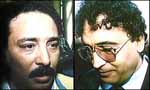
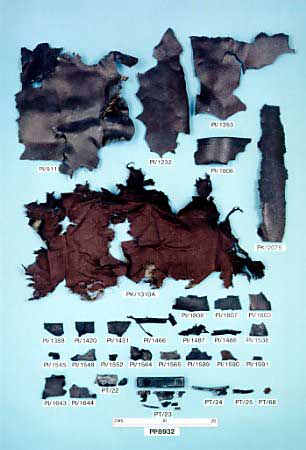
| Wednesday, 31 January, 2001: One of the two Libyans accused of the Lockerbie bombing has been convicted of murdering all 259 people on the plane and another 11 who died on the ground. The guilty verdict on Abdelbaset Al-Megrahi (right), a married man with children, was delivered after an historic 84-day trial under Scottish law in the Netherlands. Al-Megrahi was jailed for life. The judges recommended a minimum of 20 years "in view of the horrendous nature of this crime". An appeal is being planned. Al-Megrahi's co-accused, Al-Amin Fhimah (left), was found not guilty and has been told he is free to return home. [BBC] |
 |
 |
| Thursday, 1 February, 2001: The U.S. set out four steps the Libyan government must take to take responsibility for its actions. ``The government of Libya must take responsibility for the action of Libyan officials,'' State Department spokesman Richard Boucher told a regular briefing. ``That means revealing everything they know about the Lockerbie bombing, paying reparations, a clear declaration acknowledging responsibility for the actions of the Libyan officials and clear, unambiguous actions which demonstrate the Libyan government understands its responsibility.'' Boucher said Washington was consulting other countries to flesh out these demands and that U.S. and British officials would meet soon with a Libyan official to discuss them. [Reuters] |
|
| Thursday, 1 February, 2001: The French foreign ministry on Wednesday hailed the verdict of a Scottish court in the 1988 Lockerbie bombing, and said France hoped to expand economic ties with Libya now that "justice has been done." "The UN Security Council in April 1999 lifted sanctions against Libya after it agreed to hand over the two suspects in the trial." "This paved the way for the gradual normalization of relations between France and Libya, especially in the economic and technical sectors." "France hopes that this process will continue," the spokesman said. [AFP] |
|
| Thursday, 1 February, 2001: The Libyan Government has said it will never accept responsibility for the Lockerbie bombing, following the conviction of an alleged Libyan agent for the attack. Libya has called for the immediate lifting of sanctions imposed by the United Nations over the bombing. Asked by the BBC if Libya will accept responsibility, Libya's foreign minister, Abdel-Rahman Shalgam, replied: "Never". Libya is demanding compensation of its own, for the damage caused by the sanctions, which were imposed by the UN in 1992. [BBC] |
| Monday, 5 February, 2001: The Libyan man acquitted of murder in the Lockerbie trial has been speaking out in his home town of Tripoli. Al-Amin Fhimah told the Arabic satellite TV channel Al-Jazeera that he viewed his release as a gift from God. He said he was convinced that his co-defendant, Abdelbaset Al-Megrahi, will soon be released as well. Speaking to a crowd of well-wishers at his house in Tripoli, Mr Fhimah said he sees his acquittal as God's will, and feels no gratitude to the court that freed him. "If it had not been a gift from God, I would have stayed with my colleague. I would have continued the time with him and returned here together," he says. "It's only a matter of time. Soon Abdelbaset will come back home," he adds. [BBC] |
|
| Monday, 5 February, 2001: Doubts are growing about the conviction of one of the Libyans accused in the Lockerbie case, after the architect of the trial expressed reservations about the verdict. Robert Black, the Scottish law professor who devised the format of the trial, said he was "absolutely astounded" that Abdelbaset Al-Megrahi had been found guilty. Mr Black said he believed the prosecution had "a very, very weak circumstantial case" and he was reluctant to believe that Scottish judges would "convict anyone, even a Libyan" on such evidence. The view, published in British newspapers on Sunday, echoes that of some of the families of UK victims of the Lockerbie bombing, who are calling for a public inquiry to find "the truth of who was responsible and what the motive was". [BBC] |
|
| Monday, 5 February, 2001: Libyans are preparing themselves for new evidence in the Lockerbie case that the country's leader, Colonel Mu'ammar al-Qadhafi, has promised to reveal on Monday. The Libyan leader says his evidence will prove that Abdelbaset al-Megrahi, is innocent of the bombing. He is expected to make his announcement in front of a large gathering of supporters on Monday morning. Correspondents say two possible scenarios are being discussed in Tripoli: Qadhafi will produce evidence that Washington put pressure on the Scottish judges to convict al-Megrahi or that another non-Libyan perpetrator carried out the bombing. However, there is scepticism outside the country that hard evidence will emerge at this late stage. [BBC] |
|
| Tuesday, 6 February, 2001: Libyan leader Mu'ammar al-Qadhafi on Monday rejected any compensation to the victims of the Lockerbie bombing without Washington paying in turn for those it has wronged, and proclaimed a Libyan jailed by the Scottish judiciary a "hostage." In a discursive two-hour speech from his former home destroyed by 1986 US air strikes, Qadhafi also charged that US and British intelligence had helped prompt a Scottish court to convict Libyan national Abdel Basset Ali al-Megrahi, who he said was innocent. "It's a political verdict," and a "mascarade," said Qadhafi. Asked about the compensation demanded by the US and Britain for the families of the 270 who died in the bombing, the maverick Libyan leader said "all the victims of the United States, from Vietnam to Tripoli" would have to be paid damages first. But Qadhafi called for a settlement of the affair, saying: "We want peace, and the U.S. is interested in finding markets for its products." "As the trial against Abdel-Basset al-Megrahi is political, an accord is always possible. That will avoid a return to the cold war and confrontation," Qadhafi said. [AFP] |
|
| Tuesday, 6 February, 2001: Russia said Monday that the end of the Lockerbie bombing trial opened the way for sanctions against Libya to be dropped. The Kremlin expressed that view in a statement and the Foreign Ministry said Russian and Libyan diplomats had consulted each other on the sanctions issue. ``We view with understanding an appeal from the League of Arab Nations to the U.N. to lift sanctions against Libya,'' the Kremlin said in its statement, referring to a call made last week by Arab League chief Esmat Abdel-Meguid. ``We consider that with the ending of the legal process, the prospect emerges of finally lifting sanctions from Tripoli.'' [Reuters] |
| Russia: Sanctions against Libya to be dropped.. |
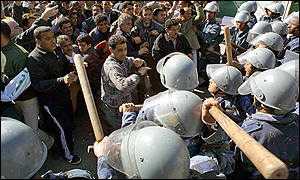 |
| Libyan anti-riot police have clashed with angry demonstrators |
|
| "People are very angry. They want to storm into the British embassy to express their anger and that's why we were obliged to intervene" Libyan police officer |
|
| Thursday, 8 February, 2001:The Scottish Prison Service has denied reports the Libyan secret agent convicted of the Lockerbie bombing has gone on hunger strike. A lawyer for Abdel Baset Ali Mohmed Al-Megrahi, 49, said on Wednesday that the Libyan intelligence agent had begun refusing food the day before. But a Scottish prison service spokesman, although conceding he may have missed a meal on Wednesday, said: "He's not on hunger strike. There is a long way between turning down a meal or two and being on hunger strike." Megrahi was sentenced to life imprisonment last Wednesday for the 1988 bombing of Pan Am flight 103 over the small Scottish town of Lockerbie, which killed 270 people.[Reuters] |
|
| Thursday, 8 February, 2001:Libyan leader Moammar Gadhafi will visit Nigeria next week to deliver a lecture in memory of a former Nigerian military ruler. The majority state-owned Daily Times, organisers of the February 13 lecture in memory of late General Murtala Mohammed, said in a statement on Thursday that Gadhafi would deliver the lecture, which focuses on challenges of African integration, in Nigeria's capital, Abuja. Gadhafi has been championing the concept of a unit Africa. He last visited Nigeria in 1997 during the reign of the late dictator Sani Abacha.[Reuters] |
| Gadhafi will visit Nigeria next week |
| Thursday, 8 February, 2001: Libyan secret agent Abdel-Basset al-Megrahi has gone on hunger strike after being convicted of the Lockerbie bombing. One of his original lawyers said al-Megrahi had begun refusing food and was "depressed". Al-Megrahi announced on Wednesday he was appealing against his 20-year sentence after being convicted by a Scottish court at Camp Zeist in the Netherlands for the 1988 bombing of Pan Am flight 103 that killed 270 people. "I have been told by the defence team that he has started a hunger strike," lawyer Stephen Mitchell said. "But the defence team and the doctors are trying to dissuade him and tell him the right course is to pursue his appeal. He is very depressed," said Mitchell, who has kept in contact with al-Megrahi's present legal team. [Sky News] |
| But..has he really..? |
|
| Libyan secret agent Abdel-Basset al-Megrahi has gone on hunger strike |
| Wednesday,7 Februray, 2001: Scotland -- The Libyan intelligence agent sentenced to life imprisonment for his role in the Lockerbie bombing has launched an appeal against his conviction. The Scottish Courts Service said notice of the intent to appeal was received by the Justiciary Office in Edinburgh on Wednesday. A Scottish judge will now rule on whether to permit the appeal by Abdel Baset Ali Mohmed Al-Megrahi, 48, who was sentenced last week. Al-Megrahi was found guilty after a nine-month trial held under Scottish law at Camp Zeist in the Netherlands. Another defendant, Lamen Khalifa Fhimah, was acquitted.[Reuters] |
| The Appeal is under way.. |
| Thursday, 8 February, 2001, 03:27 GMT The Chadian President, Idriss Deby, is in Libya for talks with Colonel Gaddafi. The Libyan news agency said the two leaders were having discussions ahead of next week's meeting of the Sahel group of African states, which was founded by the Libyan leader. Other reports say that President Deby is also seeking assurances that Libya would not provide support for the rebellion in northern Chad led by a former defence minister. There has been heavy fightging in the north for several months, and in December Chadian troops are reported to have pursued the rebels of the Democratic Movement for Justice in Chad or MDJT well inside Libya. President Deby reportedly said last month that Libya had promised it would end support for the rebels and deny them bases.[JANA] |
|
| Chad president in Libya for talks with President Qaddafi.. |
| Saturday, 10 February, 2001: South Korea has assured Libya that the Seoul government will help a failed local civil engineering firm complete a giant waterway project in Libya, officials said Friday. In a letter sent to Libya Thursday, the construction and transportation ministry vowed to support the completion of the construction, they said. Dong-Ah Engineering and Construction Co. Ltd, a South Korean civil engineering giant, has been involved in the huge man-made river project in Libya, but is now collapsing under a huge debt. "The government assured in the letter to Libya's Great Man-made River Authority that it will do its best to complete the construction project even if Dong-Ah goes bankrupt," a ministry official said. The Libyan authorities had warned on Saturday that it would claim against the Seoul government for any delay in the project. [AFP] |
| South Korea has assured Libya that.. |
|
|
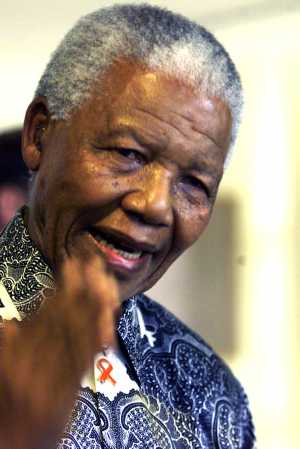
| Saturday, 10 February, 2001: Tony Blair and Nelson Mandela are locked in a diplomatic stand-off after the former South African president complained yesterday that Britain had reneged on its undertaking to press for the final lifting of sanctions against Libya. Mr Mandela told The Independent yesterday that Britain and the US had "moved the goalposts" on the issue of lifting sanctions, after he played a vital mediation role with Colonel Mu'ammar al-Qadhafi to secure the handover of two Libyan suspects wanted for the Lockerbie bombing. Mr Blair said in a letter to Mr Mandela on Wednesday that sanctions, which were suspended by the UN Security Council in April 1999, would not be applied again. "The condition that Qadhafi must accept responsibility for Lockerbie is totally unacceptable," Mr Mandela insisted yesterday. "As President for five years I know that my intelligence services many times didn't inform me before they took action. Sometimes I approved, sometime I reprimanded them. Unless it's clear that Qadhafi was involved in giving orders it's unfair to act on that basis." [The Independent] |
|
| Nelson Mandela upset.. |
| Saturday February 10,2001 8:45 AM ET A Libyan court on Saturday postponed for the ninth time the trial of six Bulgarian health workers charged with deliberately infecting hundreds of Libyan children with the HIV virus Bulgarian state radio said. The medics' trial formally opened on February 7, 2000. The five nurses and a doctor, detained in Tripoli two years ago, could face the death penalty if convicted.``The Libyan People's Court postponed the trial until March 17,'' the radio said. As in previous cases, the delay was granted at the request of the defense. The six medics are charged with intentionally infecting 393 Libyan children with blood products contaminated with HIV in what the indictment says was a bid to destabilize Libya. Eight Libyans and a Palestinian face similar charges. The radio quoted the medics' Libyan lawyer, Osman Byzanti, as saying he expected this would be the last delay in the case. Earlier this week the human rights group Amnesty International said it was concerned over Libya's handling of the case. ``Our major concern is that Libya has not investigated allegations of the use of torture against the medics in the one-year pre-trial period,'' an Amnesty official said. Byzanti has said that two of his clients told him they had made confessions under duress. The medics' case has evoked deep passions in Bulgaria, where some media and the opposition accuse the government of moving too slowly to help the medics. Political analysts say the case will be a major issue in campaigning for the general election due in June. |
| Libya Said Delaying HIV Trial of Bulgarian Medics .. |
 |
| Monday, 12 February, 2001: South African President Thabo Mbeki reaffirmed Pretoria's support to Libyan leader, Col. Mu'ammar al-Qadhafi for condemning the conviction at the Lockerbie trial, the official JANA news agency reported Sunday. JANA said Mbeki told Qadhafi in a telephone conversation that South Africa calls for "the immediate and permanent lifting of the sanctions imposed on Libya", and that it is done in accordance with international conventions. Furthermore, Mbeki stressed the importance of the proclamation of African Unity, a crucial stage toward the unification of the continent. [JANA] |
| South African President Thabo Mbeki reaffirmed.. |
|
| Monday, 12 February, 2001: Jordan's King Abdullah held talks with Libyan leader Mu'ammar al-Qadhafi on Sunday on bilateral cooperation and latest developments in the Israeli-Palestinian conflict, Libyan media reported. It is Abdullah's second official visit to Libya since last September. Qadhafi paid a three-day visit to Jordan last October when he offered Libyan help to a multimillion dollar scheme to pump water from the southern Dissi region to Amman. [Reuters] |
| Jordan's King Abdullah held talks with Qadhafi .. |
| Monday, 12 February, 2001: Eleven African leaders will discuss wars raging on the continent, an economic revival plan and the Lockerbie trial when they meet in Khartoum for their summit starting late Monday, officials said. "The leaders will discuss freely the Lockerbie trial and African conflicts," according to the secretary general of the Community of Sahel-Saharan States (COMESSA). COMESSA's 11 member countries are Burkina Faso, the Central African Republic, Chad, Djibouti, Eritrea, Gambia, Libya, Mali, Niger, Senegal and Sudan. [AFP] |
| Eleven African leaders .. |
| Monday February, 2001. 12 6:10 AM ET - The Libyan sentenced to life in prison for the 1988 Pan Am bombing reaffirmed his innocence and said in an interview published Monday that he is fasting to be closer to God.``God is my witness that I am innocent, I have never committed any crime and I have no connection to this issue,'' Abdel Basset Ali al-Megrahi said in an interview with the Arabic daily Asharq Al-Awsat from his prison in the Netherlands.Scottish judges in the nine-month trial ruled Jan. 31 that al-Megrahi planted the bomb in a suitcase from the Mediterranean island of Malta. The bombing of New York-bound Flight 103 killed 270 people.``I swear to God that I have never seen any suitcase nor did I put any suitcase (on the plane),'' the newspaper quoted al-Megrahi as saying.Al-Megrahi's alleged accomplice, Lamen Khalifa Fhimah, was acquitted and returned to a hero's welcome in Libya. Al-Megrahi, meanwhile, has appealed and has six weeks to submit a detailed argument.The London-based newspaper quoted al-Megrahi as denying earlier media reports that he was on a hunger strike, saying he was fasting ``to be closer to God to lift the injustice done to him.''Muslims usually fast from sunrise to sunset during the holy month of Ramadan, but some fast extra days during the year.Al-Megrahi also challenged the testimony of a Maltese shopkeeper who identified him as the man who purchased the clothes wrapped around the bomb.``This Maltese man, since his first testimony, said I was 50 years old. At that time I was in my 30s. He said I was black, then he changed his testimony before the court saying I was not black,'' al-Megrahi said. [CAIRO, Egypt (AP)] |
| God is my witness that I am innocent .. |
|
| Tuesday, 13 February, 2001: A Scottish Labour MP is to call on the UK Government to resume contact with Libya despite the Lockerbie trial verdict. Linlithgow MP Tam Dalyell will use a Commons debate on Tuesday morning to demand that sanctions are lifted. Libyan agent Abdel Baset al Megrahi was found guilty of the murders of the 270 victims of the Lockerbie bombing and sentenced to life in prison. He has lodged an appeal against his conviction at the special Scottish court in the Netherlands. His lawyers say there is nothing to prove that he carried out the bombing of Pam Am Flight 103, which exploded above the Scottish town in 1988. And Mr Dalyell agrees with them, saying that he believes Al Megrahi is innocent. He insists it is time sanctions against Libya are removed. He will use the debate at Westminster to call on ministers to resume contact with the government in Tripoli. The UK Government is limiting its comments until the appeal is concluded. [BBC] |
| A Scottish Labour MP: Lift 'em off .. |
|
| Tuesday February 13, 2001. 12:05 pm Eastern Time Chairman Archie Dunham said Tuesday he was ``very optimistic'' U.S. President George W. Bush will lift long-standing sanctions against Libya, allowing U.S. oil firms to return to the energy-rich nation. Dunham, also chief executive of the Houston oil firm, expressed hope that the arrival of former Texas oilmen Bush and Dick Cheney to the White House could pave the way for ending the 15-year-old sanctions against Libya. ``I think this administration is more willing to re-look at sanctions policy, which has been a total failure,'' Dunham told reporters on a tour of a refinery installation in eastern Venezuela. ``I am very optimistic that changes will be made in U.S. policy with the new administration. I can't say specifically if that is going to happen in the next 30 days or 60 days,'' he said. U.S. oil firms were forced to abandon lucrative operations in OPEC-member Libya by former President Ronald Reagan's 1986 executive order. Dunham, head of the No. 4 U.S. oil company, said the new Republican U.S. administration, which took office in late January, is said to be far less keen on economic sanction which harm U.S. business interests overseas than its Democrat predecessor. |
| Conoco chief optimistic Bush to end Libya sanctions.. |
| Wednesday, 14 February, 2001: Libyan leader Mu'ammar al-Qadhafi late Tuesday cancelled a trip to Nigeria at the last minute after he was refused permission to visit a northern state where Islamic law has been declared, a Nigerian official told AFP. A senior official in the office of Nigerian President Obasanjo told AFP that Qadhafi had been invited to give a speech Wednesday in Abuja on the theme of African unity. But Obasanjo objected when he learned that the Libyan leader had also planned to visit the northern Nigerian state of Zamfara, which last year introduced strict Islamic law. Qadhafi cancelled the trip after he learned he had been refused permission to travel to Zamfara, said the official, who asked not to be named. [AFP] |
| Mu'ammar cancelled a trip to Nigeria at the last minute .. |
| Wednesday, 14 February, 2001: The U.N. Security Council is meeting to discuss a request by non-aligned nations to end UN sanctions against Libya. South Africa, current chairman of the Non-Aligned Movement, submitted a proposal urging "the immediate and complete lifting of the sanctions" last week. It is not clear whether the council will vote on the request, since two of its five permanent members - Britain and the U.S. - say Libya has not yet met all the conditions for lifting sanctions. Diplomatic sources say 10 of the 15 council members would certainly agree to remove the sanctions if a vote were taken, with two other probables and an abstention. [BBC] |
| Security Council is meeting .. |
| Thursday, 15 February, 2001: U.N. Security Council members appear willing for now to give the U.S. and Britain time to negotiate with Libya on their outstanding demands before pressing to have U.N. sanctions against Tripoli permanently lifted. The council met behind closed doors for over two hours Tuesday to hear from the U.S. and British ambassadors on their first talks with the Libyan ambassador since a Scottish court convicted a Libyan intelligence agent, Abdel-Basset al-Megrahi, in the Lockerbie bombing. The powerful 15-member council, which includes veto-wielding United States and Britain, took no action. And no action was immediately expected as long as the U.S.-British-Libyan talks progress ``positively and rapidly toward a consensus solution,'' said Tunisian Ambassador Said Ben Mustapha, the current council president. [AP] |
| Cover page story.... (Feb. 17th 2001) |
| Thursday, 15 February, 2001: Libyan leader Mu'ammar al-Qadhafi has hailed the results of the third summit of the Community of Sahelian-Saharan States (COMESSA), which wound up Tuesday in Khartoum, Sudan. According to Qadhafi, the summit achieved fruitful and positive results not only towards the political and economic integration of member states, but more especially towards the African Union of which he is the brainchild. At a news conference held Tuesday evening in the Sudanese capital, Qadhafi commended the adhesion of five new countries to the community. The five new members are Nigeria, Morocco, Tunisia, Egypt and Somalia. COMESSA now covers more than half of Africa with more than 300 million people, he noted. [PANA] |
| Qadhafi has hailed the results of the third summit .. |
| February 15, 2001 Nigeria's federal government has explained that disagreement over personal weapons and length of stay were responsible for the cancellation of Libyan leader Moammar Kadhafi's scheduled visit to Nigeria. Dispelling speculations that the cancellation had to do with Kadhafi's request to visit the northern State of Zamfara, government spokesman Jerry Gana, told journalists in Abuja that security officials from both countries had disagreed on the type of personal weapons that would be allowed into Nigeria for the visit. Kadhafi had been scheduled to visit Nigeria Wednesday (14 February) to deliver a lecture in memory of the assassinated Nigerian former Head of State, Gen. Murtala Mohammed. Gana said Nigerian security officials were opposed to a request by the Libyan authorities to come in with some highly- sophisticated weapons, and had explained to their Libyan counterparts that the (Nigeria) security forces were capable of providing safety for Kadhafi in the country. "Our security officials, doing their work, were very clear that there are certain categories or grade of guns that cannot be brought to Nigeria by security officers accompanying visiting Heads of States," he said. According to Gana, who is the Information and National Orientation Minister, there was also a disagreement over the duration of the visit. He said Kadhafi's request to extend his two-day trip by an additional two days did not fit into the programme of Nigerian President Olusegun Obasanjo. Gana explained that contrary to speculations, there was no request from the Libyan leader to visit Zamfara, which blazed the trail in introducing the controversial Islamic legal code, the Sharia, in January 2000. The introduction of the code by a number of Nigeria's northern States, is a source of tension between the country's Mulsim-dominated north and the predominantly Christian south. The American former president B. Clinton had visited the country earlier with even greater measures of security. |
| Nigeria Explains Cancellation of Kadhafi Visit .. Why not with Clinton's.. |
| Friday February 16 06:26 PM EST The situation in Iraq has gotten so bad that many of the country's leading lights have left.One of the most recognized modern Iraqi writers, Nuha Al-Radi, who wrote an account of life in Baghdad during the war, now lives in Lebanon.One Iraqi university claims to have lost up to 20 percent of its staff in the first five years of sanctions. In early February, the Bush administration even gave support for Iraqi opposition groups to resume activities inside Iraq with American funding.A State Department official told the Washington Post that the administration was telling Iraqis abroad: "You're beyond the organizational phase. Now do something."The story for most Iraqi exiles, however, is no different from many immigrant tales. They usually wind up wherever they can - for Iraqis, it's friendly Islamic countries like their neighbors Jordan and Libya and Pakistan, or further afield, in Indonesia or Malaysia.A smaller proportion wind up in the United States, Great Britain or Australia.Whatever the case, these upper-middle-class Iraqis wind up taking jobs below what they had in their home country, experts say.There's even a joke in Jordan, where the majority of Iraqi exiles have wound up: If your butcher is slow in cutting your meat, then he's probably an Iraqi surgeon.It's no small task for Iraqis to leave home, said Masri. "Iraqis don't have a history of leaving." Iraq is a landlocked country, she said, and even during the Iran-Iraq war, there was not much of an exodus.She also said the outside world is reluctant to deal with Iraqi immigrants. Entry visas are very difficult for Iraqis to get, she said, because of the international hostility towards the regime.Even neighboring Arab countries attempt to curb their intake levels, because of their own troubled economies.And now, the Iraqi government itself has placed tight controls on who can leave. "They're panicking and they've lost so many skilled people," said Halliday.An exit visa is 400,000 dinars, he says - when typical monthly salaries hover around 10,000 dinars - about $5.In addition, some reports say Iraq has imposed a bond of up to 1 million dinars on anyone with an education beyond the level of a bachelor's degree, to ensure they return.With tickets and bribes, a trip out of Iraq can reportedly cost $3,000 - or 6 million dinars. |
| The Great Iraqi Brain Drain..To Libya |
| Sunday, 18 February, 2001: Middle Eastern states reacted with indignation to the air strikes on Iraq. The following are a selection of quotes: ... Libyan Government statement: "Libya... reiterates its denunciation of this aggression and it reaffirms its support for, and solidarity with, sister Iraq in confronting it." ... Russia and China have both condemned the latest raids by British and US warplanes in Iraq. A senior Russian defence ministry official said the US was "trying to replace the UN Security Council, which constitutes a dangerous tendency that will destabilise an already fragile international situtation." A Chinese representative at the UN said his country opposed "armed intervention by any UN member state under any circumstances against any other nation without the express consent of the Security Council". There was a cool response from France - the other permanent member of the Security Council. [BBC] |
| indignation to the air strikes on Iraq.. |
| Saturday, 17 February, 2001: The U.S. says it will follow evidence on the Lockerbie bombing wherever it leads, even to Libyan leader Mu'ammar al-Qadhafi. Families of the victims say they doubt Washington will go after Qadhafi, partly because of a letter written by U.N. Secretary-General Kofi Annan in 1999 on the urging of the U.S. and Britain assuring Qadhafi that suspects in the trial would not be used to undermine the Libyan regime. U.S. State Department spokesman Richard Boucher did not mention Qadhafi by name when asked if Washington wanted him indicted. But he added, "The U.S. government position ... is that we will follow the evidence wherever it leads". Asked again to link this to Qadhafi, he replied, "We will follow the evidence wherever it leads. I think there was a dispute over a letter ... that seemed to imply that we wouldn't go that far. But we've said, quite clearly, we'll go wherever it leads." [Reuters] |
| "We will follow the evidence wherever it leads" |
| Tuesday, 20 February, 2001: South African President Mbeki is scheduled to attend a special summit of African leaders in Libya next month, to discuss the replacement of the 53-member Organization of African Unity by the African Union (AU). The special summit, schedule for March 1, will deal with such outstanding issues as the date on which the AU will be officially launched, according to a statement released by South African Foreign Ministry on Monday. A South African diplomatic mission will also be established in Tripoli soon, the statement said. [Xinhua] |
| President Mbeki is to attend a special summit in Libya |
| Tuesday, 20 February, 2001: Libya recently informed South Korea that it will make a claim for over US $1.2 billion in compensation for any failure by Dong Ah Construction Co. to proceed with the construction of the Great Manmade Waterway in Libya, a Korean ruling party lawmaker said Sunday. Rep. Lee Yoon-soo of the Millennium Democratic Party said that the Libyan Consturction Minister has sent a letter to his South Korean counterpart to notify that the Libyan government will file a suit with a South Korean court to demand over US $1.2 billion in compensation if Dong Ah cannot continue the construction work. The letter dated Feb. 6 claimed that the Libyan government has the right to file the suit until the end of June, Lee said. [Bernama] |
| Compensation for any failure by Dong Ah Construction Co. .. |
| Monday, 19 February, 2001: Although most African countries have ratified the international Mine Ban Treaty, the continent continues to use landmines more than any other region in the world, a two-day inter-governmental meeting in Bamako, Mali, heard on Thursday. The 1997 treaty bans the use, production, transfer and stockpiling of antipersonnel mines. "Since this treaty entered into force, antipersonnel mines have been used in more conflicts in Africa than in any other region," said Jody Williams, 1997 Nobel Co-Laureate and ICBL Ambassador at the opening of the meeting. Ten African countries that have yet to ratify it are: Central Africa, Comoros, Congo, Egypt, Eritrea, Libya, Morocco, Nigeria, Congo (DRC) and Somalia. [Africa News] |
| Mine Ban Treaty .. |
| Tuesday, 20 February, 2001: The Korean government has asked a Seoul court to consider placing the ailing Dong Ah Construction into receivership. The move comes in view of a possible diplomatic row with Libya over Dong Ah's failure as prime contractor for Libya's man-made waterway project. Son Hak-rae, senior official of the Construction and Transportation Minister, said Monday that Libya had threatened to terminate its man-made river project. So his ministry had asked a local court to seek to place the ailing company into receivership to prevent a diplomatic issue expected to arise with Libya over the halt to the man-made waterway project. Son said Libya proposed in a letter dated Feb. 6 that Dong Ah and Korea Express would join up to complete the man-made river project, adding that the government would convey its position on Dong Ah's situation to Libya through diplomatic channels. [Asia Pulse] |
| The Korean government has asked .. |
| Wednesday, 21 February, 2001:"We have not given shelter to Osama bin Laden so that we can make a deal to hand him over" - Taleban ambassador to Pakistan. Afghanistan's ruling Taleban movement has denied it will give in to Western pressure and surrender Osama bin Laden.The American authorities call bin Laden the driving force behind explosions which blew up two US embassies. Abdul Salam Zaeef, the Taleban ambassador to Pakistan, dismissed a newspaper report that the Taleban might hand over bin Laden in exchange for recognition as the government of Afghanistan."Our policy is clear from the beginning and this policy still prevails."Taleban Foreign Minister Wakil Ahmad Muttawakil said separately if it turned over bin Laden, hostile governments would find another reason not to recognise his group as Afghanistan's legal rulers.The United Nations has imposed a variety of political and economic sanctions on the Taleban.This includes an arms embargo in an attempt to pressure the militant Islamic group into surrendering bin Laden. Pakistan, Saudi Arabia and the United Arab Emirates are the only countries to recognise the Taleban as the government of Afghanistan, despite the fact it holds more than 90 per cent of the country. The United Nations continues to recognise the opposition who are isolated in the north of the country. Reports from unknown souece have Claimed that the Libyan government is considering offering a home to Mr. Bin Ladin. |
| Libya and Bin Laden .. |
| Wednesday, 21 February, 2001: The 5th extraordinary Organisation of African Unity (OAU) Summit to discuss the African Union billed for March in Sirte, Libya was at the centre of recent discussions in Gaborone, Botswana between OAU secretary general Salim Ahmed Salim and President Festus G. Mogae of Botswana. Salim informed Mogae that 41 countries have signed the constitutive act of the African Union since the OAU summit in Togo in July 2000. He added that 13 of the signatories had ratified the instrument. Mogae, on his part, said that his country had decided to sign the act. [PANA] |
| African Union .. |
 |
| Saturday, 24 February, 2001: In the CIA's latest unclassified, semi-annual report to Congress on proliferation, was an assessment that Libya, with continued foreign assistance, may successfully develop a medium-range ballistic missile, which has long been its goal.``Outside assistance is critical to its ballistic missile development programs, and the suspension of U.N. sanctions last year has allowed Tripoli to expand its procurement effort,'' the CIA report said.Another new assessment in the report was evidence that Libya was trying to acquire the capability to develop biological warfare agents.``Evidence suggests Libya also is seeking to acquire the capability to develop and produce BW (biological warfare) agents,'' the report said.Libya still has a goal of establishing chemical warfare capability, the report said. It continues to develop its nuclear research and development program, but requires ``significant foreign assistance'' to advance to a nuclear weapons option, it said. |
| Libya And Ballistic Missiles .. |
| Saturday, 24 February, 2001: Libya's Khaled Khamees scored twice as Libya tied Togo 3-3 Friday in a qualifying match for the 2002 World Cup. Khalifa al-Maqni scored Libya's other goal. The teams, both 0-2-1, remained tied for last in Group "A" of African qualifying, where only each of the five group winners will advance to the tournament in South Korea and Japan. Cameroon (3-0) leads the group with nine points, followed by Angola (2-1) with six, Zambia (1-1) with three, and Libya and Togo each has one. [AP] |
| Libya tied Togo 3-3 .. |
| Monday, 26 February, 2001: Libyan leader Mu'ammar al-Qadhafi heaped praise on African states for supporting him in his struggle against Britain and the U.S. over the Lockerbie bombing, Libyan media reported. African leaders helped ease Libya's isolation in 1998 when they decided at an OAU summit to ignore the U.N. embargo imposed on Libya. "The will of Africa won over the will of the colonialist Western powers and forced them to accept Libyan conditions on the sitting and procedures related to the Lockerbie trial," Qadhafi was quoted as saying. Qadhafi was addressing about 50 foreign ministers and other officials at the start of a four-day meeting of the 53-member Organisation of African Unity in Tripoli on Saturday night. [Reuters] |
| Al-Qadhafi heaped praise on African states.. |
| Sunday, 25 February, 2001: Col. Qadhafi opened the 73rd ordinary session of the OAU Council of Ministers in Tripoli Saturday with a call for early ratification of the Constitutive Act of African Union conceived in Sirte in September 1999 and adopted by OAU leaders in July 2000 in Togo. "We cannot wait for years for the Union to go into force. You have to explain to your leaders to facilitate the process of the Union. We do not need to go on a pilgrimage to obtain the decision," Qadhafi told the Ministers, who, apart from their regular annual budgetary and financial sessions, would also prepare the agenda for their leaders' Summit on the African Union in Sirte. [PANA] |
| OAU Council of Ministers .. |
| Monday, 26 February, 2001: The Libyan leader, Colonel Mu'ammar al-Qddafi, has held talks with President Bashar al-Assad during the Syrian leader's first trip to Libya since succeeding his father last year. Libyan radio said the two men discussed the situation in the Arab world and the Palestinian uprising. It said President Assad also expressed support for Libya in opposing the UN sanctions imposed on it after the Lockerbie bombing in 1988. Mr Assad has now flown back to Damascus, where he's expected to meet the U.S. secretary of state, Colin Powell, Monday. [BBC] |
| Talks with President Bashar al-Assad .. |
| Wednesday, 28 February, 2001: France's top public prosecutor urged its highest court Tuesday to protect Libyan leader Mu'ammar al-Qadhafi from prosecution for the 1989 bombing of a French DC-10 airliner over Niger. Advocate General Jean-Yves Launay told the court that diplomatic practice required that France reject a bid by one of its own investigating magistrates to bring Qadhafi to trial for ''complicity in murder in relation to a terrorist act.'' In a landmark decision, a French appeals court last October rejected an argument from state prosecutors that Qadhafi enjoyed immunity as a serving head of state and could not be tried in France for the bombing. But in a final appeals hearing before the Cour de Cassation, Launay warned that trying Qadhafi would open a Pandora's box of possible suits against France. The court, which usually follows the advice of the advocate general, said it would announce its decision on March 13. [Reuters] |
| To protect Libyan leader Mu'ammar al-Qadhafi .. |
| Wednesday, 28 February, 2001: Nigerian President Olusegun Obasanjo is expected to embark on a two-day visit to Libya on Thursday, the Punch newspaper reported on Tuesday. Obasanjo is expected to hold bilateral talks with his Libyan counterpart Mu'ammar al-Qadhafi on the issue of the African Union, a statement issued by the Nigerian State House was quoted as saying. The Union project, for which the Libyan leader sponsored a special summit last year, will be submitted to the various African countries to approve. Qadhafi, who was scheduled to visit Nigeria on February 14 this year, had to cancel his tour. [Xinhua] |
| Nigerian President Olusegun Obasanjo is expected to visit Libya.. |
| Wednesday, 28 February, 2001: The three-day 73rd extraordinary session of OAU Council of foreign ministers wound up in Tripoli early Tuesday with the adoption of some 20 decisions on administrative, financial and budgetary matters. The ministers and a multitude of reporters and other participants have left by bus and plane for Sirte, 450 kilometres east of Tripoli. In Sirte, the ministers and other delegations are expected to hold another session, ahead of the Sirte II summit of the Heads of state and government. The latter would take part in the proceedings of the OAU extraordinary summit on the African Union slated for 1 and 2 March. [PANA] |
| OAU Council of foreign ministers wound up .. |
| Wednesday, 26-28 February,, 2001: Lundin Oil AB is pleased to announce the achievement of a crucial milestone in the development of its En Naga North and West Field. International Petroleum Libya Limited (IPLL), a wholly owned subsidiary of Lundin Oil AB and operator of the En Naga Development in Area NC177, has awarded two engineering, procurement, installation and construction (EPIC) contracts for the construction of processing facilities and a 94.5 km pipeline. The pipeline will connect the En Naga Development with the existing pipeline network which will take the produced oil to export facilities on the Mediterranean coast. Ian H Lundin, President of Lundin Oil AB said, "The award of these contracts is a significant step towards bringing the En Naga Field into production. We can now expect with a reasonable degree of certainty the achievement of first oil before year end and we look forward to achieving our first production in Libya together with our partners, The National Oil Corporation." The En Naga North and West Field was discovered by IPLL in 1998 and contains certified proven and probable reserves of over 100 million barrels of oil. Lundin Oil AB is a Swedish independent oil company with exploration and production activities in eight different countries worldwide. The Company is listed on NASDAQ (symbol "LOILY") and the Stockholm Stock Exchange (symbol "LOILB"). |
| Libya: Process Facilities and Pipeline Construction .. |