 |
|
|
|
|
|
|
|
|
|
|
|
|
|
|
|
|
|
|
|
|
|
|
|
|
|
|
|
|
 |
|
|
|
Unlimited Fuel from Unlimited Ingenuity |
|
|
| Recent advances in artificial intelligence, construction methods, and advanced materials, have made it possible to build machines of unprecedented capabilities that can operate in extreme environments reliably and economically. Such are the machines of the New Atlantis Development Project. |
|
|
| The New Atlantis Development Project is a new company that will send robot submarines down to the deep-sea hydrothermal vents of the Mid-Atlantic Ridge. Once there, they will use the scalding heat and crushing pressures to drive conventional catalytic reforming processes, such as the Houdry Process, Sabatier reaction, or Reverse Water Gas Shift, among others, to process the extremely hot, pressurized, chemically rich water into a series of valuable hydrocarbon fuels. It duplicates the natural processes that create petroleum, but at a vastly accelerated rate. |
|
|
| Once on the surface, the fully laden vessels will rendezvous with tankers that bring the products to a fuel hungry world. That done, they return to their deep ocean realm and begin the process again. |
|
|
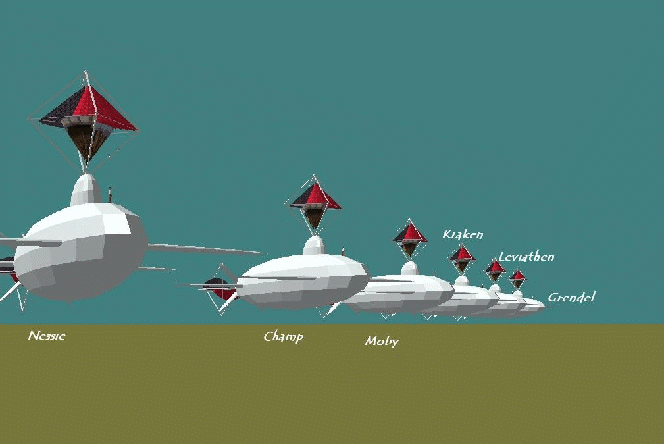
| These machines, the Dragons, utilize the latest advances in pure cybernetics available. While they are operated by humans, safely located on surface ships and shore facilities, they are true autonomous robots, fully capable of carrying out their mission for months without direct supervision. |
|
|
| They will gather the molecules of hydrocarbons like a whale feeding on krill, and then thermo-chemically 'digest' them into synthetic gasoline, kerosene, diesel oil and lubricants. These machines are fully aware of their environment and can react to changes like any organism. They are also highly maneuverable, silent and fish and bird friendly. |
|
|
 |
|
|
| Design: |
|
|
| The Dragons were designed by AEOLUS HEURISTICS, which owns the design and A.I., and licensed to The New Atlantis Development Project. They will be built under contract by several shipyards utilizing the latest CAD/CAM/CAE software. |
|
|
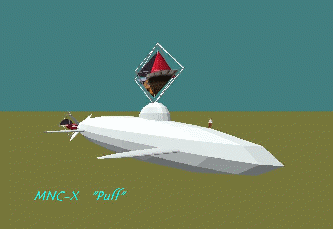
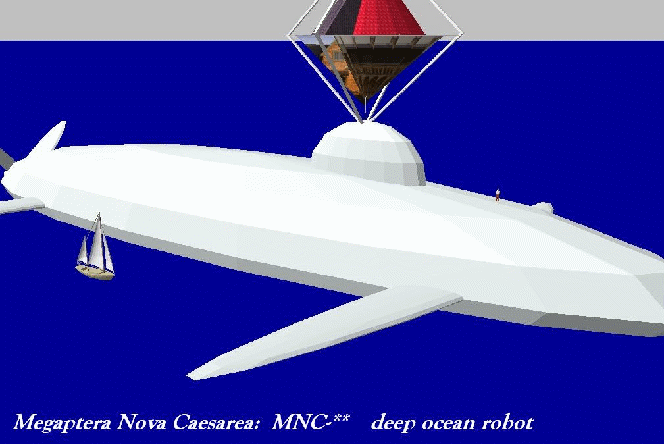
| Each Dragon is 502 feet long, 123 feet wide and 86 feet tall, when rotors are retracted inside the hull. They can generate 65 Megawatts and hold 50,000 barrels of product. They can operate safely at depths to 7500 feet, and with a small modification, can operate to 30,000 feet. |
|
|
| Each Dragon has as its primary systems, a wind turbine which folds into the hull when submerged, and a folding hydro-turbine for generating power underwater. These turbines heat thermal batteries of molten salts, which drive the chemical reactions for the hydrocarbon processors, and power thermionic generators for electrical power. |
|
|
| Propulsion is via a jet-pump or glider fins, similar to those used by 'slocum gliders'. |
|
|
| Surface navigation is by conventional means like GPS and LORAN-C but undersea navigation is via a unique, proprietary system using magnetic fields and blue-green lasers. |
|
|
 |
|
|
| The Dragons themselves are products of the sea. The hulls will be made via electrolytic accretion at a yard in the Windward Islands. Here the sea is rich in calcium carbonate, limestone. By passing a mild current through a wire mesh in the desired shape, the limestone, which is naturally dissolved in seawater, collects, accretes, on the surface of the mesh, much like a clam makes its shell. This forms a hull of synthetic coral, which is very strong, light for its strength, and resistant to seawater. This is a very low cost way to build extremely large marine structures. It is also self-repairing. |
|
|
| The Artificial Intelligence running the machine is an advancement in cybernetics. The machine intelligence is integrated into the entire structure and systems of the vessel existing in a digital, analog, fluidic, electro-mechanical, mechanical, and structural form, simultaneously. Thus the machine and the AI are fused into a single entity that reacts and adapts to its surroundings. |
|
|
| Business Model: |
|
|
| The business model is simplicity itself. All products will be produced under contract and delivered to the customer's tankers. No storage of volatile products is ever required. The entire output will be sold to SUNOCO for their Marcus Hook and Paulsboro refineries, at market less 12%. |
|
|
| Because all 'consumables' are free, the cost of production is merely amortizing the cost of the Dragon, plus overhead costs for shore facilities and operations vessels, and salaries. This works out to a cost of production considerably lower than current prices. We are confidant we can sell all we can produce. |
|
|
| Development Plan: |
|
|
| Because of the size and scope of the project we plan to do this is two phases. In Phase One we will build a ¼ size demonstrator, establish the control center, and obtain international patents. |
|
|
|
Phase Two will involve licensing the design to investment groups which will finance construction of the Dragons. They will be franchisees who will pay a percentage of their revenues as royalties, license fees, and operator fees. |
|
|
| A cash flow is available. |
|
|
The New Atlantis Project |
|
|
|
|
|
p.o. Box 26577 |
|
collegeville, pa 19426 USA |
|
|
|
|
|
610-564-6154 |
|
|
|
[email protected] |
|
|
 |
|