 |
|
|
|
|
|
|
|
|
|
|
|
|
|
|
|
|
|
|
|
|
|
|
|
|
|
|
|
|
|
|
|
|
|
|
|
|
|
|
|
|
|
|
The Hidden River Project: |
|
|
|
by Solaris Cybernetics, llc |
|
|
 |
|
|
|
Business Plan |
|
|
|
Winter 2008 |
|
|
|
TABLE OF CONTENTS |
|
|
| Page |
|
|
| Executive Summary 4 |
|
|
| Business Plan |
|
|
| Executive Summary |
|
|
| A New Approach to Green Energy |
|
|
| One of the major issues of our time is energy. The customary forms of energy production, based on fossil fuels, present problems that are steadily eroding our way of life. These problems are well known. The use of petroleum-based (carbon-based) fuels is damaging the environment, leading to potential long-term climate consequences. More importantly, supplies from politically volatile parts of the world are becoming more costly and more uncertain. There is a pressing need for an alternative fuel that is renewable, does not pollute, is economical to produce, affordable to consume, is available now, and can be produced domestically. |
|
|
| Solaris Cybernetics (“the Company”) has developed The Hidden River Project, a business and technology to convert intermittent renewable energy, such as ocean, solar and wind, and store it thermally. It then delivers the stored energy to existing power plants that use the heat directly in their boilers instead of consuming fuel of any kind, and there are no gaseous emissions whatsoever to add to air pollution, acid rain or global warming. The thermal batteries can hold the heat for over 3 weeks so it can be used as needed, rather than as available. You have all the desirable characteristics of nuclear power but without any radioactive materials, and it can be used in existing power plants, eliminating the expense and time of new construction. With this technology an existing 50 year old power plant can generate completely clean power for $0.03 per Kilowatt-hour. |
|
|
| We mean that investors can make a very generous profit selling electricity for $0.03 per kilowatt-hour. Now, imagine what power for that price would mean for our economy. Energy represents over 40% of the cost of living. Imagine what a 75% reduction in that cost can do. American goods become cheaper by half, food is cheaper and cleaner, the air and water can be made pristine. The cost of heating and cooling homes falls to one-quarter what it is now. Yet investors see returns of 130%. Everybody wins. |
|
|
| The process begins with the SF-1 robots, the Dragons. The Company has developed a proprietary robot design and artificial intelligence that allows large numbers of robots to operate at sea, gather energy and return to the power plants, without any supervision. Leveraging core strengths and experience in power systems and automation, Solaris Cybernetics has designed a completely autonomous, mobile system, powered by solar and wind energy only, that can function unattended for weeks or months. Unlike biofuel crops such as soybean, corn and palm, the company's ZENOC engine does not disrupt or affect costs of food production, and it does not consume dwindling supplies of arable land or potable water. By robotizing and automating the process, Solaris Cybernetics can operate the Dragons where there is abundant renewable energy 24 hours a day, every day. Production at sea is safe, abundant and continuous - all at a low operating cost because the system requires only a minimal staff. |
|
|
| The ZENOC engine and thermal battery can be easily installed at existing power plants turning them into zero-emission plants with practically no expense. No new plants are required, and older plants can be brought back on-line. Thus, the transition from fossil fuel to green energy becomes gradual, seamless, and inexpensive. |
|
|
| Solaris Cybernetics is currently operating a small-scale pilot plant. |
|
|
| With funding, the Company will enter into Phase One of the core project, where a production facility will be constructed. The Company has identified a 200-acre site near Vineland, NJ, in which The Hidden River Project can begin producing green energy for the City of Vineland and two nearby commercial power plants. There have been preliminary third party tests and discussions surrounding this compelling economic opportunity between the Company and the local municipality. The Hidden River Project also has the option to provide 100% of the power for a new industrial park on the adjoining property. |
|
|
| This project was created by Rudolph Behrens and it embodies the sum of his education and experience. It has been his goal to find ways to make doing business in an environmentally responsible manner the way of choice not through altruism but through business pragmatism. Free energy, if it can be applied effectively, is a compelling choice for any industrial activity. Rudolph majored in Aerospace Engineering and Economics since Aerospace, at the time, represented the cutting edge of technology, and Economics because he wanted to keep his work rooted in sound business principles. Post degree, he worked for Worthington Corporation, a builder of turbo-machinery. He was one of many outside consultants called in during the Three Mile Island Accident. Later he was chief mechanical engineer for pump technology for SUNOCO, which is where he learned the petroleum business. He represented SUNOCO on API committees 610 and 617. After that he developed PUMPCOM, a mathematical system that integrates fluid and thermo-dynamics into a predictive analysis tool. It was used to monitor power generating plants, especially nuclear. It remains the heart of the PROMETHEUS A.I. used in the robots. He also operated, with his family, an organic, hydroponic farm that provided herbs and vegetables to the ACME chain of stores. The greenhouses were all self-sustaining - powered by solar and wind, and generating their own nutrients. The Dragon robots are a derivative of this domain expertise. |
|
|
| II. Business Plan |
|
|
| Summary |
|
|
| In energy projects, while efficiency is a key indicator of the success of a design, it is cost per kilowatt-hour that ultimately determines its financial success. The company's approach is to focus on cost per kilowatt-hour. To this end it was determined that using relatively inexpensive systems to collect ubiquitous sources of renewable energy gave the best cost per kilowatt-hour. The form of energy that is easiest to collect and uses the least expensive equipment is heat. Ironically, it is also the most efficient since our measure of inefficiency is what portion of the energy turns to heat. Thus a thermal system is inherently 100% efficient. Additionally, the largest use of energy from fuels is to convert it to heat. By saving the intermediate step of combustion we save the costs and pollution associated with that conversion and deliver energy in the a form it which it is instantly usable. |
|
|
| Those forces that have always driven the energy market are now amplified by orders of magnitude because of new realities of the 21st Century. |
|
|
|
Rising global energy demand and consumption |
|
|
|
Decreased availability and increased cost of fossil fuels |
|
|
|
Massive global appetite for fuel |
|
|
|
Realization of the poor economics of agricultural feed stocks like corn |
|
|
|
Significant degradation of the environment beyond the capability of small-scale or incremental projects to correct. |
|
|
| More than three decades of 'research' have not made renewable energy a significant part of our energy mix. The reason is it fails a primary requirement of commercial energy, and that is dispatchability. That means being available whenever, and in whatever quantity is needed. Solar and wind are available at unpredictable times and durations, and are not easily stored. Therefore they are not considered dispatchable. For green energy to become our primary source it must become dispatchable, and available in sufficient quantity, and at a low enough cost to displace base load plants such as coal and nuclear power. Until it can do that, renewable energy remains an interesting fringe technology. |
|
|
| Solaris Cybernetics Group, LLC believes it has solved the issue of large-scale, dispatchable, zero emission, base load, non-nuclear power production. The ZENOC Engine and the Dragon robots make power production cheaper than all other sources, including coal and nuclear. The combination of these two technologies differentiates Solaris Cybernetics from the rest of the renewable energy industry. |
|
|
| The Company seeks $2M to fund the construction and operation of a commercial large-scale facility in Southern New Jersey. [B.L. ENGLAND S.E.S.] |
|
|
| The Green Energy Market: |
|
|
| In reality, all biofuel projects are already obsolete because there is not enough land, water or labor to provide for more than 5 or 6% of the world's energy needs under the best of circumstances. Restrict the problem further to that of providing for America's needs, within America's borders, and it becomes a cruel joke. We would have to cultivate every acre of arable land to produce 10% of our fuel needs, and we would then need to import all our food. We could have made excellent use of such technologies in the 1970's but we have wasted a generation. The conventional and traditional, even yesterday's 'new' technology, does not work anymore. They are all 'too little, too late'. It is time to embrace the technologies of the 21st Century, use them for more than war and live the life we have always dreamed of. The system is silent and does not produce any waste products and does not harm any ecosystems. It can produce not only enough for survival, but for comfort, economic growth, and healing the planet. |
|
|
| With sufficient political will, wind and solar could provide 100% of our energy needs, but traditional forms of wind and solar are not dispatchable. Efficient storage is the key to it being successful. The ZENOC-NN system solves the storage issue and is designed to integrate into a larger network of wind turbines, solar arrays, capacitor storage stations and geo-thermal power plants for a completely clean, zero-emission, non-nuclear power system that has enough power for everyone beyond current levels and at half the cost in real dollars. Energy is what defines all modern economies so the cost of energy is a regressive tax that redistributes income. The ZENOC-NN system offers the ultimate tax cut. |
|
|
| History: |
|
|
| We have long had a hunter-gatherer paradigm for our energy supplies. We were content to find easily consumed supplies of fossil fuel to power our increasingly technological society. As a first step that was acceptable, but we never progressed beyond that. Now our consumption of energy is reaching the limits of what is available, and more to the point, what is the limits of what the Earth can tolerate. For our own economic, and literal, survival we must change our mindset about energy from that of hunter-gatherer, to that of farmer. We must cultivate and replenish our energy as a farmer does his fields. Wind and solar energy represents our energy income. If we live within our means we will be all right. The Sun, through the mechanisms of direct sunlight, wind, hydro, and biomass, provides all the energy we need, if we know how to use it. And this is abundant energy. There is no need to restrict the use of cars, or how we heat and cool our homes if we use that energy we receive free every day. |
|
|
| But energy is not our only need. We all need food and water, too, and a clean place to live. Taking precious land and water resources away from the vital use of life support and devoting them to make fuel for wasteful vehicles is irresponsible. We need energy, but we can't sacrifice food and water to get it. We can't be satisfied with marginal, incremental solutions that are 'less polluting' than fossil fuels while providing a tiny fraction of our needs. That is no longer an adequate answer. The Earth can no longer take up the slack of that which we don't want to pay for. ALL of our energy must be 100% clean and renewable, and it must cost much less than it does now. If we wish to not only survive, but prosper, in the 21st Century we must take more responsibility, and hold more sacred, our relationship with the Earth. We share it with more than 6 Billion other people, all of whom have a right to life, liberty and the pursuit of happiness. Even biofuels must be seen as an interim step. What we need is a power source that is cheap, perfectly clean, and does not consume precious land or potable water. The answer is closer than you think. |
|
|
| Technologies: |
|
|
|
ZENOC-NN: Zero Emissions, NO Carbon |
|
|
|
clean, dispatchable power without emissions |
|
|
| The ZENOC-NN system renders all biofuel and green energy projects obsolete. Lower in cost than any other form of energy, including coal, hydro and nuclear; lower construction costs, lower operating costs, perfectly dispatchable, and ZERO carbon emissions makes the ZENOC-NN system the power system of choice. |
|
|
| Fervilithic is from the Latin meaning fervid= very hot, and lithos= stone. Very hot stone. In concept it is a very simple way to store energy. In practice it is nearly as simple. Advances in materials such as high temperature insulating materials, and machine intelligence, make a commercially practical solution for green energy production. We use solar collectors, wind or hydro turbines. These send heat to a mass of thermal storage media. This container is surrounded by insulation. The media is heated to around 1400 degrees F. Once the entire thermal 'battery' is charged the heat goes to a poly-phasic engine. |
|
|
| This engine is a Rankine-cycle engine in which multiple chambers are connected in series via one-way, pressure relief valves. It is filled with a non-combustible fluid. When heat is applied to the exterior of the chambers a small portion of the fluid changes state to a gas, increasing in volume to many times that of the chamber. Driven by this expansion, the fluid exits the chamber at high pressure and velocity in both a liquid and gaseous state. This liquid/gas is directed into a turbine with blades configured to convert the liquid portion of the flow into kinetic energy via an impulse exchange, while simultaneously converting the velocity of the gaseous portion into pressure energy via a reaction exchange. As the turbine absorbs the kinetic energy of the fluid as work, the fluid cools and the gaseous portion returns to a liquid within the flow. Downstream of the engine the fluid enters the chambers where the phase change of the gaseous portion causes a reduction in volume. The one way valves prevent a flow reversal therefore the resulting change in volume causes a pressure drop and cooling. Residual pressure inside the engine returns the liquid to the chambers where the cycle starts again. |
|
|
| The heat from the thermal battery can also be directed into existing Joule-cycle generating plants, instantly converting them to green, zero-emission power plants. This can be done at a fraction of the cost of new wind or solar power plants. |
|
|
| Once charged the system can generate power for days without further input of energy due to new super-insulating materials. It allows the best of both worlds. It efficiently stores renewable energy when it is available, for use when it is needed in whatever quantity that is needed. The heat storage medium is chemically inert, non-pressurized and non-combustible. It is the safest energy storage system available. |
|
|
|
Dragon: makes its own river |
|
|
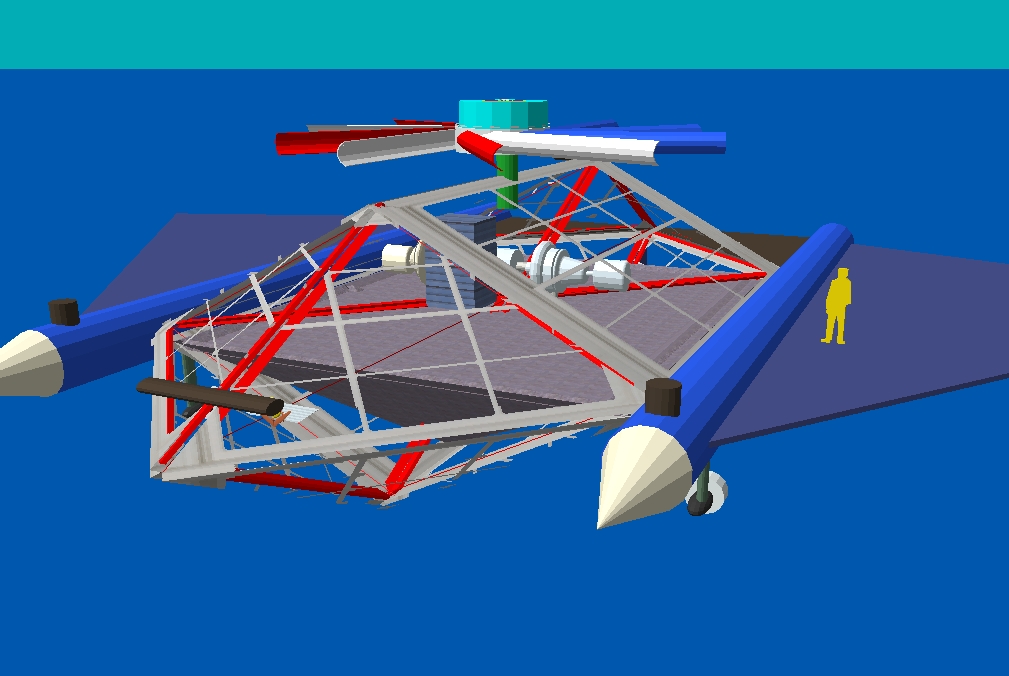
| While the ZENOC-NN power system is the centerpiece of the system, it is the Dragon robot that makes the system profitable on a large scale. Until now, renewable power systems such as wind and solar, were passive. They have to wait for the sun or wind to be available, limited to certain times of day, or year, when conditions are favorable and still limited by the vagaries of weather. The Dragon robot does not have this problem. A true, mobile marine vessel, it is able to make its own 'river' whenever it wants by diving. As it glides downward, the speed of its passing through the water drives a special bi-modal turbine which generates power and stores it in the thermal batteries. Once near the seafloor it drops its ballast and returns to the surface where it repeats the cycle, as often as needed until the thermal batteries are fully charged. |
|
|
| With a full 'charge' of thermal energy, it returns on its own to a shore station where the heat is directed to the ZENOC polyphasic engine, producing electricity. |
|
|
| Each Dragon can generate 8,812,800 kilowatt-hours per month. These can be stored and used as needed over a period of weeks, or released in a one hour, 24 Megawatt burst. The choice is yours. Once fully discharged the Dragon can return to a full charge in 2 or 3 hours. This means the Dragon can cycle anywhere from 3 to 6 times per day. |
|
|
| The Dragons are completely autonomous, which means they can perform their function day or night without direct human control. |
|
|
| When you amortize the power generated over the life of the machine, plus labor, the cost of generation is less than $0.02 per kilowatt hour. This is cheaper than coal or nuclear and it produces NO products of combustion or harmful discharges of any kind. |
|
|
|
Contact us at 610-564-6154 or |
|
|
|
[email protected] |
|
|
|
 |
|