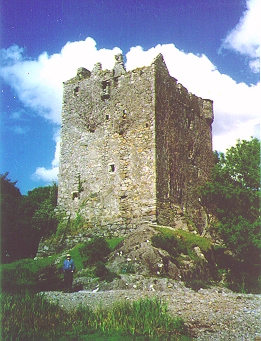
 Special thanks to Nada and William Arnold for the colour picture of Moy Castle!
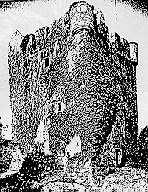
- The castle, in "Tower House" style, stands on a low rock platform at the head of Loch Buie. The site commands a wide prospect of the loch and a fertile plain on the landward side. The lack of natural defences on the landward approach was made good by the construction of a rock ditch to the NW and by the erection of a barmkin wall enclosing the an area to the SE of the castle extending 8.8m (29') from the north angle and 12.8 m (42') SE of the east angle of the tower. There is a boat landing some 36m (40 yards) from the tower.
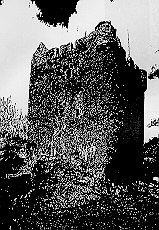 Much of the surviving fabric of the castle is first half of the 15th century, following acquisition of the lands from the Lord of the Isles in the last quarter of the 14th century by Hector, elder brother of Maclean of Duart. The castle first appears on record in a royal charter of March 1494.
Alterations and additions, confined mainly to the upperworks, were carried out about the turn of the 16th and 17th centuries and are attributed to John McLean or his son, Hector, 8th Chief of Lochbuie who died about 1614. In October 1690 the Laird of Lochbiue was obliged to surrender to the government and Archibald, 10th Earl of Argyll garrisoned Moy Castle with 24 men under the command of Colin Campbell of Braglen. It was abandoned as a residence about 1752.
Building materials of the original castle is schistose slabs quarried from Laggan, harled stone, and beach boulders, all laid with lime mortar. Quoins and margins to all openings are a fine-grained sandstone of greenish hue quarried at Carsaig on the Ross of Mull. Large blocks of slate paving for the parapet-walk were probably quarried from Ballachulish.
The north facing gateway was protected by an wooden door which in turn was guarded by a hinged iron grating or yett (now preserved at Lochbuie House)
On the ground floor a vaulted lobby immediately within the entrance doorway is served by a 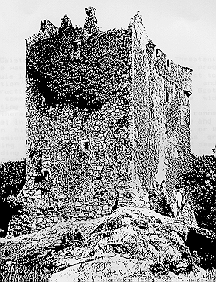 guard-chamber. The main ground-floor room is reached through a large doorway with pointed head and arched embrasure. Near the centre is the remains of a well with a stone shaft descending 1.2 metres (3'10"). Though cut into solid rock, the well always has water in it but never overflows.
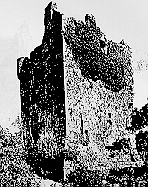 At the main first-floor is an impressive barrel-vaulted chamber which probably served as the main hall in the original arrangement. At the NE end of the hall appears to be a raised platform or dias. The hall is served by two original mural chambers in the diagonally opposed E and W corners. There is a garderobe and latrine-chute still visable on the SW wall. Near the angle formed by the two limbs of the chamber is a hatch providing the only access to a well-contructed pit-prison; 3.3m (10'8") in depth and 1.2 m (3'4") square at the base with tapering side walls, corbelled at the neck.
Spiral stone stairs and a short lintelled passage lead from the stairs to a long narrow apartment formed within the thickness of the SE wall, possibly intended as a bed chamber, though some historians claim it was used to hold the dead during funeral obsequies. The second level rooms are reached through a fine original doorway with ointed arched head composed of four voussoirs and the dressed surround uniformly wrought with a broad chamfer. The next two stories had their floors of wood though the walls are 2.2 m (7') thick.
Externally the most interesting features are in the upperworks of the tower where the parapet is battlemented with broad merlons and crenelles of deep and narrow proportions. Each turret is provided with small windows and smaller square openings, possible firing-apertures. A steeply raked loop with double aperture at the base protects the entrance to the castle.
 on the scale of 12 deer skins, which according to the legend, determined the size of the castle.