Septs and Tartans of the Clan
TABLE
OF CONTENTS
Please Note:
- "Mac" and "Mc" is simply Gaelic for "Son of". It in NO WAY represents if a family is from Scotland, Ireland, is Protestant, or if they are Catholic.
- Spelling variations differed widely for a number of reasons (personal choice, bad spelling, or to differentiate a family branch). A good example of this is William Shakespeare, who spelled his own name with over ten variations!
- Any member, including ALL the different Septs of the Clan Maclaine of Lochbuie are entitled to wear any of the Maclaine tartans.
- The following descriptions are compiled from numerous sources and are by no means complete. If you have any comments or information that you would like to contribute, please e-mail it to
[email protected]or any of our other Contact Names.
Click here to download a compressed file containing the Maclaine clan tartans, badges, castle, etc,....

Other Spellings:
Clean, Cle�an, Gellion, Gilhon, Gillan, Gilland, Gillane, Gilleain, Gillean, Gilleoin, Gill�E`oin, Gilleon, Gillian, Gillon, Gill� Sheathainn, Gillzean, Gilzean, Gilzeane, Giolla-eoin , Lain, Laine, Lane, Layne, Lean, Mac a Leathainn, Macclane, Macclean, Maccleane, Macclen, MacGilleathain, Mac Gille E` oin, Macgillane, Mac Gill� Sheathainn, MacIlleain, MackCleiden , Mackcline , Mackelein, Macklain, Macklan, Macklane, Macklayne, Macklen, Maclane, Maclean , Maclein, Maclyn, Macolean, Makclane, Makclayne, Makclean, Makcleane, Makclen , Makeleen , Makelyne, Makgillane, Makgilleoin, Makgilleon, Makgilleone, Makgilleoun, Maklane, Maklayne, Makllane, Malynne , Mcgilleoune, McIlaine, Mcillaine, Mcillayn, Mcillon, McKlane, M�Clan, M�Clane, M�Clayne, M�Clean, M�Cleane, Mclen, Mclene,
Mcoleane, M�Gilhon, M�Gillayne, M�Gilleoin, M�Gilleon, M�Gilleone, M�Gilleoun, M�Gillichean, M�Gillon, M�Gilloyne, M�Gleane, M�Illclayne, M�Killeane, M�Klane, M�Klayne, M�Klin, M�Layne, M�Leand, M�Leane, M�Len, M�olane, M�Olean, M�Olaine, M�Olloine, V�Oleane
There are two main branches of the Maclaines/MacLeans, those of Lochbuie and those of Duart. The clans were vassals of the MacDonalds, Lord of the Isles, and in their own right controlled Mull, Coll, Tiree and on the mainland, Morvern, Ardgour and Kingairloch.
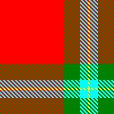
 Mull Island (District) tartan
The name Maclaine comes from the Gaelic "Mac Ghille Eoin", "Son of the servant of (St) John". Maclaine of Lochbuie is known in the Gaelic appellation as "Mac'ill-Eathain Lochabuidhe". The Clan is sometimes referred to as "Siol Eachainn", meaning "Children of Hector" or as "Sliochd Mhurchaidh Ruaidh", meaning "Children of Murdoch the Red (or Roy)". Murdoch the Red was second Chief of the Clan.
Maclaine of Lochbuie, Dress.
The Maclaine of Lochbuie dress tartan dates back to at least the 18th century, and is found in many earlier collections.
J.P. Maclean, in his noted publication, went to great length to argue that the only correct spelling of the name is "MacLean". This has no evidence in history, as the name was spelled in a variety of different ways in the past by many Chiefs. The original Gaelic name has been Anglicised, and the families used the form that was eventually settled upon by their ancestors. If there IS a correct form of the name, it is more likely "Gillean" or "MacGillean", both of wich go back further as historical fact.
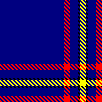
Maclaine of Lochbuie, Hunting.
The Maclaine of Lochbuie hunting tartan is known to have been in use during the later years of the nineteenth century. It was first published in James Grant's work, in 1886. D.W. Stewart points out that the use of so much light blue is unique among old tartans.
 Maclaine, Hunting (circa 1906). Note that this tartan lacks the black stripes that flank the yellow stripe.
Other Spellings:
Fadyen, MacFadyen, MacFadin, MacFadion, MacFadwyn, MacFadyean , MacFadyon, MacFaddien, MacFaddin, MacFadzan, MacFadzean, MacFadzein, MacFadzeon, MacFayden, MacFeyden, MacPaden, Macpadene , MacPhadden, MacPhaiden, Makfadieane, Makfadzane, McFaddan, McFaddin, McFadzen, McFayeane, McFydeane, McKfadyean, McPhadan, McPhaddion, McPhaden , McPhadzen, McPhaiden, McPyden, McSpadden, M�Faden, M�Fadzean, M�Fadzeane, M�Fadzeans , M�Fadzeon, M�Faggaine, M�Fedden, M�Phaden, M�Phadden, Phaidean, Paton, Padan, Padon, Padyen, Patein, Pateman, Paten , Patone, Patonson, Patonsoun, Pautoun, Patoune, Patoun, Patowne, Patovnson, Pattinson , Patynson, Patten, Patton, Pattoun, Pattoune, Pattounsoun, Pattowsone, Pawton, Pawtonsoun, Pawtoun, Pawtoune, Pedan, Peden, Pedin, Pedden, Petensen, Pethein , Pethin, Patenesone, Peathine
From the Gaelic "MacPhaidein" -- "little Pat", meaning son of Paidin, a diminutive of Padraig (Patrick). The name is first recorded in Kintyre in 1304. The McFadyens were the original owners of the lands at Lochbuie. They are also known as "Sliocht Nan Or-Cheard", "The Race of Goldsmiths" on the Isle of Mull.
The McFadyens are a very old tribe. They were the first Sept to join the Maclaines, although under dubious circumstances. It is a tradition that the McFadyens were the first owners of Lochbuie. When Hector Maclaine went to claim the lands given to him by the MacDonalds, he found the lands already under the possession of the McFadyens. For mutual protection (from various raiders and neighbouring tribes), the McFadyen Chief granted him permission to build a fortalice at the head of Lochbuie. After the castle was completed, Maclaine used the Castle to wage war on the McFadyens! Legend says that Hector climbed to the top and shot an arrow through a bone that the McFadyen Chief was eating. Not being foolish, the McFadyen Chief removed himself from the scene. Whether Maclaine was aiming for the bone, and hit, or at McFadyen, and missed, is a matter of speculation (and perspective).
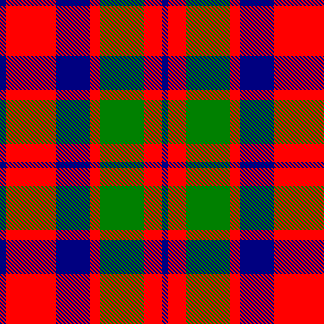 McFadyen Dress.
This version is from mid 19th century records of the Inverness Tweed Mills, Inverness, now Pringles of Inverness. The late Miss Margaret MacDougall wrote: - "Beside the pattern is a note 'This piece of tartan was made at the time of Culloden. DMcD'. This appears to be Macdougall of the Tartan Warehouse - as it appears to be his writing and initials."
The McFadyens had a reputation for parsimony (being cheap), whether they deserved it or not, as in the following bitter little satire current in Mull, Tiree and Islay: "McFadyen of the hen in the homestead of penury: though he stayed til she was boiled, he stayed not til she was eaten - for fear of paying for her." -- "Black's Surnames of Scotland", 1946, pg. 492,
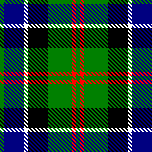 McFadyen Hunting
Thread count taken from a coarse kilt in the possession of Dr. John MacFadyen of Stirling. The material was handwoven and made by a weaver in Rogart
Many McFadyens moved to the Colonies, settling in such places as Victoria County, Canada, or to the United States, New Zealand, and Australia. Some became farmers -- one of the largest seed companies in Canada is named after them -- and others were blacksmiths, merchants, teachers, etc,... The name McFadyen is still common on Mull, Islay, and Tiree.
There is a Patoun(Patton) Stature in the square of Glascow -- one of eight beheaded by
Mary, Queen of Scots for being Presbyterian.
In 1975, Elizabeth McFadyen, (BA'63, LLB'64) was the first woman to serve on the Federally-appointed District Court of Alberta, Canada. Upon its amalgamation with the Court of Queen's Bench in 1979, McFadyen was appointed to the Queen's Bench. In 1993, she was appointed to the Court of Appeal, the highest court in Alberta.

Other Spellings:
Cormac, Cormack, Cormacus, Cormag, Cormick, Cornick, Cornock, C`ormaic, Cramick, Cramik, MacC(h)ormaig, MacCormack, MacCormaic, MacCormaig, M�accormick , MacCormok, MacCornack, MacCornock, Makarmik, Makcormak, Makcormok, Makcornak, Makcornik, McArmick, McCarmick, McCarmike, McCormick, McCormok, McCornak, McCornick, McCornock, McCornok, McKermick, McKornock, M�Comok, M�Cormick, M�Cormock, M�Cornock, M�Cronock, M�Gormock, M�Kernok, M�Kornok
From the Gaelic "MacChormaig", meaning "Son of the charioteer". The MacCormicks relocated from Lochbuie to Ireland in the 1700s as part of the Ulster Plantation, settling in the Derry area. There is evidence that MacCormicks accompanied Ewan, 6th Chief of Lochbuie, on his return from Antrim to Lochbuie to recapture Moy Castle. As a result, there is an enscription above the door of Moy Castle reading "Biadh is deoch do MhacGormaig" or "Food and drink for MacCormick".
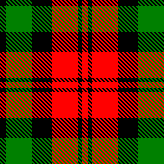 MacCormick Tartan
The MacCormick Tartan was registered with the Scottish Tartans Society in 1985 but is assumed to be older. It was derived from a piece in the Pendleton Mills sample book.
James MacCormick of Londonderry was a signer of the "Gentlmen's Appeal to William and Mary" on the seige of that city. Another famous MacCormick was Cyrus Hall MacCormick, the inventor of the first practical reaper, whose descendants founded the International Harvester Company. Queen Victoria had as her piper Calum Beag MacCormick.
There is a Chapel MacCormaig (Church of St. Charmaig) on the Isle of Eilean, at the mouth of Loch Sween. Mor MacCormick (Eilean Mor ui Charmaig in Gaelic), is owned by the Scottish National Party. The early and medieval Christian monuments and site on the island are under the guardianship of the Ancient Monuments Branch of the Scottish Development Department.
From "Mac a' bhuidhe", translated as "son of the yellow (haired) lad".

Other Spellings:
Bea, Bey, MacBey, MacVay, MacVeagh, MacVeigh, MacVey, M�Ba, M�Bae, M�Bay, McBea, McBee, M�Vay, M�Veagh

Other Spellings:
McPhetridge, Macfatridge, MacFedries, MacFedris, MacPedderis, MacPheadruis, MacPhetrish, MacPhetruis, Makfedderis, McFetheris, McPeteris, McPhedrice, McPhetrus, M�Fatridge, M�Federis, M�Fedreis, M�Phedreis
Gaelic for "Son of Peadrus (Peter)"

Other Spellings:
Gilivray, Macgillavery, MacGillevoray , Macgillivrie, Macgillivry , Macgillvary, MacGillvray, Macgilvary, Macgilvery, Macgilvra, Macgilvray, Macillevorie,
MacIloray, Macilvray, Makillewray , Maolbhrath, McGillavrach , McGillievraid,
McGillivray , McGilvra, McGilwrey, McIliwray , Mc illura , McIlra, McIluray,
McIlverie, McIvery, McIlvora, McIlvrach, McIlvrae, McIlwray, M�Gillevray,
M�Gillewra, M�Gillowray, M�Gwillwray, M�Ivra, M�Ilvray, M�Ilwra, VcGillevorie, Macilvoray, Macolvorie, Malcovorie , McIlvoray, McOulvorie, M�Ilworrie, M�Ilvorrie,
From "Macgille bhrath", translated as "son of the servant of judgement". The original home of the MacGillivrays was on the Isle of Mull. The main MacGillivray settlement was in Glencannel, north of Lochbuie. Murdoch Maclaine (known as 'the Short') who escaped from the Duarts to Glencannel was raised by MacGillivrays.
Some of the clan moved north to start a branch in Dunmaglass, Strathnairn. They became among the first members of Clan Chattan. The Laird of Dunmaglass and his brother fought on the Jacobite side in 1715 and at Culloden in 1746. Like the Maclaines/MacLeans, it is up to their family history -- or personal preference -- as to which group they choose to follow. Either way, they are more than welcome in any of the clans.
MACILVORA is believed to be an offshoot from the old Clan Gillivray.
The Beatons, hereditary doctors for the Isle of Mull were located at Pennyghael, north of Lochbuie.
Other Spellings:
Blac, Blacke, Blackie , Blaec, Blaecca, Blaick , Blaiky, Blaikze, Blak, Blakie, Blaky,
Blakye, Blakyie, Blayk, Niger
Old English: (personal name)
Other Spellings:
MacIldowie, Dowie, Dowy, Clandaindouey, Gilleduf, Huie, MacAlduies, Macgildhui,
Macgilladubh, MacGilledow, Macgillewey, MacGillewie, Macgilliduffi, MacGilligowie, MacGilliue, Macildowy, MacIldue, MacIduf, Macilduy, Macilghuie, Macilguie, MacIlzegowie, MacIlzegui, MacIlldowie, MacYelewe, Mackegilduf, M�Ahoy, Makgillevye, Makgillewe, Makgillewie, McAhuies, Mcgildui, McGilewe, McGillewe, McGilliewie, McGilligowy, McGillivi, McGilliwie, McHui, McIlewe, McIlhoy, McIlleve, McIllezuie, Mcilliduy, McKeldowie, McKleduffe, Meiklduff, M�Gilavie, M�Gilevie, M�Gillewie, M�Gillewye, M�Gillizvie, M�Gilvie, MickeIlduff, M�Ildeus, M�Ildoui, M�Ilduff, M�Ilguie, M�Ilguy, M�Illewie, M�Illhuy, M�Malduff
From "Mac Gille dhuibh", translated as "Son of the black lad"
Other Spellings:
Clanichan, ClanEachainn, Eachainn, Echan, Eechan, Eichan
From "Clan Eachainn", or "Clan of Hector".
TABLE
OF CONTENTS