
Lesson_5
Many laymen are familiar with the term, "complex" from televised shows on clinical psychology. Chaplin points out however, that "...the concept does not necessarily carry the implication of abnormality and may be used to characterize associations of desires, impulses and sentiments which occur in normal persons".
Indeed, it is helpful to study complexes from an inter-species perspective which is what the psychologist often calls "comparative psychology". When we compare various animal species, we see complex behavioral patterns, each of which is related to some aspect of goal-directedness. Consider the particular expressions related to each of the following collections of behaviors, some of which may be more strongly represented in some species rather than others. Try to imagine how these behaviors are manifested in fish or reptiles or birds or mammals:
Gregariousness
Mastery-Dominance
Pain Reduction-Avoidance
Exhibitionism
Acquisitiveness-Hoarding
Sexuality
Nurturance
Succorance
Curiosity
Play
Destructiveness
A good exercise would be to discuss some examples of these from your observations of various species on IMP. Can you think of REWARD and PUNISHENT COMPLEXES other than those above? Which do you think is most important in humankind?
SELF-ENHANCING/SELF-REDUCING
One broad way to categorize these complexes is in terms of whether they have an outcome which is enhancing or diminishing to the self. Are they "self-actualizing" or not? Either reward or punishment complexes may be self-enhancing or self-diminishing. Of course there are many self-theories in philosophy-psychology.
Some would even suggest that the self must be destroyed in order to "transcend" the limitations of this world, to "overcome" if you will. But these philosophies or religions must face the prospect that this greater, transcendent self is still in a realm which has the same overall framework of reward-punishment circumstances, even if the particulars are changed greatly. The major religions all seem to have a notion of Paradise of which BF Skinner would highly approve, ie reward without any elements of punishment: the great Skinner Box on high if that is not too irreverent.
PRIMARY and SECONDARY
Rewards and punishments which pertain to that which is innate or inherent are called primary. Food is a primary reward and the acquisitive squirrrel may hoard nuts and seeds. The aquisitive human probably prefers to hoard money, a secondary reward. Secondary rewards and punishers are those which are DERIVED from their primary counterparts. I will say "derived" rather than "associated" because the term association implies a theory on how these secondary rewards and punishers may come about. ASSOCIATION LEARNING, also called Classical Conditioning, is not necessarily the way secondary rewards and punishments are developed because we humans have cognitive abilities which are quite powerful compared to those of animals. An animal may not learn to avoid a hot electric stove plate unless it is associated with certain "discriminative stimuli" or "cues" to tell it that painful heat is present. Such a secondary stimulus may consist of the coiled visual stimulus of a stove plate. But a human can learn by cognitive means, eg by reading a manual on stove operation. The human does not need to experience the pairing of coil and pain.
Stimuli which increase habit strength are categorized as primary and secondary rewards or reinforcers. Stimuli which reduce habit strength are called primary and secondary punishers. A complex may include various combinations of these elements. For example, a behavioral pattern of mastery-dominance may include accepting a rigrorous and punishing training regimen to master football. Some of the punishing stimuli may be primary and some may be secondary. A tackle for example is sometimes a painful primary stimulus while the sight of a tackling player coming toward you is a secondary punisher. A cool glass of water after a game is a primary reward but the money received is a secondary reward.
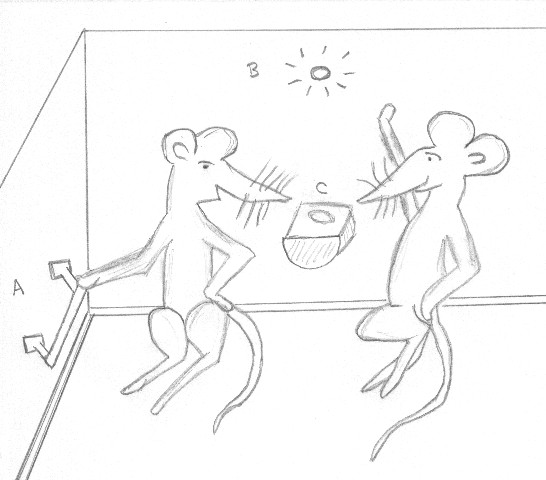
A= Operand (operant behavior, ie bar pressing)
B= Discriminative Stimulus
C= Reinforcer (food pellet)
Subjects are as illustrated.
Since the Skinner Box can be totally automated, it constitutes an autonomous teaching machine.
Rewards and punishments are usually delivered according to schedules or timing of administration. There are four schedules: FR, VR, FI and VI. Fixed ratio (FR) schedules deliver the reward/punishment after a fixed number of responses, eg every 50. Variable ratio (VR) schedules deliver after a variable number of resposnes, eg 50 +/- 10 with random variations around the average of 50. FI schedules deliver the rewarding or punishing stimulus after a fixed time interval. The fixed interval, FI, may be every 24 hours, for example. VI administration may be 24 hours +/- 2 hours.
Again we must recognize the difference between humans and lower species because of human cognitive ability. The animal about to receive a food reward after 24 hours of food deprivation will start responding vigorously, eg by bar pressing in a Skinner Box, as the 24 hour time approaches. This response pattern is called the "FI Scallop" from the pattern it exhibits when graphed out. But a human about to receive mail may do no such thing, simply setting a clock-timer for the 24 hour mail delivery and responding otherwise only when the 24 hours is up by going to the mail box. There may be little or nothing in the way of anticipatory responding. The animal does not have the cognitive ability to precisely measure time while the human does have this ability.
PARADIGMS
Chaplin defines a paradigm as "a model or pattern which demonstrates all the possible functions of what it represents." The paradigm includes all of the considerations above and it includes the physical setting in which teaching-learning takes place. The Maze is such a paradigm; so too is the Avoidance Conditioning Apparatus, the Skinnner Box...and the Digital Teaching Machine.
TRANSCENDING REWARD and PUNISHMENT
Arguably there are some humans who can transcend reward and punishment as they act on principle. However, the reminders above on the over-riding power of cognition have to do with something else. Cognition in humans may over-ride the lower order (in a species sense) schedules of reinforcement and lower order association learning. That is not an over-riding of the overall framework of reward and punishment or the reward-punishment complexes. Our cognitive abilities still serve the objectives of reward and punishment.
Like it or not, this is our essence, an essence we share with the other animals and there seems to be no escaping it except to become machine-like.
***********************************