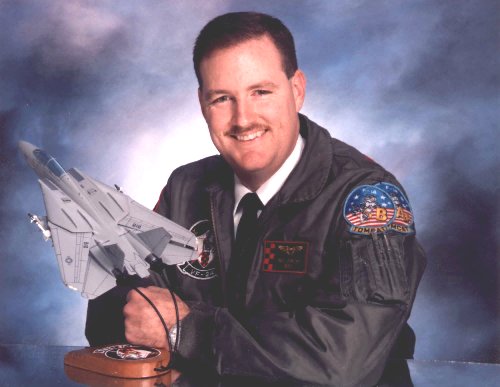
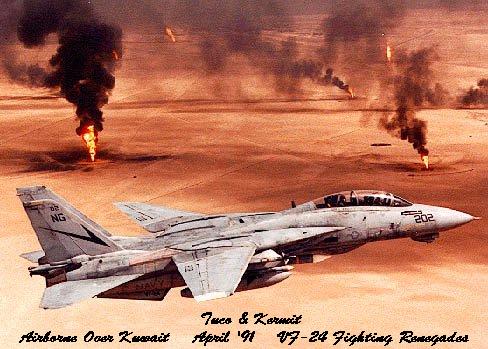
My name is LCDR "Bugs", otherwise known as mach1bugs. I was a friend and classmate of Keith's through AOCS (Aviation Officer Candidate School - Keith was one class behind mine) and through Basic Flight Training at NAS Pensacola, Florida in 1988. At advanced flight training, he went into the BN pipe-line for the A-6 (obviously) and I went into the RIO pipe-line for the F-14 Tomcat. Before his partial ejection, I had not seen or heard from him since flight school. In July of 1991. I was a Lieutenant Junior Grade (LTJG) in the VF-24 Fighting Renegades assigned to CVW-9 aboard the USS Nimitz deployed to the Persian Gulf. We were near the end of our tour in the Gulf waiting for the USS Lincoln to relieve us on station. And so begins my addition to the story...
While we were in the Persian gulf, we followed the progress of the USS Lincoln as it slowly made it's way across the Pacific to relieve us. It had stopped along its way to aid in the evacuation after the eruption of Mt. Pinatubo. Could that have been a warning? After it left the evacuation operation, some very bad things started to happen on and around the USS Lincoln that concerned us as well as the entire Naval Aviation Community.
The first incident occurred on Saturday, 29JUN91 during an Air Combat Maneuvering (ACM) or dog-fight training flight which launched from the deck of the USS Lincoln. In fighter aviation we practice ACM regularly and always brief a minimum safe separation between aircraft. This distance was usually 500 feet and referred to as the "500 foot bubble." On this flight, two Tomcats went well inside this bubble and had a severe mid-air collision. They struck in a slightly offset canopy to canopy orientation where the vertical stabilizers of one aircraft tore off about 12 feet of one wing from the other aircraft. The second aircraft was able to limp into an airport in Singapore where it landed safely - there was no way it could have recovered aboard the ship. The first aircraft was not quite so lucky. With no vertical stabilizers, it had almost no yaw control and began to spin out of control. Not only that, the aircraft was on fire - in the cockpit! The RIO ejected the crew by reaching down into flames to initiate ejection by the lower handle. The RIO and Pilot both had a successful ejection and were soon recovered and returned to the USS Lincoln. As it turned out, all four crewmen were safe, but the VF-213 Black Lions had lost two aircraft and four aircrew until they recovered from their minor injuries and completed the accident inquiries.
Soon after this incident, the other Tomcat squadron aboard the USS Lincoln had a mishap. On Thursday, 04JUL91 the VF-114 Aardvarks had a maintenance troop working in the cockpit of a Tomcat on the flight deck who somehow managed to jettison the canopy - while it was open! This was something we at that time didn't think was possible. This may not sound like a big incident, but the canopy landed on the deck and could very well have caused someone serious injury. It was at this time we on the USS Nimitz began talking about a bubble around the USS Lincoln - a bubble we soon began referring to as the "Bubble of Destruction."
It wasn't long before the Bubble of Destruction was confirmed. On returning from a training flight on Monday, 08JUL91, another Tomcat from VF-213 arrived in the overhead traffic pattern to enter the "break" and land on the ship. The break turn is used during Case I VFR (Visual Flight Rules) recoveries as the most expeditious way to get aircraft back aboard the boat. An aircraft will approach the ship from the stern at high speed and do a hard 180 degree turn to the left overhead the ship to bleed off airspeed and move into a landing configuration. Besides being efficient flight ops, it looks really cool! For the Tomcat, this means coming in at about 350 to 400 knots (or faster) with the wings fully swept back at 68 degrees. Since this is nowhere near supersonic, the wings must be swept aft in the manual mode and placed back out to 20 degrees for landing as the aircraft slows in the break turn. As this Black Lion entered the break turn, he was coming in fast and looking good, but as he began to slow down, trouble started. For some reason, the wings did not sweep back out. With the wings aft, the Tomcat can barely hang in the air at speeds less than 200 knots, much less the 135 knot average approach speed. The aircraft began to stall and rock and for some reason the pilot did not realize that it was due to the fact that the wings were still aft as he slowed down. Unable to control the aircraft, the crew ejected and were safely recovered. Strike three for the "Bubble of Destruction."
It was the very next day, Tuesday, 09JUL91 that Keith Gallagher's partial ejection occurred. We on the USS Nimitz were soon wondering how large this Bubble of Destruction was and what would happen as it passed over us. Our concerns were soon met with reality - on the night before the USS Lincoln relieved us in the gulf. The Bubble of Destruction was given dimensions - the "500 Mile Bubble of Destruction."
It was our last night of operations in the gulf and the Tomcat and Hornet squadrons were flying their last night sorties of Operation Southern Watch patrolling in Kuwait and Saudi Arabia along the Southern borders of Iraq. It had been a long night and everyone was looking forward to seeing the USS Lincoln the next day as we began our exit of the gulf and the journey home. A section of two F/A-18 Hornets were returning from one of these long missions for a night recovery. One of the two aircraft had a system malfunction which had degraded his cockpit displays to what is referred to as "partial panel." This meant that instead of getting all his information through the HUD (Heads up Display), he would have to scan the actual instruments down inside the cockpit to check airspeed, altitude, rate of descent, etc as well as scan outside the cockpit for line-up and glide-slope information. This task was quite a challenge for Hornet pilots who had become accustomed to always getting this info through the HUD without having to look inside the cockpit. The final approach for a carrier landing happens very quickly and as this pilot approached the ship, he took one last scan inside at the instruments. When he looked back outside, he saw that he had drifted far too low and was about to strike the round-down on the aft end of the landing area. Amid frantic calls from the LSO's for more POWER, the pilot throttled up to full afterburner, but still struck far short of the landing area. His main landing gear hit about 8 feet down on the angle before the horizontal surface and his tail hook caught the safety net that rings the flight deck. The right main landing gear was torn off as well as the aft burner section from the right engine, but amazingly the tail hook remained intact. Had the pilot known this fact, he might not have initiated the next series of events.
The aircraft was sliding down the deck in full afterburner on two wheels and leaning hard to the right. Thinking that there was no way his tail-hook could have survived and that he was about to slide off the end of the landing area into the ocean, he initiated ejection and departed the aircraft. Since the tail-hook had survived and luckily had released what remained of the safety net, it was able to catch one of the arresting wires and brought the aircraft to a stop. The pilot got a good parachute which slowed him just in time to land back on the deck near the LSO's. Since there was about 30 knots of wind over the deck, his chute remained inflated and began to drag him aft toward the deck edge. The LSO's managed to catch him and deflate his chute in time to keep him from going for a swim. Now back to the aircraft.
Yours truly, LTJG Bugs, was watching TV in his stateroom which just happens to be right below the flight deck at just about the position that aircraft stop when they catch a wire on landing. It's normal for aircraft to power up on touchdown just to ensure that they will be able to fly away if they miss all the wires, and they don't throttle back until they come to a complete stop. Needless to say, as aircraft land and stop, the noise was deafening in my room until the aircraft throttles back. This night was no different until one aircraft landed and stopped, but left his throttles at full power, just sitting there right over my head. I changed the TV channel to the PLAT which showed a live view of the flight deck and saw this F/A-18 sitting there with no pilot, no canopy, and leaning over with full afterburner flames shooting right onto the deck. The next instant, the ship went to GQ (General Quarters) and I headed down to the Ready Room.
On the flight deck, the firemen were instantly energized to start dowsing the live missiles still on the Hornet to ensure they didn't overheat. They also tried to snuff the engines by shooting water down the intakes with multiple 2.5 inch high pressure water hoses which had absolutely no effect - very impressive! Finally, a brave fireman climbed up to the cockpit and pulled back the throttle leavers to kill the engines. On the deck behind and around the Hornet were strewn aircraft parts. We lost one Hornet that night, but the pilot was safe with minor injuries.
This all happened just hours after the USS Lincoln came within 500 miles of our position that night. Thus, the "500 Mile Bubble of Destruction" surrounding the USS Lincoln was officially dubbed by our certainly unofficial group of fellow tactical aviators.

 home page.
 to mach1bugs' site!