| AUSTIN'S STORY |
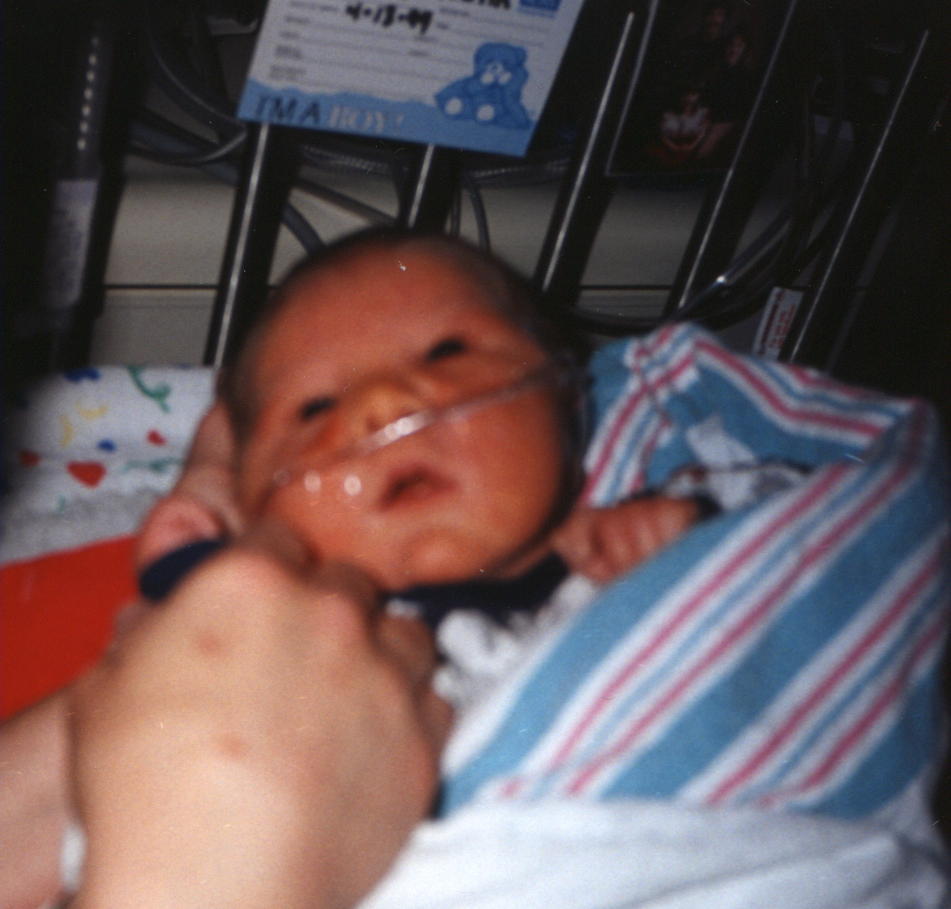 |
| Austin on 4/13/99-shortly after birth |
| When Austin was first born, we had no idea that anything was wrong. All my prenatal tests came back normal and the ultrasounds looked good too. In fact, I had two ultrasounds because when he ordered one at 16 weeks the placenta was partly over my cervix. The physician said that sometimes this happens and it usually moves up. Then at 20 weeks, I had another ultrasound done and it showed the placenta was higher in the uterus and the baby's features and movement looked normal. The only thing different with this pregnancy was that I had a lot more heartburn and the fetal activity was decreased; however, I still felt him move the 5-10 times in an hour like they tell you to keep track of; I did mention it to my physician and he said just to keep an accurate record of fetal movement. If I did not feel at least five types of movement in an hour, I was supposed to let him know. On April 13, 1999, I arrived at the hospital at 8:00am, because my blood pressure had been running high and I had a trace of protein in my urine. My OB/GYN decided that we would go ahead and induce my labor since it was only a week before my due date. At 11:32am Austin was born, I knew something was wrong the minute I saw and heard him. I kept asking , "S HE OK!! IS HE OK!!" The Physician tried to keep me calm and stated he was breathing and pinking up. This is where I thought my world was falling apart and just couldn't believe that this was happening to us. I kept asking why us God to myself. Austin was 6lbs.10oz., 20 inches long and I was 39-week gestation.� His APGAR score was 5 and 8;�� he required stimulation and oxygen, and they had to give him Narcan.� His muscle� tone was very low.� His cry was very weak and almost pathetic sounding, and at times had inspiratory stridor (to describe this sound would be like listening to someone breathe that has something wrapped tightly around their neck.)�� Especially when his neck was stretched back. Well when the initial shock wore off, I just thought and prayed for Austin to make it.� The first night was the longest and most stressful time of my life.� Because Austin had to be in the NICU,� of course I could go see him whenever I wanted, but it just wasn't the same as being in the same room with him. Well Austin made it through the first night but not without any problems, his muscle tone didn't get any better; in addition, he wouldn't try and eat at all because of his difficulty breathing when trying to nurse. ��� He also had contractors of both hands in which the last three fingers on his hands were effected, and he had a left clubfoot. His blood glucose level was running low so they had to give him formula through a nasogastric tube. Then during the night of the 13th, he started running a sinus tachycardia with heart rates in the 280-290's for, which resolved by itself and we never did find out the cause of that. � So the next afternoon our pediatrician decided to send Austin to a third level hospital, which is the� University of Iowa, this is about 3 hours away from Ames.� The reason Austin was transferred was because his skin color was worse and because of his one spell of rapid heart rate.� Therefore, the physician started IV fluids running and decided to give him a dose of antibiotic, Ampicillin. His cry remained� high-pitched stridor and very weak, with retractions of the ribs. We arrived at the University Hospital about 10:00pm on 04/14/99, Austin was immediately taken into the NICU for tests.� Upon arrival to the hospital in Iowa City, he received an echocardiogram, which was reported as normal. They placed him on oxygen to keep up oxygen saturations. � The pediatric otolaryngology physician was consulted and reported finding mild laryngomalacia (Softening of the tissues around the larynx), and bilateral true vocal cord paralysis. A request by the ENT physician was that they would like to do a MRI and see if there was any malformation of the brain and brain stem, to rule out Amold Chiari or other malformations. ��� Also Pediatric Genetic physician was consulted and requested a skeletal survey which was normal. Genetics also requested a retroperitoneal ultrasound, which showed normal renal anatomy. The MRI showed no evidence of Arnold Chiari, but was notable for the presence of an atrophic cerebellum (underdeveloped cerebellum). Ophthalmology consult was done which showed no ocular problems. When they discovered that he had an underdeveloped cerebellum. Other tests performed on the recommendation of Genetics were: ����� 1)��� Serum ceruloplasmin-low ����� 2)��� Serum Copper-normal ����� 3)��� plasma amino acids-slight increased tyrosine ����� 4)��� Serum very long chain fatty Acids-normal ����� 5)��� Carbohydrate deficient transferrin-normal ����� 6)��� Spinal muscular atrophy DNA-normal. ����� 7)��� Chromosomal tests-normal � Then Pediatric neurologist was consulted which requested an auditory brain stem potential, which Austin failed the preliminarily test, but later passed. Iowa Neonatal Screen was also done,�which was also normal. � All these tests listed above were performed during the dates of 04/14/99 through 04/29/99, which was when we finally got to bring Austin home for the first time. During our hospital stay, Austin never did well with feeding from a bottle. He would only take about a 1/2-ounce each feeding. Then we had to feed the rest through a Nasogastric Tube. However, since I am a registered nurse, they let me go home with NG feedings. He started eating from the bottle more and more each feeding at home and went completely off NG feedings on 5/17/99 and remained off for approximately 3 weeks.� However, the physician thought that he was not gaining enough weight so he wanted me to add formula to the breast milk to add calories.� Well,� that was a big mistake and I wish I had never done it because from then on everything went down hill. That summer we battled with Austin having GI Reflux really bad and low weight gain.� We tried every kind of medication for GI Reflux and every kind of formula, on the shelf and specially ordered from the pharmacy.� We did end up with Carnation Good Start being the best for Austin.� The reason I say this is because the nutritionist at Iowa City stated the Carnation Good Start was closest to breast milk and easily digested. So that summer I spent alot of time holding Austin and searching on the Internet for answers about several different problems.� I researched everything that had to do with muscle disorders and cerebellum hypoplasia.� Just looking for anything to help my son.� � On August 25, 1999, Austin had completely quick taking the bottle and almost the pacifier. I got some information from AEA OT therapist that had a New Visions web site with tons of information for kids with feeding disorders and ways to help with their feeding problems.� It also stated in there that if you push a infant to hard and cause discomfort, such as putting a NG tube inside their nose that they will eventually shut down with their mouths. We than decided to get a Gastrostomy feeding tube placed and a Nissen tie (tie something around the top of your stomach to help strengthen the reflux muscle.) This prevents GI Reflux get better and also helps to keep him from aspirating fluid into his lungs. On August 31, 1999,� we decided it was time for a Gastrotomy tube and Nissen tie. So we could get him to gain some weight and also to help with the reflux.� Well that didn't help much because he became an air swallower.� So as we were feeding him, he would also swallow air and make himself miserable and bloated. September 1999-When Austin had surgery they had put a G button in,� which is called a Bard Button. I'll tell you one thing if anyone ever has to have a gastrostomy button put into a child, I would highly recommend the Mickey button.� The reason I say this is because of the way the physician's have to replace the buttons.� The Bard Button, what they do is basically have to yank the button out because the tool that is used to straighten the button out so it can come out more smoothly has to be used cautiously, due to the risk of the tool puncturing through the button and straight into the intestine, which could cause major damage.� The Mickey buttons are much more convenient and look a whole lot smoother when changing them.� They are designed with the idea of a� foley catheter.�� The straight tube is lubricated with KY jelly and inserted to the stoma and than there is a valve on the side of the button where a 5-cc syringe is attached and then 5-10cc is inserted and a balloon is inflated.� This is what holds the button in place.� It's so simple of a button that a parent can change them.� Just make sure you always have a spare button at home in case the balloon part breaks, then you can replace it, right away. Austin was still crying� everytime I fed him like he was in pain because of his stomach being� to full.� I asked our pediatrician if it was possible that it could be from reflux.� I even went to the extreme of video taping Austin during one of his feedings to give to our Pediatrician to watch.� Our physician watched the video and told me Austin did not turn blue and he didn't appear to be having seizures but he did appear to be tightening up and crying in discomfort.� But he stated that may be caused by his neurological disorder and that may be just the way Austin is. I explained to him that just because he has the Nissen tie� doesn't me that the reflux is gone.� It could be like a pop bottle that has carbonated pop in it and if� you were to shake it up with the lid on and you would be able to� feel the bottle's pressure building.� This could be what was happening with Austin.� The reflux is causing pressure on that new surgery incision and causing pain and discomfort, because the fluid has no where to push up and out, which causes it to apply pressure and pain. My husband and I even went to the extreme of designing a feeding device that would allow the air to come out of Austin's stomach and feed him at the same time.� So what this device looked like was a Y tube, so that there was three openings 1) attached to Austin's Mickey button 2) hooked to a tube that we attached to an IV pole and the 3) tube went to an extension to the feeding pump. October 1999- Started going to a cranial-sacral Physician of Osteopathic Medicine.� She is trying to shape and mold the skull plates so that his head is more normal shaped.� I noticed after a few weeks of the cranial sacral therapy that Austin's palate of his month was actually coming down. November 1999-� We got the test results that Iowa City had shipped off to the Rainbow Children's Hospital in Cleveland and the genetics physician stated that Austin did have the Mitochondrial disorder.� So they wanted to try him on a experimental drug in which they called it an enzyme cocktail which included several vitamin and enzymes and started Austin on this three times a day. On Oct 12, 1999, we went to an ENT physician, and he looked at Austin's Vocal cords with a scope and told us that his vocal cords are now moving normally. The reason he has a stridor breathing is due the laryngomalacia. Which he should grow out of by 12-18 months old. On 10/31/99, I felt Austin was gradually getting worse so we went to ER, and the physician checked him out and sent us home. I felt he needed to stay but he said just to take him into the clinic the next day and see our primary physician. It wasn't all doctors visits and terrible times. Austin had the best life we could give him. I would decorate the house up with streamers, lights and shiny ornaments across the ceiling and all around the room. He had PT, 3 times a day, and every night I gave him a bubble spa bath and then massage him with baby lotion. And of course we were always taking him outside for bicycle rides in the bike tote along or walks if the weather permitted. His sister, Mary did a lot of playing with him and also helping do things. He was always a happy little boy or tried to be. He loved to be held and that's what we did most of the time was hold and love him as much as we could. In December 1999, Austin was admitted to the hospital due to lack of weight gain. Our primary physician wanted to do some trial and error things with his feeding. ; Because no matter what I did he seemed that Austin was uncomfortable when I fed him. We also found out that he had the start of pneumonia. So we immediately started him on Predisone and breathing Treatments 4 times a day. On December 14, 1999- Austin was released from the hospital and then went to Iowa City on the 15th and saw an orthopedic physician. He ordered Austin have a back brace for his Scoliosis and said his r. hip was dislocated. He suggested surgery but I said I didn't think it was needed. Went back in January and got Austin's back brace. This brace did not last very long due to the fact that it restricted his breathing and pushed on his stomach. Which started the reflux again. At least until I got a second opinion. Which I did get from Austin's Cranial Sacral physician, who stated that Austin's hip, was not dislocated. We also found out that Iowa City physicians had made a wrong diagnosis. And they said it was not Mitochondrial disorder. But would like us to go see a physician in Chicago, after we get another MRI. So after all the problems we encountered with the University of Iowa we decided not to go back to University of Iowa Hospitals again. I felt that they did not perform the best possible care for my child. The only time we returned to University of Iowa Hospitals was to get Austin's second MRI done, in March of 2000. Made appt. with a physician at the University of Chicago for April 25, 2000. But before we went we had a big birthday party for Austin's 1st birthday. We made a special vacation for our visit to Chicago. Instead of just going for the doctor's appt. We went four days before and went to the Aquarium and the Science and Industry Museum. The Ronald McDonald House dropped off Easter Baskets in front of our room doors for the kids because it was Easter Weekend. When it was time for the doctor's appt. we encountered yet another nightmare because they couldn't find Austin's MRI and without the MRI's, the physician was unable to make a diagnosis of what he thought it might be. So we basically went home with no diagnosis, again. Since all the misdiagnosis and the losing of records, I had decided to cease all further testing. Because on April 27, 2000, the physician called and confirmed what he had thought to be Pontocerebellar Hypoplasia Type 1 with Spinal Muscular Atrophy. These children don't usually live past the age of 12 months. Because what happens is that the cerebellum and pons of the brain deteriorate and they usually die of respiratory complications. So for the next few months at night I would research on the Internet and during the day we spent as much time enjoying time with Austin and family. In November 2000, I found some articles about a drug called Synagis. Which could help fight RSV. I asked our physician about it and he stated he didn't meet the standards for receiving it. What it does is boost the immune system. But it is very expensive. But thanks to our physician, we got it approved for our insurance company to pay for it. Austin came down with an ear infection, right before we were going to Texas to visit my grandparents and he was put on Amoxicillin, in which he broke out in a rash. So the physician switched him to Cefzil. Well we headed down to Texas on November 17, 2000 we stopped at a hotel in Emporia, Kansas and I noticed Austin's rash had changed but he was still ok. That is until the next morning when we woke up and I saw that Austin had quit breathing and was turning blue. So I started CPR and my husband dialed 911 and the ambulance got there pretty fast. He had started responding, but continued to have trouble breathing. So they whisked him up and said I could ride along with in the front of the ambulance. When we arrived at the hospital I yelled to the doctors that he normally is floppy and that I thought it was allergic reaction to Cefzil. Well after they got him somewhat stabilized the physicians there thought they did not have the expertise of a bigger hospital so they life flighted him to Kansas City Children's Hospital. The physicians there were wonderful and with the help of our primary physician Austin pulled through. We did not end up going to Texas, but thank goodness we still had our little boy. So that gave us a wake up call that Austin may not be here with us very much longer so we better cherish every moment with him. And we did. I continued decorating the house for him and Mary enjoyed it, too. We had a wonderful fall and winter; Austin did not have any colds that season. Not even a runny nose. In fact we had a great Christmas with all his smiles and little coos of I Love You's and MA, MA and especially Hi DaDa. We truly cherish the moments with our children. On March 4, 2001, we decided to try our trip to Texas again and we took our time and enjoyed the sights and experiences as a family vacation. In Texas, we got to visit with my grandparents, go to Mexico shopping and I got to take Austin and Mary to the Gulf of Mexico. We also stopped at the Precious Moments chapel in Missouri, so that we could let Austin look at the stained glass windows and the paintings. We got home on March 15, 2001. Then on March 24, 2001, that's when my little angel decided it was the best time for him to go to heaven. He just went to sleep and was lifted up by the angels to a more beautiful place and a place where he could run and play like we would of like to see him do here down on earth with us. We will miss you, Austy, and until we see you again, you will forever be in the hearts of many. And the ache and pain of my loss will seem unbearable but I will have wonderful memories of you. At least now you are at peace and until we meet up with you again. MaMa, DaDa and sissy, Mary will miss you dearly The highlighted parts of this story are ideas for anyone that may be considering a G-tube placement or are having troubles with a child's digestive system. |
 |
 |