Moon Lore (Rev. Timothy Harley [1885])
Chapter Two - Lunar Fancies
Chapter Three - The Moon a Worldwide Deity
Chapter Four - The Moon a Water Deity
The Golden Bough (Sir James George Frazer [1922])
Chapter 30. Adonis in Syria
Chapter 31. Adonis in Cyprus
Chapter 32. The Ritual of Adonis
Chapter 33. The Gardens of Adonis
The Masculine Cross and Ancient Sex Worship (Sha Rocco [1874])
Chapter Two: Yoni
Chapter Three: Unity
The Amazons (Guy Cadogan Rothery [1910])
Chapter One, Introduction
Chapter Ten, Conlusion
Egyptian Myth and Legend (Donald Mackenzie [1907])
Chapter 24; Changes in Social and Religious Life
Chapter 27: The Empire of Rameses and the Homeric Age
The Illustrated Bible Dictionary (M.G. Easton [1897])
"Ashtaroth" and "Ashtoreth"
"Jealousy, (Image of)"
"Eth-baal"
"Idol"
Pagan and Christian Creeds (Edward Carpenter [1920])
Chapter Two, Solar Myths and Christian Festivals
Chapter Seven: Rites of Expiation and Redemption
Intermediate Types among Primitive Folk (Edward Carpenter [1914]) - Chapter 4: Hermaphordism Among Gods and Mortals
Legends of Babylon And Egyptian Relation to Hebrew Tradition (Leanard W. King, 1916)
The Evil Eye (Frederick Thomas Elworthy [1895]) - Appendix One
From Ritual to Romance (Jessie L. Weston [1920]) - Chapter Nine: The Fisher King
Shakti and Shâkta (Arthur Avalon (Sir John Woodroffe) [1918])
Ancient Fragment of the Key of Solomon
Ancient Legends, Mystic Charms, and Superstitions of Ireland (Lady Francesca Speranza Wilde [1887]) Ancient Mysteries
Pagan Regeneration (Harold R. Willoughby [1929]) - Chapter Five, the Regenerative Rites of the Great Mother
Myths of Crete and Pre-Hellenic Europe (Donald A. Mackenzie [1917]) - Chapter Eight; Cave Deities and their Symbols
Ancient Fragments (I. P. Cory [1832 ed.]) - The Theology from the Phoenicians - The Cosmology
Religious Cults Associated With the Amazons (Florence Mary Bennett [1912]) CHAPTER Four: Artemis Astrateia and Apollo Amazonius
Atlantis, the Antediluvian World (by Ignatius Donnelly [1882]) - Chapter Nine
Moon Lore (Rev. Timothy Harley [1885]) - Chapter Two, Lunary Fancies
The Roman Missal will present to any reader "Sancta Maria, coeli Regina, et mundi Domina"; the Glories of Mary will exhibit her as the omnipotent mother, Queen of the Universe; and Ecclesiastical History will declare how, as early as the close of the fourth century, the women who were called Collyridians worshipped her "as a goddess, and judged it necessary to appease her anger, and seek her favour and protection, by libations, sacrifices, and oblations of cakes (collyridæ)." 276 This is but a repetition of the women kneading dough to make cakes to the queen of heaven, as recorded by Jeremiah; and proves that the relative position occupied by Astarte in company with Baal, Juno with Jupiter, Doorga with Brahma, and Ma-tsoo-po with Boodh, is that occupied by Mary with God. Nay more, she is "Mater Creatoris" and "Dei Genetrix": Mother of the Creator, Mother of God. Having thus been enthroned in the position in the universal pantheon which was once occupied by the moon, what wonder that the ignorant devotee should see her in that orb, especially as the sun, moon, and stars of the Apocalypse are her chief symbols.
[262:276] Mosheim's Ecclesiastical History. London, 1847, i. 116.
Moon Lore (Rev. Timothy Harley [1885]) - Chapter Three. The Moon a World-Wide Deity
When we search the Hebrew Scriptures, we find too many allusions to the Queen of Heaven, to Astarte and the groves, for us to doubt that the Israelites adored
"--moonèd Ashtaroth,
Heaven's queen and mother both." (Milton's Odes.)
Dr. Goldziher is an incontestable authority, and thus writes: "Queen or Princess of Heaven is a very frequent name for the moon." 141 Again, "Even in the latest times the Hebrews called the moon the 'Queen of Heaven' (Jer. vii. 18), and paid her Divine honours in this character at the time of the captivity." 142 And, to complete this author's witness, he again says: "What was the antiquity of this lunar worship among the Hebrews, is testified (as has long been known) by the part played by Mount Sinai in the history of Hebrew religion. For this geographical name is doubtless related to Sin, one of the Semitic names of the moon. The mountain must in ancient times have been consecrated to the moon. The beginning of the Hebrew religion, which was connected with the phenomena of the night-sky, germinated first during the residence in Egypt on the foundation of an ancient myth. The recollection of this occasioned them to call the part of Egypt which they had long inhabited, eres Sînîm, 'moonland' (Isa. xlix. 12)." 143 It is but just that we should hear the other side, when there is a difference of opinion. The above mentioned 'Queen of Heaven' is beyond question the Ashtoreth or Astarte (identical with our star), which was the principal goddess of the Phoenicians; and we believe she was originally the goddess of the moon. This is doubted by a modern writer, who says, "Baal is constantly coupled with Astarte; and the more philosophical opinion is that this national god and goddess were the lord and lady of Phoenicia, rather than the sun and moon: for to a people full of political life the sun and moon would have been themselves representatives, while a Divine king and queen were the realities. And if so, the habitual inclination of the Israelites, an essentially political people, for this worship becomes the more easily understood." 144 Professor F. D. Maurice, in his Moral and Metaphysical Philosophy, also takes this view. The question here is not whether the Jews worshipped Astarte, but whether Astarte was the moon.
This we cannot hesitate to answer in the affirmative. Kenrick writes: "Ashtoreth or Astarte appears physically to represent the moon. She was the chief local deity of Sidon; but her worship must have been extensively diffused, not only in Palestine, but in the countries east of the Jordan, as we find Ashtaroth-Karnaim (Ashtaroth of two horns) mentioned in the book of Genesis (xiv. 5). This goddess, like other lunar deities, appears to have been symbolized by a heifer, or a figure with a heifer's head, whose horns resembled the crescent moon. The children of Israel renounced her worship at the persuasion of Samuel; and we do not read again of her idolatry till the reign of Solomon (1 Kings xi. 5), after which it appears never to have been permanently banished, though put down for a time by Josiah (2 Kings xxiii. 13). She is the Queen of Heaven, to whom, according to the reproaches of Jeremiah (vii. 18, xliv. 25), the women of Israel poured out their drink-offerings, and burnt incense, and offered cakes, regarding her as the author of their national prosperity. This epithet accords well with the supposition that she represented the moon, as some ancient authors inform us." 145 Dr. Gotch, an eminent Hebrew scholar, says that there is no doubt that the moon is the symbol of productive power and must be identified with Astarte. "That this goddess was so typified can scarcely be doubted. The ancient name of the city, Ashtaroth-Karnaim, already referred to, seems to indicate a horned Astarte, that is an image with a crescent moon on her head like the Egyptian Athor. At any rate, it is certain that she was by some ancient writers identified with the moon, as Lucian and Herodian. On these grounds Movers, Winer, Keil, and others maintain that originally Ashtoreth was the moon goddess." 146 Clearly, then, the Hebrews worshipped the moon. But, even apart from Astarte, this worship may be proven on other evidence. Dr. Jamieson says that the word mena (moon: Anglo-Saxon, mona) "approaches most nearly to a word used by the prophet Isaiah, which has been understood by the most learned interpreters as denoting the moon. 'Ye are they that prepare a table for Gad, and that furnish the offering unto Meni' (Isa. lxv. 11). As Gad is understood of the sun, we learn from Diodor. Sicul. that Meni is to be viewed as a designation of the moon." 147 This is Bishop Lowth's view. "The disquisitions and conjectures of the learned concerning Gad and Meni are infinite and uncertain: perhaps the most probable may be, that Gad means good fortune, and Meni the moon." 148 One point is worthy of notice. In our English version Meni is rendered "number"; and we know very well that by the courses of the moon ancient months and years were numbered. In Isaiah iii. 18 we find the daughters of Zion ornamented with feet-rings, and networks, and crescents: or, as our translation reads, "round tires like the moon." And, once more, in Ezekiel xlvi., we read that the gate of the inner court of the sanctuary that "looketh toward the east, shall be opened on the day of the new moon"; and the meat offering on "the day of the new moon shall be a young bullock without blemish, and six lambs, and a ram." If there was no sacred significance in the observance of these lunar changes, why did the writer of the New Testament Epistle to the Colossians say, "Let no man judge you in respect of the new moon"? A competent scholar, in recognising this consociation of Hebrew religion with the moon's phases, rightly ascribes to it an earlier origin. Says Ewald: "To connect the annual festivals with the full moon, and to commence them in the evening, as though greeting her with a glad shout, was certainly a primitive custom, both among other races and in the circle of nations from which in the earliest times Israel sprang." 149 And the Bishop of Derry remarks: "To a religious Hebrew it was rather the moon than the sun which marked the seasons, as the calendar of the Church was regulated by it." 150 We have sought to place this Hebrew luniolatry beyond dispute, because so many Christians have supposed that "the chosen people" lived in unclouded light, and "the uncovenanted heathen" in outer and utter darkness.
Passing on we find that "in Pontus and Phrygia were temples to Meen, and Homer says Meen presides over the months, whilst in the Sanskrit Mina, we see her connected with the Fish and Virgin. It is not improbable that the great Akaimenian race, as worshipping and upholding sun and moon faiths, were called after Meni, the moon." 151 Among the Arabians the moon was the great divinity, as may be learned from Pocock's Specimen Historiæ Arabum; Prideaux's Connection; Gibbon's Decline and Fall of the Roman Empire; and Sale's Preliminary Discourse to his translation of the Koran. Tiele says: "The ancient religion of the Arabs rises little higher than animistic polydæmonism. The names Itah and Shamsh, the sun god, occur among all the Semitic peoples; Allât, or Alilât, and Al-Uzza, as well as the triad of moon goddesses to which these last belong, are common to several, and the deities which bear them are reckoned among the chief." 152 The Saracens called the moon Cabar, the great; and its crescent is the religious symbol of the Turks to this day. Tradition says that "Philip, the father of Alexander, meeting with great difficulties in the siege of Byzantium, set the workmen to undermine the walls, but a crescent moon discovered the design, which miscarried; consequently the Byzantines erected a statue to Diana, and the crescent became the symbol of the state." Dr. Brewer, who cites this story, adds: "Another legend is that Othman, the sultan, saw in a vision a crescent moon, which kept increasing till its horns extended from east to west, and he adopted the crescent of his dream for his standard, adding the motto, Donec repleat orbem." 153 Schlegel mentions the story that Mahomet "wished to pass with his disciples as a person transfigured in a supernatural light, and that the credulity of his followers saw the moon, or the moon's light, descend upon him, pierce his garments, and replenish him. That veneration for the moon which still forms a national or rather religious characteristic of the Mahometans, may perhaps have its foundation in the elder superstition, or pagan idolatry of the Arabs." 154 No doubt this last sentence contains the true elucidation of the crescent. For astrolatry lives in the east still. The Koran may expressly forbid the practice, saying: "Bend not in adoration to the sun or moon"; 155 yet, "monotheist as he is, the Moslem still claps his hands at sight of the new moon, and says a prayer." 156
Footnotes:
262:141 Mythology among, the Hebrews, p. 158,
262:142 Ibid., 159.
262:143 Ibid., 160.
262:144 Jewish History and Politics, by Sir Edward Strachey, Bart. London, 1874, p. 256.
262:145 Phoenicia, by John Kenrick, M.A. London, 1855, p. 301.
262:146 Dictionary of the Bible, edited by William Smith, LL.D. Art. ASHTORETH.
262:147 Dictionary of the Scottish Language, iii. 299.
262:148 On Isaiah. London, 1824, ii. 374.
262:149 The Antiquities of Israel, by Heinrich Ewald (trans. by Solly).London, 1876, p. 341.
262:150 p. 270 The Bampton Lectures for 1876, by William Alexander, D.D., D.C.L. London, 1878, p. 378.
262:151 Rivers of Life, showing the Evolution of Faiths, by Major-General J. G. R. Forlong. London, 1883, ii. 62.
262:152 Outlines of the History of Religion, by C. p. Tiele, p. 63.
262:153 Dictionary of Phrase and Fable, p. 194.
262:154 The Philosophy of History, by Frederick von Schlegel, translated by J. B. Robertson. London, 1846, p. 325.
262:155 El-Koran; or, The Koran, translated from the Arabic by J. M. Rodwell, M.A. London, 1876, p. 199.
262:156 Tylor's Primitive Culture, ii. 274.
Moon Lore (Rev. Timothy Harley [1885]) - Chapter Four; The Moon a Water Deity
"The name Astarte was variously identified with the moon, as distinguished from the sun, or with air and water, as opposed in their qualities to fire. The name of this goddess represented to the worshipper the great female parent of all animated things, variously conceived of as the moon, the earth, the watery element, primeval night, the eldest of the destinies."
The Golden Bough (Sir James George Frazer [1922]) - Chapter 30. Adonis in Syria
THE MYTH of Adonis was localised and his rites celebrated with much solemnity at two places in Western Asia. One of these was Byblus on the coast of Syria, the other was Paphos in Cyprus. Both were great seats of the worship of Aphrodite, or rather of her Semitic counterpart, Astarte; and of both, if we accept the legends, Cinyras, the father of Adonis, was king. Of the two cities Byblus was the more ancient; indeed it claimed to be the oldest city in Phoenicia, and to have been founded in the early ages of the world by the great god El, whom Greeks and Romans identified with Cronus and Saturn respectively. However that may have been, in historical times it ranked as a holy place, the religious capital of the country, the Mecca or Jerusalem of the Phoenicians. The city stood on a height beside the sea, and contained a great sanctuary of Astarte, where in the midst of a spacious open court, surrounded by cloisters and approached from below by staircases, rose a tall cone or obelisk, the holy image of the goddess. In this sanctuary the rites of Adonis were celebrated. Indeed the whole city was sacred to him, and the river Nahr Ibrahim, which falls into the sea a little to the south of Byblus, bore in antiquity the name of Adonis. This was the kingdom of Cinyras. From the earliest to the latest times the city appears to have been ruled by kings, assisted perhaps by a senate or council of elders. 1
The last king of Byblus bore the ancient name of Cinyras, and was beheaded by Pompey the Great for his tyrannous excesses. His legendary namesake Cinyras is said to have founded a sanctuary of Aphrodite, that is, of Astarte, at a place on Mount Lebanon, distant a day's journey from the capital. The spot was probably Aphaca, at the source of the river Adonis, half-way between Byblus and Baalbec; for at Aphaca there was a famous grove and sanctuary of Astarte which Constantine destroyed on account of the flagitious character of the worship.
The Golden Bough (Sir James George Frazer [1922]) - Chapter 31. Adonis in Cyprus
THE ISLAND of Cyprus lies but one day's sail from the coast of Syria. Indeed, on fine summer evenings its mountains may be descried looming low and dark against the red fires of sunset. With its rich mines of copper and its forests of firs and stately cedars, the island naturally attracted a commercial and maritime people like the Phoenicians; while the abundance of its corn, its wine, and its oil must have rendered it in their eyes a Land of Promise by comparison with the niggardly nature of their own rugged coast, hemmed in between the mountains and the sea. Accordingly they settled in Cyprus at a very early date and remained there long after the Greeks had also established themselves on its shores; for we know from inscriptions and coins that Phoenician kings reigned at Citium, the Chittim of the Hebrews, down to the time of Alexander the Great. Naturally the Semitic colonists brought their gods with them from the mother-land. They worshipped Baal of the Lebanon, who may well have been Adonis, and at Amathus on the south coast they instituted the rites of Adonis and Aphrodite, or rather Astarte. Here, as at Byblus, these rites resembled the Egyptian worship of Osiris so closely that some people even identified the Adonis of Amathus with Osiris. 1
But the great seat of the worship of Aphrodite and Adonis in Cyprus was Paphos on the south-western side of the island. Among the petty kingdoms into which Cyprus was divided from the earliest times until the end of the fourth century before our era Paphos must have ranked with the best. It is a land of hills and billowy ridges, diversified by fields and vineyards and intersected by rivers, which in the course of ages have carved for themselves beds of such tremendous depth that travelling in the interior is difficult and tedious. The lofty range of Mount Olympus (the modern Troodos), capped with snow the greater part of the year, screens Paphos from the northerly and easterly winds and cuts it off from the rest of the island. On the slopes of the range the last pine-woods of Cyprus linger, sheltering here and there monasteries in scenery not unworthy of the Apennines. The old city of Paphos occupied the summit of a hill about a mile from the sea; the newer city sprang up at the harbour some ten miles off. The sanctuary of Aphrodite at Old Paphos (the modern Kuklia) was one of the most celebrated shrines in the ancient world. According to Herodotus, it was founded by Phoenician colonists from Ascalon; but it is possible that a native goddess of fertility was worshipped on the spot before the arrival of the Phoenicians, and that the newcomers identified her with their own Baalath or Astarte, whom she may have closely resembled. If two deities were thus fused in one, we may suppose that they were both varieties of that great goddess of motherhood and fertility whose worship appears to have been spread all over Western Asia from a very early time. The supposition is confirmed as well by the archaic shape of her image as by the licentious character of her rites; for both that shape and those rites were shared by her with other Asiatic deities. Her image was simply a white cone or pyramid. In like manner, a cone was the emblem of Astarte at Byblus, of the native goddess whom the Greeks called Artemis at Perga in Pamphylia, and of the sun-god Heliogabalus at Emesa in Syria. Conical stones, which apparently served as idols, have also been found at Golgi in Cyprus, and in the Phoenician temples of Malta; and cones of sandstone came to light at the shrine of the "Mistress of Torquoise" among the barren hills and frowning precipices of Sinai. 2
In Cyprus it appears that before marriage all women were formerly obliged by custom to prostitute themselves to strangers at the sanctuary of the goddess, whether she went by the name of Aphrodite, Astarte, or what not. Similar customs prevailed in many parts of Western Asia. Whatever its motive, the practice was clearly regarded, not as an orgy of lust, but as a solemn religious duty performed in the service of that great Mother Goddess of Western Asia whose name varied, while her type remained constant, from place to place. Thus at Babylon every woman, whether rich or poor, had once in her life to submit to the embraces of a stranger at the temple of Mylitta, that is, of Ishtar or Astarte, and to dedicate to the goddess the wages earned by this sanctified harlotry. The sacred precinct was crowded with women waiting to observe the custom. Some of them had to wait there for years. At Heliopolis or Baalbec in Syria, famous for the imposing grandeur of its ruined temples, the custom of the country required that every maiden should prostitute herself to a stranger at the temple of Astarte, and matrons as well as maids testified their devotion to the goddess in the same manner. The emperor Constantine abolished the custom, destroyed the temple, and built a church in its stead. In Phoenician temples women prostituted themselves for hire in the service of religion, believing that by this conduct they propitiated the goddess and won her favour. "It was a law of the Amorites, that she who was about to marry should sit in fornication seven days by the gate." At Byblus the people shaved their heads in the annual mourning for Adonis. Women who refused to sacrifice their hair had to give themselves up to strangers on a certain day of the festival, and the money which they thus earned was devoted to the goddess. A Greek inscription found at Tralles in Lydia proves that the practice of religious prostitution survived in that country as late as the second century of our era. It records of a certain woman, Aurelia Aemilia by name, not only that she herself served the god in the capacity of a harlot at his express command, but that her mother and other female ancestors had done the same before her; and the publicity of the record, engraved on a marble column which supported a votive offering, shows that no stain attached to such a life and such a parentage. In Armenia the noblest families dedicated their daughters to the service of the goddess Anaitis in her temple of Acilisena, where the damsels acted as prostitutes for a long time before they were given in marriage. Nobody scrupled to take one of these girls to wife when her period of service was over. Again, the goddess Ma was served by a multitude of sacred harlots at Comana in Pontus, and crowds of men and women flocked to her sanctuary from the neighbouring cities and country to attend the biennial festivals or to pay their vows to the goddess. 3
If we survey the whole of the evidence on this subject, some of which has still to be laid before the reader, we may conclude that a great Mother Goddess, the personification of all the reproductive energies of nature, was worshipped under different names but with a substantial similarity of myth and ritual by many peoples of Western Asia; that associated with her was a lover, or rather series of lovers, divine yet mortal, with whom she mated year by year, their commerce being deemed essential to the propagation of animals and plants, each in their several kind; and further, that the fabulous union of the divine pair was simulated and, as it were, multiplied on earth by the real, though temporary, union of the human sexes at the sanctuary of the goddess for the sake of thereby ensuring the fruitfulness of the ground and the increase of man and beast. 4
At Paphos the custom of religious prostitution is said to have been instituted by King Cinyras, and to have been practised by his daughters, the sisters of Adonis, who, having incurred the wrath of Aphrodite, mated with strangers and ended their days in Egypt. In this form of the tradition the wrath of Aphrodite is probably a feature added by a later authority, who could only regard conduct which shocked his own moral sense as a punishment inflicted by the goddess instead of as a sacrifice regularly enjoined by her on all her devotees. At all events the story indicates that the princesses of Paphos had to conform to the custom as well as women of humble birth. 5
Among the stories which were told of Cinyras, the ancestor of the priestly kings of Paphos and the father of Adonis, there are some that deserve our attention. In the first place, he is said to have begotten his son Adonis in incestuous intercourse with his daughter Myrrha at a festival of the corn-goddess, at which women robed in white were wont to offer corn-wreaths as first-fruits of the harvest and to observe strict chastity for nine days. Similar cases of incest with a daughter are reported of many ancient kings. It seems unlikely that such reports are without foundation, and perhaps equally improbable that they refer to mere fortuitous outbursts of unnatural lust. We may suspect that they are based on a practice actually observed for a definite reason in certain special circumstances. Now in countries where the royal blood was traced through women only, and where consequently the king held office merely in virtue of his marriage with an hereditary princess, who was the real sovereign, it appears to have often happened that a prince married his own sister, the princess royal, in order to obtain with her hand the crown which otherwise would have gone to another man, perhaps to a stranger. May not the same rule of descent have furnished a motive for incest with a daughter? For it seems a natural corollary from such a rule that the king was bound to vacate the throne on the death of his wife, the queen, since he occupied it only by virtue of his marriage with her. When that marriage terminated, his right to the throne terminated with it and passed at once to his daughter's husband. Hence if the king desired to reign after his wife's death, the only way in which he could legitimately continue to do so was by marrying his daughter, and thus prolonging through her the title which had formerly been his through her mother. 6
Cinyras is said to have been famed for his exquisite beauty and to have been wooed by Aphrodite herself. Thus it would appear, as scholars have already observed, that Cinyras was in a sense a duplicate of his handsome son Adonis, to whom the inflammable goddess also lost her heart. Further, these stories of the love of Aphrodite for two members of the royal house of Paphos can hardly be dissociated from the corresponding legend told of Pygmalion, a Phoenician king of Cyprus, who is said to have fallen in love with an image of Aphrodite and taken it to his bed. When we consider that Pygmalion was the father-in-law of Cinyras, that the son of Cinyras was Adonis, and that all three, in successive generations, are said to have been concerned in a love-intrigue with Aphrodite, we can hardly help concluding that the early Phoenician kings of Paphos, or their sons, regularly claimed to be not merely the priests of the goddess but also her lovers, in other words, that in their official capacity they personated Adonis. At all events Adonis is said to have reigned in Cyprus, and it appears to be certain that the title of Adonis was regularly borne by the sons of all the Phoenician kings of the island. It is true that the title strictly signified no more than "lord"; yet the legends which connect these Cyprian princes with the goddess of love make it probable that they claimed the divine nature as well as the human dignity of Adonis. The story of Pygmalion points to a ceremony of a sacred marriage in which the king wedded the image of Aphrodite, or rather of Astarte. If that was so, the tale was in a sense true, not of a single man only, but of a whole series of men, and it would be all the more likely to be told of Pygmalion, if that was a common name of Semitic kings in general, and of Cyprian kings in particular. Pygmalion, at all events, is known as the name of the king of Tyre from whom his sister Dido fled; and a king of Citium and Idalium in Cyprus, who reigned in the time of Alexander the Great, was also called Pygmalion, or rather Pumiyathon, the Phoenician name which the Greeks corrupted into Pygmalion. Further, it deserves to be noted that the names Pygmalion and Astarte occur together in a Punic inscription on a gold medallion which was found in a grave at Carthage; the characters of the inscription are of the earliest type. As the custom of religious prostitution at Paphos is said to have been founded by king Cinyras and observed by his daughters, we may surmise that the kings of Paphos played the part of the divine bridegroom in a less innocent rite than the form of marriage with a statue; in fact, that at certain festivals each of them had to mate with one or more of the sacred harlots of the temple, who played Astarte to his Adonis.
The Golden Bough (Sir James George Frazer [1922]) - Chapter 32. The Ritual of Adonis
In the great Phoenician sanctuary of Astarte at Byblus the death of Adonis was annually mourned, to the shrill wailing notes of the flute, with weeping, lamentation, and beating of the breast; but next day he was believed to come to life again and ascend up to heaven in the presence of his worshippers. The disconsolate believers, left behind on earth, shaved their heads as the Egyptians did on the death of the divine bull Apis; women who could not bring themselves to sacrifice their beautiful tresses had to give themselves up to strangers on a certain day of the festival, and to dedicate to Astarte the wages of their shame. 1
[...] We have seen that incense was burnt at the corresponding Babylonian rites, just as it was burnt by the idolatrous Hebrews in honour of the Queen of Heaven, who was no other than Astarte.
The Golden Bough (Sir James George Frazer [1922]) - Chapter 33. The Gardens of Adonis
Now Astarte, the divine mistress of Adonis, was identified with the planet Venus, and her changes from a morning to an evening star were carefully noted by the Babylonian astronomers, who drew omens from her alternate appearance and disappearance. Hence we may conjecture that the festival of Adonis was regularly timed to coincide with the appearance of Venus as the Morning or Evening Star. But the star which the people of Antioch saluted at the festival was seen in the East; therefore, if it was indeed Venus, it can only have been the Morning Star. At Aphaca in Syria, where there was a famous temple of Astarte, the signal for the celebration of the rites was apparently given by the flashing of a meteor, which on a certain day fell like a star from the top of Mount Lebanon into the river Adonis. The meteor was thought to be Astarte herself, and its flight through the air might naturally be interpreted as the descent of the amorous goddess to the arms of her lover. At Antioch and elsewhere the appearance of the Morning Star on the day of the festival may in like manner have been hailed as the coming of the goddess of love to wake her dead leman from his earthy bed. If that were so, we may surmise that it was the Morning Star which guided the wise men of the East to Bethlehem, the hallowed spot which heard, in the language of Jerome, the weeping of the infant Christ and the lament for Adonis. 12
The Masculine Cross and Ancient Sex Worship (Sha Rocco (pseudonym Abisha S. Hudson) [1874]) - Chapter Two: Yoni
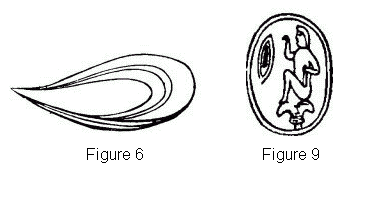
The Argha, Fig. 6, is a contrite form, or boat-shaped dish or plate used as a sacrificial cup in the worship of Astarte, Isis, and Venus. Its shape portrays its own significance. The Argha and crux ansata were often seen on Egyptian monuments, and yet more frequently on bass-reliefs. Fig. 7 is a Buddhist emblem in which the two triangles typifying the male and female principles are united by a serpent, the emblem of desire. It also typifies wisdom.
Equivalent to Iao, or the Lingham, we find Ab, the Father, the Trinity, Asher, Anu, Hea, Abraham, Adam, Esau, Edom, Ach, Sol, Helios (Greek for Sun), Dionysius, Bacchus, Apollo, Hercules, Brahma, Vishnu, Siva, Jupiter, Zeus, Aides, Adonis, Baal, Osiris, Thor, Oden, the cross, tower, spire, pillar, minaret, tolmen, and a host of others; while the Yoni was represented by Io, Isis, Astarte, Juno, Venus, Diana, Artemis, Aphrodite, Hera, Rhea, Cybele, Ceres, Eve, Frea, Frigga, the queen of heaven, the oval, the trough, the delta, the door, the ark, the ship, the chasm, a ring, a lozenge, cave, hole, pit, Celestial Virgin, and a number of other names. Lucian, who was an Assyrian, and visited the temple of Dea Syria, near the Euphrates, says there are two phalli standing in the porch with this inscription on them, "Those phalli I, Bacchus, dedicate to my step-mother Juno."
"Set me as a seal upon thine heart, as a seal upon thine arm, for love is strong as death" (Sol. Song viii, 6). Solomon's seal was in outline the shape of the unit in the field of Fig. 9. The same lozenge-shaped figure was the symbol of Astarte, the Celestial Virgin, wherefrom Solomon may have obtained it.
The Masculine Cross and Ancient Sex Worship (Sha Rocco (pseudonym Abisha S. Hudson) [1874]) - Chapter Three: Unity
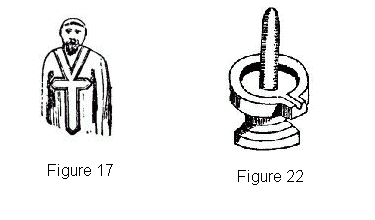
But Fig. 17 puts it to another use. Worn as a part of the dress it is called the priest's pallium. It combines the cross and yoni--the triad and unit--with the prelate's head passed through the latter. The robe or surplice is a telltale portion of phallic and yonijic worship. It is common at the present time in all but the most democratic churches in this country. The surplice is a figment of woman's dress; it can be traced back to the Egyptians, Assyrians, Phoenicians, and others, who worshiped Isis, Astarte, Venus, Iswari and others in that garb. The priests put on female habiliments in which to perform their sacred rites, as the most pleasing, characteristic, and to make themselves like their Creator. On the other hand, women put on male attire. When religious rule instigates to sex consideration in dress, it is but a short step to a more overruling consideration of devout sex intercommunion and behavior, of which see sequel.
Solomon built high places for Ashtoreth, Astarte, or Venus, which became mounts of Venus, mons veneris--Meru and Mount Calvary--each a slightly elevated skull-shaped mount that might be represented by a bare head. The Bible translators perpetuate the same idea in the word "calvaria." Prof. Stanley denies that "Mount Calvary" took its name from its being the place of the crucifixion of Jesus. Looking elsewhere and in earlier times for the bare calvaria, we find among Oriental women, the Mount of Venus, mons veneris, through motives of neatness or religious sentiment, deprived of all hirsute appendage.
See a Mount Calvary, in imitation, in the shaved poll of the head of the priest, Fig. 17. The priests of China, says, Mr. J. M. Peebles, continue to shave the head. To make a place holy, among the Hindus, Tartars, and people of Thibet, it was necessary to have a Mount Meru. also a Linga-Yoni, or Arba, Fig. 22.
SAYS Hyslop: "The hot cross-buns of Good Friday, and the dyed eggs of Pasch or Easter Sunday, figured in the Chaldean rites just as they do now. The buns known, too, by that identical name were used in the worship of the Queen of Heaven, the Goddess Easter (Ishtar or Astarte), as early as the days of Cecrops, the founder of Athens, 1,500 years before the Christian era." "One species of bread," says Bryant, "'which used to be offered to the gods, was of great antiquity, and called Boun.' Diogenes mentioned 'they were made of flour and honey.'" It appears that Jeremiah the Prophet was familiar with this lecherous worship. He says: "The children gather wood, the fathers kindle the fire, and the women knead the dough to make cakes to the Queen of Heaven (Jer. vii, 18). Hyslop does not add that the "buns" offered to the Queen of Heaven, and in sacrifices to other deities, were framed in the shape of the sexual organs, but that they were so in ancient times we have abundance of evidence.
The Amazons (Guy Cadogan Rothery [1910]) - Chapter One, Introduction
This ever-menacing danger, with dim recollections of an outworn stage of development, when a matriarchal polity prevailed, and the nearer, more ghastly remembrance of the worship of cruel, sensual Astarte, that moon huntress goddess who came out of the Far East smeared with human gore, surrounded by her women priests, evolved in the brains of men whose thoughts were prone to take the dramatic form the idea of a truly monstrous state, the very existence of which was a perpetual threat against humanity. Indeed, the Amazonian state, with its population of women warriors, ruled by a queen who banished all men save a few crippled slaves, and banded together with the express purpose of making war upon mankind, perfectly symbolised the peril that Greece had to face. For the myth told not merely of war, but of unnatural war, war which if successful foredoomed family and civic life.
It is symbolic however we look upon it. A noteworthy fact is that certain legends made the Amazons worshippers of Artemis, while others declared them to be deadly enemies of that goddess and her followers. In art we find Amazons wearing the crescent moon on their heads; possibly, too, the triple-towered crown; while their shields were either crescent-shaped or round--these, with their spears and bows and arrows, are the emblems of the moon huntress goddess, both in the guise of savage Astarte and of her Hellenised, humanised counterpart, Artemis. It would be natural for a state whose people lived on the spoils of sport and warfare, who looked upon the sacrifice of male infants as a duty, who drank out of human skulls and were suspected of cannibalism, to worship Astarte, whose early history reeked of blood and was punctuated by mutilation, a deity who symbolised a stage of society when the hunting of wild beasts was of supreme importance. The apparent conflict between the various versions of the myth no doubt arose from a confusion brought about with the lapse of time between the two aspects of this goddess. In the early. forms of the legend it would be quite in accordance with their general trend to associate the warrior women with a female deity who, at all events in the degenerate days of her cult in Asia Minor, represented lust in excelsis. And here, it is likely enough, the myth was founded on solid fact, for it is well-nigh certain that the savage horde from Scythia paid homage to some prototype of Astarte. Her worship is undoubtedly of Eastern origin; this being so, one more reason would be added for the Greeks looking with mingled anxiety and abhorrence to the north-east. Among the several great cities of antiquity which were said to have been founded by queens leading successive swarms from the great parent hive of the Amazonian state was Ephesus. We know that its celebrated Temple to Diana (Artemis) was attended by eunuch priests and probably contained statues of Amazons due to the chisels of the foremost of Grecian sculptors. Though her servants cried aloud, "Great is Diana of the Ephesians," she was really a mild version of Astarte, tamed by the influence of Greek art and thought. Another significant fact is that in its earlier forms the myths of the Amazons and gryphons are represented as implacable enemies, and even in quite late art they are jumbled up with the wars of the centaurs and the gigantomachia, which points to the realms of fancy.
The Amazons (Guy Cadogan Rothery [1910]) - Chapter Ten, Conclusion
This segregation of women during periods of childbirth may be traced as having been a matter of common occurrence in all times and places. We have much evidence of this among the Hebrews and their neighbours, and also in modern times among races far apart. The Toda dairy folk of the Nilgeri Hills, whose most strange pre-nuptial custom is extremely suggestive of ceremonies attending the worship of Astarte of old and of the Indian goddesses Kali and Durgan to this day, build special huts for expectant mothers, such huts being placed away from the villages and all paths used by man and the sacred herds. They may not join the community again until after having undergone a purificatory ceremony.
Where moon-worship prevails, this custom is apt to be very much exaggerated, the segregation going right through the tribe, in obedience to the supposed lunar influence on physiological conditions. This idea was at the base of the religious ceremonies in which only one sex could take part, and which we find among barbarians and even the highly civilised Greeks and Romans, but which, in the more primitive states, would cause the sexes to divide up temporarily into unisex tribes. The Amazons of Asia, we are told, were worshippers of Artemis (Astarte), who had her great mysteries only to be witnessed by women, as well as ceremonies in which both sexes mingled in secret and openly.
It is difficult not to see in this a local tradition with a Greek gloss, for we know how they loved to allegorise facts and to Greecise barbarian gods. Is not Venus in this instance Astarte? that Ashtoreth whom men knew as "Queen of the Heavens" and worshipped in such ghastly fashions as goddess of fertility? And is not Hercules her consort, the great Baal, giver of life and lord of fire, with his club-like thunderbolt? The whole story has the appearance of an allegorical description of some religious mysteries. By one of those peculiar, but easily understandable, workings of the human mind, worship was mainly propitiatory, linked up with the idea of sacrifice, which often led to such terrible conclusions.
Herodotus says that the Egyptians beat themselves after offering sacrifices to Isis; but Strabo tells us of far more significant human sacrifice in the Caucasus, and darkly reveals two other forms at Phanagoria; for we know that both death and even more terrible kinds of self-sacrifice were offered to Astarte and to Baal. A point of which we are bound to take note is raised by Mr. J. G. Frazer, who suggests that Astarte became a moon goddess as the result of an error, or rather a confusion in art representation. He points out that in the Semitic language the moon is masculine, and says that it is through the very early influence of Egyptian art in Assyria that the moon was associated with the Eastern goddess. Both Isis and Hathor are sun goddesses, usually depicted as adorned with the sun disc between two cows' horns placed on their heads. Often the horns are shown alone, and this may have given rise to the notion that the disc was the full moon and the horns the crescent moon. So, he holds, Astarte was given the horns of the crescent moon. While giving this all due weight, we must not forget that Astarte and her congeners were the consorts of Baal and his congeners, and regarded as the goddess of the night sky. The peculiar appearance of the moon in its last phase, with the darkened disc seemingly resting in the bright crescent cup; its total disappearance, to be followed by a reappearance of a small curved fillet which gradually grew, led to its being regarded as feminine, as abundant folklore testifies.
The Babylonian trinity consisted of Anu, the Creator; Sin, the sun god; and Ishtar, the moon goddess, who wore the crescent. As the planet was credited with influence on fertility generally, we have one reason for certain specialised sacrificial ceremonies connected with the worship of that goddess in her many manifestations, from the grim Ishtar to the more gentle, though often cruel, Venus. Some hint of this we have in relation to the Amazons of the Caucasus, who, according to Strabo, spent two months of each spring on a neighbouring mountain which formed the boundary between their own territory and that of the Gargarenses, who also ascended the mountain, so that, in obedience to ancient custom, they might perform common sacrifices. They met "in secret and in darkness," as might be expected from worshippers of Astarte.
Angelo Mosso, writing of the Minoan age in Crete, finely says: "Priestesses were mothers and maidens who initiated the Greek race into the religion of beauty." That, however, was in an advanced stage. Often the sacerdotal state might, indeed, enjoin abstention from marriage, yet demand personal sacrifice. This was unquestionably the case with the followers of Astarte.
Two matters may be touched upon lightly: the association of the Amazons with sun and moon worship and with cannibalism. Strabo is our authority for the sanctuary to the moon god in the Caucasus and the shrine to Venus Apatura, while we know the Greeks all declared the Amazons worshipped Artemis (Astarte) and carried crescent-shaped shields.
Egyptian Myth and Legend (Donald Mackenzie [1907]) - Chapter 24; Changes in Social and Religious Life
[...] The foreign elements in society exercised a marked influence on the religious beliefs of the age. Strange gods were imported, and the voluptuous worship of the goddesses of love and war became increasingly popular; the former included Baal, Sutekh, and Reshep, and the latter Astarte, Anath, and Kadesh. Ere we deal with the changes which were effected by foreign influence in the Egyptian religion, we will pass these deities briefly under review.
[...] Another Asiatic deity who was honoured in Egypt was Reshep (or Reshpu), the Resef of the Phoenicians. He was another form of Baal, a "heaven lord", "lord of eternity", "governor of the gods", &c. His name signifies "lightning", or "he who shoots out fire". As the thunder god he was the god of battle. The Egyptians depicted him as a bearded man with Semitic profile, carrying a club and spear, or a spear and the symbol of life (ankh). From his helmet projects the head and neck of a gazelle, one of the holy animals associated with Astarte. A triad was formed in Egypt of Min, Reshep, and Kadesh.
Astarte was the most popular of the imported deities. Her worship became widespread during the later dynasties. At Memphis she was adored with the moon god Ah, and when Herodotus visited the city he found a small temple dedicated to "the strange Aphrodite" (Venus). She was the goddess of the eastern part of Tanis (Zoan). Astarte is the goddess of ill repute referred to in the Bible as Ashtaroth and Ashtoreth "of the Zidonians". Solomon "went after Ashtoreth" (1 Kings, xi, 5). The Israelites were condemned when "they forsook the Lord and served Baal and Ashtaroth"
p. 311
(Judges, ii, 13). Samuel commanded: "Put away the strange gods and Ashtaroth from among ye". This goddess was worshipped both by the Phoenicians and the Philistines, and when the latter slew Saul they hung his armour in her temple (i Samuel, xxxi, 10). Temples were erected to her in Cyprus and at Carthage. As Aphrodite she was the spouse of Adonis, and at Apacha in Syria she was identified with the planet Venus as the morning and evening star; she fell as a meteor from Mount Lebanon into the River Adonis. As a goddess of love and maternity she links with Isis, Hathor, Ishtar, "Mother Ida", Mylitta, and Baalath. Among the mountains this Mother Goddess had herds of deer and other animals like the Scottish hag "Cailleach Bheur".
Astarte was worshipped in Egypt early in the Eighteenth Dynasty, and was a lunar deity and goddess of war. She appears to have been introduced into the Nile valley with the horse. Like Tefnut, and other Egyptian feline goddesses, she was depicted with the head of a lioness. As the "Lady of Horses" she stands in a chariot driving four horses over a fallen foe.
There were many local types of this Great Mother deity in Asia. Another who was honoured in Egypt was Anthat (Anta), who was associated in ancient Arabia with the moon god Sin, and in Cappadocia, Asia Minor, with Ashir (Ashur). Several towns in northern and southern Syria bear her name. Thothmes III erected a shrine to her at Thebes, and in a treaty between Rameses II and the Hittites she and Astarte are coupled like Isis and Nepthys. Anthat is also the spouse of Sutekh. She is depicted on the Egyptian monuments as a goddess of battle, holding a spear in one hand and swinging a battleaxe in the other, seated on a throne or armed with shield
p. 312
and club riding on a horse in her Aasith form, favoured by Seti I. Rameses III named a favourite daughter Banth-anth, "daughter of Anthat".
Kadesh (Quedesh) "the holy one", was another form of Astarte. As the "mistress of all the gods", and the patroness of the "unmoral" women connected with her temples, she emphasized the licentious phase of the character of Ashtoreth which was so warmly denounced by the Hebrew prophets. The Egyptians depicted her as a moon goddess, standing nude on the back of a lioness, which indicated that she was imported from the Hittites; in one hand she carries lotus flowers and what appears to be a mirror, and in the other two serpents. As "the eye of Ra" she links with Hathor and Sekhet.
Egyptian Myth and Legend (Donald Mackenzie [1907]) - Chapter 27: The Empire of Rameses and the Homeric Age
The old Amon party must have been broken up, for the solar attributes of Amon-ra became more and more pronounced as time went on, while lunar worship was associated mainly with Khonsu and the imported moon goddesses of the type of Astarte and the "strange Aphrodite". To this political and religious revolution may be attributed the traditional prejudice against Thothmes III.
At the close of the Eighteenth Dynasty the Hittites were pressing southward through Palestine and were even threatening the Egyptian frontier. Indeed, large numbers of their colonists appear to have effected settlement at Tanis, where Sutekh and Astarte had become prominent deities.
The Illustrated Bible Dictionary - "Ashtaroth" and "Ashtoreth"
Ashtaroth a city of Bashan, in the kingdom of Og (Deut. 1:4; Josh. 12:4; 13:12; 9:10). It was in the half-tribe of Manasseh (Josh. 13:12), and as a Levitical city was given to the Gershonites (1 Chr. 6:71). Uzzia, one of David's valiant men (1 Chr. 11:44), is named as of this city. It is identified with Tell Ashterah, in the Hauran, and is noticed on monuments B.C. 1700-1500. The name Beesh-terah (Josh. 21:27) is a contraction for Beth-eshterah, i.e., "the house of Ashtaroth."
Ashtoreth the moon goddess of the Phoenicians, representing the passive principle in nature, their principal female deity; frequently associated with the name of Baal, the sun-god, their chief male deity (Judg. 10:6; 1 Sam. 7:4; 12:10). These names often occur in the plural (Ashtaroth, Baalim), probably as indicating either different statues or different modifications of the deities. This deity is spoken of as Ashtoreth of the Zidonians. She was the Ishtar of the Accadians and the Astarte of the Greeks (Jer. 44:17; 1 Kings 11:5, 33; 2 Kings 23:13). There was a temple of this goddess among the Philistines in the time of Saul (1 Sam. 31:10). Under the name of Ishtar, she was one of the great deities of the Assyrians. The Phoenicians called her Astarte. Solomon introduced the worship of this idol (1 Kings 11:33). Jezebel's 400 priests were probably employed in its service (1 Kings 18:19). It was called the "queen of heaven" (Jer. 44:25).
The Illustrated Bible Dictionary - "Jealousy, (image of)"
Jealousy, Image of an idolatrous object, seen in vision by Ezekiel (Ezek. 8:3, 5), which stood in the priests' or inner court of the temple. Probably identical with the statue of Astarte (2 Kings 21:7).
The Illustrated Bible Dictionary - "Eth-baal"
Eth-baal with Baal, a king of Sidon (B.C. 940-908), father of Jezebel, who was the wife of Ahab (1 Kings 16:31). He is said to have been also a priest of Astarte, whose worship was closely allied to that of Baal, and this may account for his daughter's zeal in promoting idolatry in Israel. This marriage of Ahab was most fatal to both Israel and Judah. Dido, the founder of Carthage, was his granddaughter.
The Illustrated Bible Dictionary - "Idol"
Idol (15.) Maskith, "device" (Lev. 26:1; Num. 33:52). In Lev. 26:1, the words "image of stone" (A.V.) denote "a stone or cippus with the image of an idol, as Baal, Astarte, etc." In Ezek. 8:12, "chambers of imagery" (maskith), are "chambers of which the walls are painted with the figures of idols;" comp. ver. 10, 11.
Pagan and Christian Creeds (Edward Carpenter [1920]) - Chapter Two, Solar Myths and Christian Festivals
There were Temples without end dedicated to gods like Apollo or Dionysus among the Greeks, Hercules among the Romans, Mithra among the Persians, Adonis and Attis in Syria and Phrygia, Osiris and Isis and Horus in Egypt, Baal and Astarte among the Babylonians and Carthaginians, and so forth. Societies, large or small, united believers and the devout in the service or ceremonials connected with their respective deities, and in the creeds which they confessed concerning these deities. And an extraordinarily interesting fact, for us, is that notwithstanding great geographical distances and racial differences between the adherents of these various cults, as well as differences in the details of their services, the general outlines of their creeds and ceremonials were--if not identical--so markedly similar as we find them.
At Aphaca in the North of Syria, and halfway between Byblus and Baalbec, there was a famous grove and temple of Astarte, near which was a wild romantic gorge full of trees, the birthplace of a certain river Adonis--the water rushing from a Cavern, under lofty cliffs.
Pagan and Christian Creeds (Edward Carpenter [1920]) Chapter Seven: Rites of Expiation and Redemption
The gods and the creeds of the past, as shown in the last chapter--whatever they may have been, animistic or anthropomorphic or transcendental, whether grossly brutish or serenely ideal and abstract--are essentially projections of the human mind; and no doubt those who are anxious to discredit the religious impulse generally will catch at this, saying "Yes, they are mere forms and phantoms of the mind, ephemeral dreams, projected on the background of Nature, and having no real substance or solid value. The history of Religion (they will say) is a history of delusion and illusion; why waste time over it? These divine grizzly Bears or Aesculapian Snakes, these cat-faced Pashts, this Isis, queen of heaven, and Astarte and Baal and Indra and Agni and Kali and Demeter and the Virgin Mary and Apollo and Jesus Christ and Satan and the Holy Ghost, are only shadows cast outwards onto a screen; the constitution of the human mind makes them all tend to be anthropomorphic; but that is all; they each and all inevitably ass away. Why waste time over them?"
Intermediate Types among Primitive Folk (Edward Carpenter [1914]) - Chapter 4: Hermaphordism Among Gods and Mortals
I have mentioned the Syrian Baal as being sometimes represented as double-sexed (apparently in combination with Astarte). In the Septuagint (Hos. ii. 8, and Zeph. i. 4) he is called ἡ Baal (feminine) and Arnobius tells us that his worshippers invoked him thus 1 "Hear us, Baal! whether thou be a god or goddess." Similarly Bel and other Babylonian gods were often represented as androgyne. 2 Mithras among the Persians is spoken of by the Christian controversialist Firmicus as two-sexed, and by Herodotus (Bk. i., c. 131) as identified with a goddess, while there are innumerable Mithraic monuments on which appear the symbols of two deities, male and female combined. 1 Even Venus or Aphrodite was sometimes worshipped in the double form. "In Cyprus," says Dr. Frazer in his Adonis, etc. (p. 432, note), "there was a bearded and masculine image of Venus (probably Astarte) in female attire: according to Philochorus the deity thus represented was the moon, and sacrifices were offered to him or her by men clad as women, and by women clad as men (see Macrobius Saturn iii. 7, 2)." This bearded female deity is sometimes also spoken of as Aphroditus, or as Venus Mylitta. Richard Burton says 2:--"The Phoenicians spread their androgynic worship over Greece. We find the consecrated servants and votaries of Corinthian Aphrodite called Hierodouloi (Strabo, viii. 6), who aided the 10,000 courtesans in gracing the Venus-temple. . . . One of the headquarters of the cult was Cyprus, where, as Servius relates (Ad. Aen. ii. 632), stood the simulacre of a bearded Aphrodite with feminine body and costume, sceptred and mitred like a man. The sexes when worshiping it exchanged habits, and here the virginity was offered in sacrifice."
Legends of Babylon And Egyptian Relation to Hebrew Tradition (Leanard W. King, 1916)
But more instructive than these borrowed memorials is a genuine example of Phoenician work, the stele set up by Yehaw-milk, king of Byblos, and dating from the fourth or fifth century B.C.[2] In the sculptured panel at the head of the stele the king is represented in the Persian dress of the period standing in the presence of `Ashtart or Astarte, his "Lady, Mistress of Byblos". There is no doubt that the stele is of native workmanship, but the influence of Egypt may be seen in the technique of the carving, in the winged disk above the figures, and still more in the representation of the goddess in her character as the Egyptian Hathor, with disk and horns, vulture head-dress and papyrus-sceptre. The inscription records the dedication of an altar and shrine to the goddess, and these too we may conjecture were fashioned on Egyptian lines.
[1] /Corp. Inscr. Semit./, I. i, tab. II. [2] /C.I.S./, I. i, tab. I.
The representation of Semitic deities under Egyptian forms and with Egyptian attributes was encouraged by the introduction of their cults into Egypt itself. In addition to Astarte of Byblos, Ba`al, Anath, and Reshef were all borrowed from Syria in comparatively early times and given Egyptian characters. The conical Syrian helmet of Reshef, a god of war and thunder, gradually gave place to the white Egyptian crown, so that as Reshpu he was represented as a royal warrior; and Qadesh, another form of Astarte, becoming popular with Egyptian women as a patroness of love and fecundity, was also sometimes modelled on Hathor.[1]
[1] See W. Max Müller, /Egyptological Researches/, I, p. 32 f., pl. 41, and S. A. Cook, /Religion of Ancient Palestine/, pp. 83 ff.
The Evil Eye (Frederick Thomas Elworthy [1895]) - Appendix One
We have already referred to the faith which led the Magi to follow the star to Bethlehem. Throughout the East it was the primæval instinct that a child was to be born of a celestial mother, who should destroy the spirit of evil and be the saviour of mankind. Not only so, but the mother was to conceive and to bring him forth from her own inherent power. 366 With the triune male deity we find a single female associated. "Her names are innumerable, 'Mother of all the Gods,' The Lady, The Queen, Mulita, Bilta, Ishtar, or the bright, pure being. She is also Ri, Alitta, Elissa, Beltis, Ashtoreth, Astarte, Saraha or Sara, Nana, Asurah, Tanith. All these and more are Babylonish, but elsewhere she is Athor, Dea, Syria, Artemis, Aphrodite, Rhea, Demeter, Ceres, Diana, Minerva, Juno, Venus, Isis, Cybele, Ge, Hera. As Anaitis she is 'The Mother of the Child'; reproduced again as Isis and Horus, Devaki and Christna, Aurora and Memnon. Even in ancient Mexico the mother and child were worshipped. In modern times she survives as the Virgin Mary and her Son. There were Ishtar of Nineveh and Ishtar of Arbela, just as there are now Maria di Loretto and Marie de la Garde."
From Ritual to Romance (Jessie L. Weston [1920]) - Chapter Nine: The Fisher King
In this last instance the connection of the Fish with life, renewed and sustained, is undeniable. The original source of such a symbol is most probably to be found in the belief, referred to in a previous chapter 1, that all life comes from the water, but that a more sensual and less abstract idea was also operative appears from the close connection of the Fish with the goddess Astarte or Atargatis, a connection here shared by the Dove. Cumont, in his Les Religions Orientales dans le Paganisme Romain, says: "Two animals were held in general reverence, namely, Dove and Fish. Countless flocks of Doves greeted the traveller when he stepped on shore at Askalon, and in the outer courts of all the temples of Astarte one might see the flutter of their white wings. The Fish were preserved in ponds near to the Temple, and superstitious dread forbade their capture, for the goddess punished such sacrilege, smiting the offender with ulcers and tumours 2."
Shakti and Shâkta (Arthur Avalon (Sir John Woodroffe) [1918])
For, when we throw our minds back upon the history of this worship we see stretching away into the remote and fading past the figure of the Mighty Mother of Nature, most ancient among the ancients; the Adya Shakti, the dusk Divinity, many breasted, crowned with towers whose veil is never lifted, Isis, "the one who is all that has been, is and will be," Kali, Hathor, Cybele, the Cowmother Goddess Ida, Tripurasundari, the Ionic Mother, Tef the spouse of Shu by whom He effects the birth of all things, Aphrodite, Astarte in whose groves the Baalim were set, Babylonian Mylitta, Buddhist Tara, the Mexican Ish, Hellenic Osia, the consecrated, the free and pure, African Salambo who like Parvati roamed the Mountains, Roman Juno, Egyptian Bast the flaming Mistress of Life, of Thought, of Love, whose festival was celebrated with wanton Joy, the Assyrian Mother Succoth Benoth, Northern Freia, Mulaprakriti, Semele, Maya, Ishtar, Saitic Neith Mother of the Gods, eternal deepest ground of all things, Kundali, Guhyamahabhairavi and all the rest.
Ancient Fragment of the Key of Solomon
The fourth Number is four. The fourth Sephira is Gedulah or Chesed, Magnificence or Mercy.
The Spirits of Gedulah are the Chaschmalim, or the Lucid Ones. Their empire is that of beneficence; they correspond to the imagination.
They have for adversaries the Gamchicoth or the Disturbers of Souls. The Chief or Guide of these Demons is Ashtaroth or Astarte, the impure Venus of the Syrians, whom they represent with the head of an ass or of a bull, and the breasts of a woman.
Ancient Legends, Mystic Charms, and Superstitions of Ireland (Lady Francesca Speranza Wilde [1887]) Ancient Mysteries
Many other broken fragments of the early ritual of the world can also still be traced in the popular superstitions and usages of the people. Time sun and moon with the mysterious powers of nature were the first gods of humanity. Astarte, Ashtaroth, and Isis were all the same moon-goddess under different names, and all were represented by time symbol of the horned cow. The Egyptians typified the sun and moon, Osiris and Isis, as the ox and the cow: and these symbols were still used at the Irish wake ceremonial until very recently: for the Druids also worshipped the sun and moon and time winds, and venerated trees, fountains, rivers, and pillar stones, like their Persian ancestry. But the Irish considered the east wind demoniacal, the Druidic wind of accursed power. They called it "The Red Wind," "A wind that blasts the trees and withers men is that Bed Wind," according to. a bard.
Pagan Regeneration (Harold R. Willoughby [1929]) - Chapter Five, the Regenerative Rites of the Great Mother
The prototype for this diversified, yet measurably unified complex of religious systems seems to have been the Babylonian cult of Ishtar, the deified personification of motherhood. She was known to biblical writers as Ashtoreth, and to the Greeks as Astarte or Aphrodite. With her was associated a young and active deity called Tammuz, who was slain but afterward revived. As in the case of Attis, lamentations formed an important part of his worship. In Ezekiel's day this practice was adopted by Jews, even, and among the "abominations" which the prophet saw perpetrated at the very gate of the Jerusalem temple was the weeping of women for Tammuz! In Phoenicia the mother-goddess was worshiped under the name of Ashtart, and as early as the third century B.C. her cult was so pre-eminent that the kings of Sidon served her as priests. She, too, had her consort, Eshmun by name. Their houses were built together, and they were simultaneously glorified.
To the Greek world this immortal pair was familiar as Aphrodite and Adonis, the goddess of love and her impetuous young husband. "The Fourth Venus," said Cicero, "was a Syrian . . . . who is called Astarte and is said to have been married to Adonis." Greek and Latin writers delighted to retell the story of their love and of Aphrodite's loss.
Myths of Crete and Pre-Hellenic Europe (Donald A. Mackenzie [1917]) - Chapter Eight; Cave Deities and their Symbols
In Crete the horns were of great ritual importance. "At times". Sir Arthur Evans writes, 2 "these have the appearance of being actually horns of oxen, but more generally they seem to be a conventional imitation of what must be regarded as unquestionably the original type-that is, a kind of impost or base terminating at the two ends in two horn-like excrescences. Sometimes this cult object appears on the altar. At other times it rises above the entablature of an archway connected with a sacred tree or on the roof of a shrine. It is frequently set at the foot of sacred trees." Occasionally the double axe is surmounted on a staff between the horns. A horned cult object in terra-cotta, with the eye symbol of Anatolian pottery painted on the base, was found in one of the Cretan votive caves. The horned symbol has been found associated with early Bronze Age relics in Sardinia, Italy, Switzerland, Spain, and the Balearic Islands, which were probably the Cassiterides Islands in which tin was found. It may be that the Cretan symbol was distributed by early sea-traders. In Syria the altar of Astarte had horns. The "horns of the altar" are referred to in the Bible.
Ancient Fragments (I. P. Cory [1832 ed.]) - The Theology from the Phoenicians - The Cosmology
But in process of time, whilst Ouranus was still in banishment, he sent his daughter Astarte, being a virgin, with two other of her sisters, Rhea and Dione, to cut off Cronus by treachery; but Cronus took the damsels, and married them notwithstanding they were his own sisters. When Ouranus understood this, he sent Eimarmene and Mora with other auxiliaries to make war against Cronus: but Cronus gained the affections of these also, and detained them with himself. Moreover, the god Ouranus devised Bætulia, contriving stones that moved as having life.
And by Astarte Cronus had seven daughters called Titanides, or Artemides; by Rhea also he had seven sons, the youngest of whom was consecrated from his birth; also by Dione he had daughters; and by Astarte again he had two other sons, Pothos and Eros.
(Then our historian, after some other things, goes on thus:) But Astarte called the greatest, and Demarous named Zeus, and Adodus who is entitled the king of gods, reigned over the country by the consent of Cronus: and Astarte put upon her head, as the mark of her sovereignty, a bull's head: and travelling about the habitable world, she found a star falling through the air, which she took up, and consecrated in the holy island of Tyre: and the Phoenicians say that Astarte is the same as Aphrodite.
Religious Cults Associated With the Amazons (Florence Mary Bennett [1912]) CHAPTER Four: Artemis Astrateia and Apollo Amazonius
It has been assumed in the preceding paragraph that Artemis Astrateia, because she is a goddess of the Amazons, is practically identical with Ephesia, and on this assumption an hypothetical interpretation of Apollo Amazonius has been based. In order that the investigation may be pursued from a different point of view, this argument may be dismissed for the present, to give place to an inquiry concerning the meaning
p. 43
of Astrateia. Farnell 202 does not discuss the epithet Amazonius, but for Astrateia he proposes the explanation that the word is a linguistic corruption for Astarte. By this theory the connection with a στρατεία denotes only a local attempt to account for a word of which the real significance was completely lost. The position of Pyrrhichus on the Laconian coast makes it easily credible that foreign influences might have imported the Semitic goddess.
It remains to consider the possibility that she is Astarte. Cicero 237 remarks that Astarte of Syria was identified with Aphrodite, and that in this conception she appears as the wife of Adonis. Herein the type of Aphrodite approximates that of Cybele in Lydia and Phrygia where Atys corresponds to Adonis. At Hierapolis the Syrian goddess described by the Pseudo-Lucian has characteristics of Artemis as well as Aphrodite. In these rites the torch was a prominent feature, as in those of the Thracian-Phrygian Mother. Thus Artemis Astarte might be precisely the same as Warlike Artemis. Moreover, even if the goddess at Pyrrhichus were an Astarte more similar to Aphrodite than to Artemis, the probabilities would be strong in favour of the theory that she was armed, for the cult epithet of Aphrodite-Astarte in Greek religion was Urania, of whom there is reason to believe that she was the armed Aphrodite. 238 So from two hypotheses, the one, that Artemis Astrateia is Warlike Artemis, the other, that she is Astarte, 239 the inference is to be drawn that the image at Pyrrhichus showed her armed.
Footnotes:
43:202 Farnell, op. cit. 2. p. 485. Elsewhere (2. p. 473) Farnell speaks of the identification between Artemis and the Semitic goddesses, Astarte, Derceto, Atargatis.
50:237 Cic. De Nat. Deor. 3. 23, 59.
50:238 Cf. Paus. 1. 14, 7; 3. 23, 1. V. infra, ch. V, Ares.
50:239 Possibly there is some support for Farnell's hypothesis, that Astrateia is a corruption for Astarte, in the words of St. Stephen's sermon recording the apostasy of the Jews to the Syrian goddess: ἔστρεψεν δὲ ὁ Θεὸς καὶ παρέδωκεν αὐτοὺς λατρεύειν τῇ στρατιᾷ τοῦ οὐρανοῦ, Acts, 7. 42.
Atlantis, the Antediluvian World (by Ignatius Donnelly [1882]) - Chapter Nine
"In A.D. 868 it was employed by the Northmen." ("The Landnamabok," vol. i., chap. 2.) An Italian poem Of A.D. 1190 refers to it as in use among the Italian sailors at that date. In the ancient language of the Hindoos, the Sanscrit--which has been a dead language for twenty-two hundred years - the magnet was called "the precious stone beloved of Iron." The Talmud speaks of it as "the stone of attraction;" and it is alluded to in the early Hebrew prayers as Kalamitah, the same name given it by the Greeks, from the reed upon which the compass floated. The Phoenicians were familiar with the use of the magnet. At the prow of their vessels stood the figure of a woman (Astarte) holding a cross in one hand and pointing the way with the other; the cross represented the compass, which was a magnetized needle, floating in water crosswise upon a piece of reed or wood. The cross became the coat of arms of the Phoenicians--not only, possibly, as we have shown, as a recollection of the four rivers of Atlantis, but because it represented the secret of their great sea-voyages, to which they owed their national greatness. The hyperborean magician, Abaras, carried "a guiding arrow," which Pythagoras gave him, "in order that it may be useful to him in all difficulties in his long journey." ("Herodotus," vol. iv., p. 36.)
The magnet was called the "Stone of Hercules." Hercules was the patron divinity of the Phoenicians. He was, as we have shown elsewhere, one of the gods of Atlantis--probably one of its great kings and navigators. The Atlanteans were, as Plato tells us, a maritime, commercial people, trading up the Mediterranean as far as Egypt and Syria, and across the Atlantic to "the whole opposite continent that surrounds the sea;" the Phoenicians, as their successors and descendants, and colonized on the shores of the Mediterranean, inherited their civilization and their maritime habits, and with these that invention without which their great voyages were impossible. From them the magnet passed to the Hindoos, and from them to the Chinese, who certainly possessed it at an early date. In the year 2700 B.C. the Emperor Wang-ti placed a magnetic figure with an extended arm, like the Astarte of the Phoenicians, on the front of carriages, the arm always turning and pointing to the south, which the Chinese regarded as the principal pole. (See Goodrich's "Columbus," p. 31, etc.)