 |
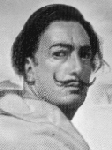
| Biography: Salvador Dali (1904 - 1989) "The only difference between me and a madman is that I'm not mad" Salvador Felipe Jacinto Dali was born 11 May, 1904 in the small town of Figueras in the Province, Catalunya. His first name had previously been given to a boy who had died in infancy. He was often aware that he was the second Salvador. Three years later, a sister was born named Ana Maria. He was a difficult child and refused to conform to a family or community customs. Dali received private art lessons in Figueras, and later attended the Escuela Especial de Pintura, Escultura y Grabado de Bellas Artes de San Fernando in Madrid. He lived in the Residencia de Estudiantes, where he met other art students. He was expelled and reinstated, but never took the final examinations. Dali felt, with good reason, that he did not need the type of education the school offered. Disowned by his father, Dali moved into a fisherman's shack in the small village of Port Lligat, two miles from Cadaques on the coast where the Pyrenees come down to the Mediterranean Sea, not far from the French border. The most important person in his life was a Russian emigree living in Paris and married to the French poet, Paul Eluard, Dlena Diakonova, known as "Gala". She left Eluard for Dali, whom she married after the death of her husband. She saved Dali from a serious nervous disorientation and took charge of every aspect of his life: financial, artistic, and sexual. With her help, he became established in Paris as a notable painter. Dali joined the Dada and Surrealist group led by Andre Breton, but left the group a few years later to become a serious surrealist. He defined his paranoiac-critical activity as "spontaneous method of original knowledge based upon the interpretive-critical association of delirious phenomena." As he became better known and more successful financially, he bought a number of fishermen's shacks adjacent to his original one and made them into an extensive house, now the property of the government of Spain. Dali never ceased to love the area near his home in Port-Lligat, and many of his paintings reflect actual scenes. The are visible from his house has been declared a national heritage, and no changes are permitted. Later paintings show his respect for great classical painters, and are often on religious or historic subjects. For many years, Dali spent the winter in New York City, always at the St. Regis Hotel. On the way to and from Spain, he often stopped for a while in Paris. In Figueras, a burned out opera house was transformed into a museum, and Dali took great pleasure in creating a monument to his artistic life. It includes a number of important paintings and drawings, and several humorous items. In early 1980 while in New York City, he and Gala both suffered from a viral pneumonia, which lingered for several months. They returned to Spain, Dali very depressed. Improper medication by Gala caused a permanent palsy, and his hand did not stop shaking as long as he lived. After the death of Gala, he moved into his villa in Pubol, where he was seriously burned in a fire caused by a short circuit. When he reached the hospital, it was found that he had nearly stopped eating, and he was so weak that it was necessary to feed him intravenously to prepare him for skin grafting. This was successful but his health continued poor. Dali died in 1989 in Figueras, Spain. |
|
 |