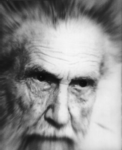
Ezra
Pound
From
America
to
Europe
Ezra
Pound
was
born
in
Idaho,
in
the
United
States.
He
came
from
an
old
American
family
of
English
descent
and
though
his
education
and
temperament
were
thoroughly
American
he
felt
very
much
attracted
by
Europe.
He finally moved to Europe in 1907 with the declared intention of studying poetry and art, giving himself cultural roots.
He
was
convinced,
like
his
friend
T.S.
Eliot,
that
European
civilization
was
a
whole
and
that
a
poet
writing
in
English
could
profit
as
much
–
if
not
more-
from
a
study
of
ancient
Greek
poetry
as
of,
say,
Wordsworth.
He
started
a
campaign
to
free
English
poetry
from
insularity,
proposing
the
study
of
the
French
Symbolists,
the
English
Metaphysical
Poets,
Dante
and
the
poets
of
the
Dolce
Stil
Novo,
and
the
French
troubadours.
In
London,
where
he
lived
from
1908
to
1920,
Pound
aroused
strong
reactions
by
openly
criticizing
contemporary
Georgian
poetry.
His
influence
on
contemporary
poets
was
very
great,
both
as
regards
the
younger
generation,
T.S.
Eliot
in
particular,
and
also
older
writers
such
as
Yeats.
He
himself
admired
Yeats
for
his
classic
restraint
and
clearly
expressed
emotions.
Pound’s
ideas
were
codified
in
an
essentially
Anglo-American
literary
movement
called
Imagism
founded
in
1912.
Four
anthologies
of
Imagist
verse
were
published
between
1914
and
1917,
notable
contributors
including
D.H.
Lawrence
and
James
Joyce.
Pound,
who
at
this
time
was
much
influenced
by
the
anti-Romantic
ideas
of
the
philosopher
Hulme,
set
down
an
Imagist
creed
which
forms
the
first
modernist
manifesto
in
English
poetry.
Its
main
principles
were:
 |
Direct
treatment
of
the
subject; |
|
To
use
no
words
that
did
not
contribute
directly
to
the
poem’s
sense; |
|
To
use
clear,
concrete
language,
not
abstractions; |
|
To
create
new
rhythms,
such
as
free
verse,
to
express
new
moods. |
Pound’s Imagist phase is illustrated by his verse collections Rispostes and Lustra containing mostly short poems written in a clear hard style.
By
this
time,
however,
he
had
already
abandoned
Imagism
and
founded
a
new
movement,
Vorticism.
In
a
sense,
this
was
a
heightened
version
of
Imagism,
in
that
it
was
violently
anti-Romantic.
It
also
violently
attacked
middleclass
values.
In
its
aggressiveness
and
celebration
of
energy,
speed,
dynamism,
visual
and
verbal
violence,
it
closely
resembled
Futurism
and
other
avant-garde
movements.
Pound
and
its
other
founding
member,
the
writer
and
painter
Wyndham
Lewis,
believed
that
these
new
creative
ideas
formed
“The
Great
English
Vortex”
–
hence
the
name
Vorticism.
Pound
contributed
much
to
the
development
of
Modernism
in
England.
With
untiring
energy
he
wrote
articles
and
essays,
organized
lectures
and
art
exhibitions,
helping
hosts
of
writers
–
including
Eliot,
Joyce
and
Hemingway
–
with
their
work,
giving
suggestions
and
often
finding
a
publisher
for
them.
In
his
own
poetry
he
made
use
of
language
that
was
both
based
on
everyday
speech
and
founded
on
tradition.
As
he
moved
away
from
the
Imagist
phase,
his
poetry
became
more
complex,
abandoning
syntactical
regularity
in
favour
of
an
abrupt
juxtaposition
of
images
and
ideas.
He
also
made
frequent
use
of
“quotations”
from
works
of
the
past,
using
them
into
a
thoroughly
modern
structure.
The
Italian
years
and
The
Cantos
In
1920
Pound
moved
to
Paris,
which
then
attracted
artists
from
many
parts
of
the
world:
Joyce,
Hemingway,
and
Picasso
were
already
living
there.
In
1024
he
moved
on
to
Italy,
attracted
by
its
art
as
well
as
by
a
Fascism,
which
he
believed
would
implement
his
own
unconventional
economic
theories.
He
settled
in
Rapallo,
where
he
was
to
live
for
the
next
twenty
years.
By
then
he
had
already
started
writing
The
Cantos,
by
some
considered
his
masterpiece.
The
first
three
cantos
came
out
in
1017;
from
the
early
1920
onwards
all
of
Pound’s
poetry
went
into
The
Cantos
and
by
the
name
of
his
death
they
numbered
119.
They
represents
at
epic
poetry
in
this
century.
Pound
defined
them
as
“a
poem
including
history”.
They
refer
to
western
and
oriental
culture,
and
contain
direct
or
disguised
quotations,
lines
of
music,
and
Chinese
ideograms
with
moments
of
intense
lyricism.
And
the
end
of
World
War
II
Pound
was
put
into
a
concentration
camp
by
the
American
forces
at
Pisa,
because
of
his
anti-war
speeches
on
Radio
Roma,
which
at
a
time
when
the
United
States
were
at
war
were
considered
an
act
of
treason.
His
imprisonment
is
vividly
recorded
in
the
most
famous
section
of
his
poem,
the
Pisan
Cantos.
He
returned
to
the
US
to
plead
at
his
trial
in
1946,
but
was
found
“insane
and
mentally
unfit
for
trial”
and
confined
to
St
Elizabeth’s
Hospital,
Washington,
DC,
for
twelve
years.
When
he
was
finally
released
he
went
to
spend
the
rest
of
his
life
in
Italy,
dying
in
Venice.