“No man is an
island, entire of itself; every man is a piece of the Continent, a part of the
main; if a clod be washed away by the sea, Europe is the less, as well as if a
promontory were, as well as if a manor of thy friends or if thine
own were; any man’s death diminishes me, because I am involved in mankind; and
therefore never send to know for whom the bell tolls; it tolls for thee.”
John
Donne
Around the table
sits an assortment of prostitutes, heroin addicts and Christians. We are in the slums of Bangkok, a
corrugated iron metropolis home to upwards of forty thousand people, a stone’s
throw from Asia’s tallest building and the glitzy hotel district. The rain thunders down outside the open front
of the small concrete flat on the fringes of the slum, cooling the heavy,
sweltering night. The young Thai girl
opposite has just discovered that her infant daughter is HIV positive, and will
die of AIDS. Gradually, the meal turns
into a makeshift bible reading, and soon a strumming guitar and enthusiastic
singing begin to compete with the sounds of the slums.
I arrived in Thailand
seventy-two hours ago, and arranged to meet up with my friend and flatmate
Henry and his girlfriend Lydia, to
see the work they do out here. I have
established something of a routine now, visiting Henry at the orphanage during
the day, and sleeping on the floor of a hotel room rented by some girls from Devon I met on the flight
over. This arrangement saves me a bit of
money, something I am going to have to excel at if I am to achieve my aim of
returning to England overland with my modest budget.
The charity Henry works for runs a small day care centre for
orphaned children with cerebral palsy.
Maternal malnourishment leads to high rates of the condition here, and
rampant HIV destroys the lives of countless more. Henry took me to visit the sick infant’s
ward. He tells me it was the extent of
the suffering on this unit that made him to return to Thailand
every summer for the past three years.
The scenes inside were harrowing.
Dozens of babies lay in rows, often five or six to a bed, many of them
covered in urine and coughed-up phlegm.
One pair of bright eyes, peering out of a wretched, tiny body,
punctuated the row upon row of glazed expressions. As the Danish nurse – alone in providing
medical care for the babies – told me how poor the prognosis was for all these
children, I watched this little girl’s eyes, a sparkling contradiction of the
state of her emaciated body, studying everything around her, exploring avidly
the modest environment in which she would probably soon die.
I sit at the
table listening as hymns in Thai echo around the street. The rainstorm is over, seemingly calmed by
the singing. It is my final night in Bangkok, and we
talk about Lydia’s time in Burmese refugee camps and what the future holds for the
orphanage. The conversation slowly
drifts onto my plans for my journey home.
I hope to enter Cambodia tomorrow and spend some time there before getting to Ho Chi Minh City and heading north to China. I say my goodbyes and catch a lift into town
with a Chinese couple who are getting married on Saturday. They drop me off in the Sukhamvit
district of Bangkok. I realise I’m late
for a meeting with the Devon girls, and start to run. The
night is cooler now, and I run as fast as I can through the streets, leaping
over simmering bowls of rice and open manholes, diving between bicycles and
parked tuk-tuks.
Running through this faraway city rekindles the familiar feeling of
reckless, innocent freedom that makes travelling so seductive and addictive…
Two weeks later
and I’m speeding up a Vietnamese mountain road on the back of a motorcycle
bound for the Chinese frontier through an almost ethereal landscape of great
limestone pillars covered in green foliage which contrast sharply with the
endless deep blue of the sky. My driver
whoops with delight as we fly over a crest in the road and scream down the
hillside towards the checkpoint. I am
dropped off five hundred metres from the border, pay the man a few thousand
dong, and proceed to walk across a deserted no-man’s land into The People’s
Republic China.
During my first two weeks in China,
the only person with whom I spoke English was myself. The SARS epidemic, which was just coming to
an end, had discouraged many people from booking holidays in the People’s
Republic, and the result was that I did not see another westerner until I
reached Shanghai. I hired a bicycle in Yangshou for a dollar, and explored the local karst landscape. My
lungs were bursting as I finally ascended one of them, scrambling up the final
twenty metres of crumbling limestone and straggling weeds to a clear, shining
panorama of green and blue. The sun,
reflected brightly in the river down in the valley beneath me, beat down on my
neck. I lay on the peak alone, sweaty
and satisfied, and was glad that I was there.
I sat next to a
young Chinese girl called Physiol on a journey
through Guanxi province. Our bus traversed bridges spanning deep
ravines, bouncing and swerving its way along precipitous mountain roads. Physiol told me she
was travelling this route once a few years ago, and the bus in front of hers
smashed through a barrier and down into the river below, killing many people on
board. Asking her grandmother why it was
the other bus, and not hers, that crashed, she was told that it was because god
had blessed her. Physiol
then told her father this, and he beat her, telling her that if she wanted to
join the Party, and have a good job, she was not to repeat such things. Only atheists are permitted to be members of
the Chinese Communist Party, and hold positions of authority.
I took a
twenty-eight hour train ride to Chongching where I
hoped to catch a boat down the Yangtze River at least as far as Wuhan. I arrived in a torrential thunderstorm at
three in the morning and gripped the saddle of the motorcycle desperately as we
sped up and down the glistening, rain-soaked streets of the eccentric city,
perched precariously on the hills and cliffs surrounding a confluence of two
giant rivers. The smell of petrol and
street cooking, the sound of tyres on wet roads, and the feeling of flying
along on the back of the bike all came together to drench my senses and my
tired brain was at once alert again.
Despite not sleeping for two days I checked in to a cheap hotel, dropped
my things, and wandered the surprisingly lively streets for hours, soaked to
the bone, feeling utterly adrift, free and content.
I slept into the afternoon and booked my passage as far as Yichang. I noticed
that I was neglecting to feed myself in China. The difficulty of ordering food with no grasp
of the language (I had even resorted to miming a shrimp once), combined with
the unpalatable result of most exchanges, had led me to only eat when I was
hungry, and my appetite had been suppressed by the heat. All too often I found myself inexplicably
light-headed and unsteady on my feet, and would suddenly realise I’d not eaten
for a day or two. This, along with my
developing penchant for chatting and laughing with myself,
made me wonder if I was heading into some kind of psychosis. I spent the rest of the day in this state of
mind, gliding up and down escalators in colossal shopping centres, pirouetting
in great expansive squares taking in the three hundred and sixty degree skyline
of sleek new skyscrapers, ducking into atmospheric food kiosks as the
cataclysmic rains broke over this eternally soaked city. I ate a piece of chicken and headed back to
the hotel around midnight, setting my alarm for the early morning when I had to
head for the river docks to catch my ferry.
I’m cruising
third-class down the third largest river in the world. I have had the honour on being bestowed a
Chinese name, Qin Zhen Shan, by my cabin-mates. Alexandra is a twenty-two year old studying
English in Chongching, and has taken up the role of
my translator with much enthusiasm.
Earlier I went to check how bad the toilets were, and, upon opening the
saloon-style door, was greeted with two rows of grinning Chinese faces,
squatting over small holes in the floor, with no screens dividing them. I hurried back to my cabin, dug around in my
first aid kit, and swallowed four Imodium tablets, not out of prudishness at
the prospect of defaecating in front of strangers,
but out of fear that my indelicate, amateurish technique may become the subject
of amusement. My bowels would not stir
again for at least four days. I sit with
Alexandra, our legs dangling from the side of the boat, the water surging
beneath us. Curiously, over half the
debris churning in the river is made up of assorted shoes. She is wearing a long yellow cotton dress.
“What colour is the sky in England?” she asks.
“Grey, usually.” I reply
“Green?” She has misheard me,
but the idea of a green sky has struck her
quite
forcefully.
“That must be very beautiful,” She goes on, “I’d love to see a green
sky. I had no idea the sky was green in England. I know it’s blue in America –
I’ve seen America on television.”
The following day we pass through the beautiful Three Gorges, giant
canyons carved by the ferocious Yangtze as it flows eastwards towards the
Pacific. Towering above our vessel, the
lush forests and high cliffs are one of China’s
natural treasures, but in a few years they will vanish forever. As evening approaches, a gigantic rectangular
concrete monolith blocks the river in the distance. As we approach the infamous Three Gorges Dam
Project, it dwarfs our sizable ferry as we are joined by others in a queue to
enter the lock. In only a matter of
years, the dam will be complete, and the gorges behind me will have been
flooded out of existence, along with the homes of over a million people. The dam will be the largest in the world,
generate a fifth of China’s energy requirements, and control perennial flooding in the plains
beneath it. Earlier that morning,
upstream of the dam, the ferry had stopped at a small town on the
riverbank. Like all the towns upstream
of the dam as far as Chongching, it was divided into
two parts; a derelict, run-down waterfront, doomed to be drowned when the dam
is completed, and, suspended fifty metres up the hill, gleaming new dock
facilities, complete with hotels and piers to serve traffic on the future
river. Someone told me that most of the
billions of yuan earmarked as compensation for those
people displaced by the project had found its way to bank vaults in Switzerland, where it now swells the personal accounts of corrupt government
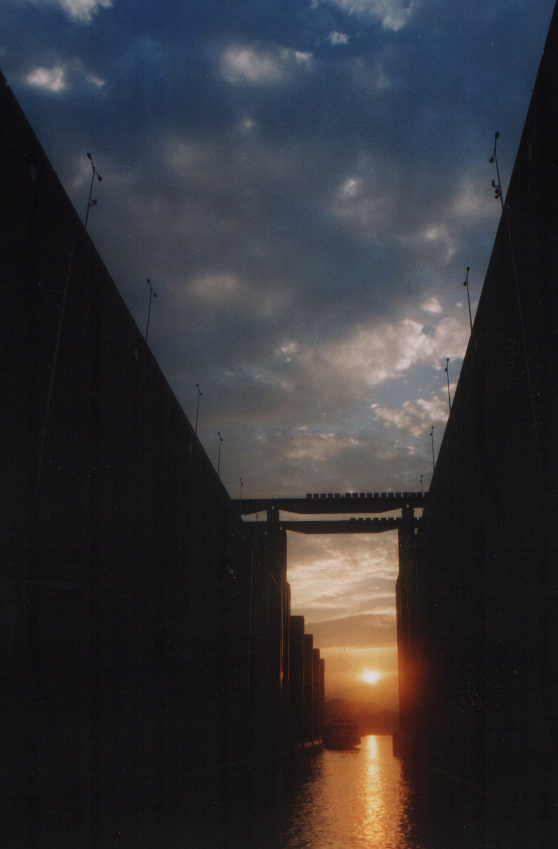
officials. The vast lock gates take
almost ten minutes to close behind our ferry, blotting out a beautiful sunset
over the condemned gorges to the west, and slowly we descend the hundred or so
metres to the bottom of the dam.
Scrambling up to
the highest in a row of crumbling watchtowers, I am rewarded by the sight of
the Great Wall snaking along the treacherous ridges to the east and west. I have come eighty kilometres from Beijing to see this
more remote part of the wall, on this, my first day out of China’s
intense, sprawling capital in almost a week.
The chance to get some fresh air is certainly welcome. Over the past month, my path through China has
taken me eastwards down the Yangtze as far as Shanghai, where I
bid farewell to the Pacific Ocean, and headed north-west to Beijing. Tomorrow I start my long train journey
westward, the first stop of which will be Ulaan Baatar in Outer Mongolia.
The landscape through which the wall runs is breathtaking. Ragged escarpments and cliffs scar the hills
in every direction, thick green scrub and small trees cover the steep
slopes. The stifling heat is almost
unbearable, and it takes me six hours to cover the nine kilometres to the end
of this section, where, for five yuan, a manically
grinning man waving a “safety test certificate” straps tourists into a harness
and fires them down a kilometre-long zip line over a lake to the deserted car
park in the distance. Regrettably, I
only have three yuan, and had to instead trudge down
the hillside, my feet steaming in my unlaced walking boots.
I have been
staying in a hostel located in the midst of a labyrinth of hutong,
the ancient, narrow, winding streets of old Beijing. Hungover from
celebrating my final night in China
with litre bottles of beer costing less than twelve pence, I manage to drag
myself out of bed at sunrise, pack my bag and mutter “huo
che zhan” to the taxi
driver. As luck would have it, he
understands my pidgin Chinese, and we arrive at the
train station with twenty minutes to spare before the Trans-Mongolian slowly
pulls out of Beijing station. Finally I’m heading
westward; homeward. Sections of the
Great Wall sweep past the window and before long we are in the open grasslands
of Chinese Inner Mongolia.
After getting to
know the other occupants of my compartment, I settle back in my bunk and begin
the fourth Harry Potter book, which I had traded for ‘The Iliad’ back in Cambodia. I finish it just as we are approaching Ereen, a small town on the Mongolian frontier. The border guards noisily tear apart the
luggage of the Chinese traders in the compartment next to ours. It is two in the morning, and the prospect of
repacking my rucksack after it’s been blitzed by an overenthusiastic Mongolian
doesn’t fill me with excitement. Our
door is flung open, orders are barked, and we struggle to our feet and lift the
beds to reveal our belongings. Suddenly,
the border guard taps me excitedly on the arm and points to something on my
bed.
“Ahhh… Har-ry Pot-tah!” he exclaims and
picks up the book, turning it over in his hands, evidently the most interesting
thing he had come across all day.
“Er… keep
it.” I say.
Beaming, our
luggage unchecked, the guard turns and leaves the compartment with his new book
and before long the train recommences its journey into the heart of Mongolia.
This is the second
time I have visited Ulaan Baatar,
and much has changed in the two years that have elapsed since I last found
myself in this remotest of capitals. The
warmly-embraced and unceasing march of capitalism and the resurgence of
once-forbidden Buddhism are visible everywhere.
It is a dusty town, its skyline dominated by the twin cooling towers of
the decaying Soviet power station, and the gleaming, mirrored façade of the
Trade and Development Bank. Surrounding
the city are teeming campsites of felt gers – the
traditional circular tents used by generations of nomadic Mongolians. Only two trains a week make the four day
journey through Siberia to Moscow, and I pay the woman at the booking office eighty-five US dollars
for the last ticket on the Tuesday train.
That gives me three days to explore Ulaan Baatar.
I decided to set off towards the rolling hills to the east, leaving
most of my belongings in a guest house.
I hitched to the edge of the city, and, liking the look of a small
forest in the distance, headed off up the hill through some low bushy
ferns. Wading through the plants in my
shorts, my legs began to tingle. A few
metres on, the tingling became an itching, which rapidly became a searing,
burning pain. I was trapped in a sea of
vicious Mongolian stinging nettles. I
ran as fast as I could up the hill and eventually came to a clearing in the
merciless nettles, where I found a piece of wood to smash my way through
towards my target. At sunset, I finally
reached the treeline, and went about erecting my
tent. I spent an evening tending to my
swollen legs, and trying to keep inch-long ants out of my makeshift home,
before I opened my daysack to get my sleeping
bag. But it wasn’t there. I had left it in the guest house. The clear skies of Mongolia,
although offering an unparalleled view of the Milky Way, cause the temperature
to plummet after nightfall, and a sleeping bag is absolutely essential. Soon I was hunched up for warmth in the
corner of the tent, the huge ants crawling over me now the least of my worries,
wondering what to do next. It was
bitterly cold; my breath formed an eerie mist in the moonlit tent, the canvas
billowing inwards in the cold wind. I
felt myself drifting off to sleep, but didn’t know if that was a good or a bad
thing. By three o’clock, my
feet were numb, so I decided to get a sling from my first aid kit and wrap them
up. As I slowly rummaged through it, I
came across an aluminium emergency blanket.
Wishing I’d remembered it sooner, I tore open the seal and wrapped myself
in the thin material. It wasn’t much,
but it was enough, and, worn out, I fell asleep.
I slept until half past ten, awoke exhausted,
and wearily packed my tent away. I began
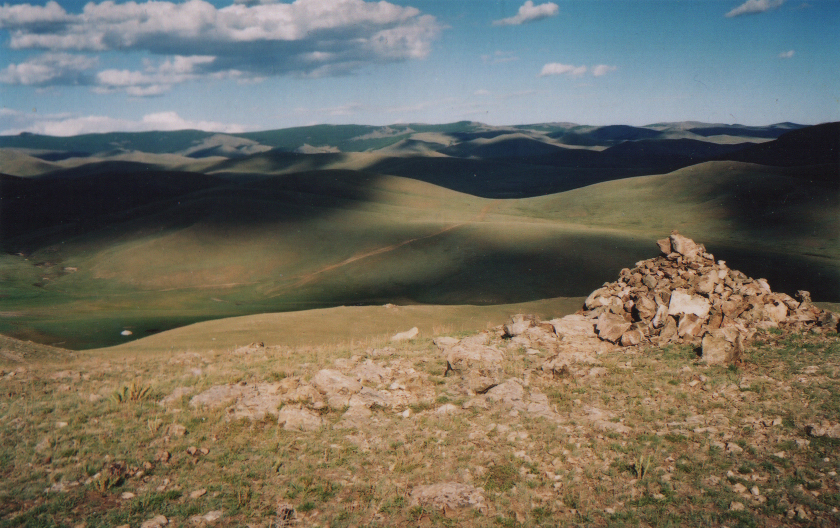
to walk across the stunning expanses of deserted grasslands, back in the direction
of the city. White clouds cast dark
shadows on the low, rolling hills which stretched out into the infinite
distance, giving the impression of vast, never-ending space. The clear air invigorated me, and I spent one
further night on the steppe, this time comfortably wrapped up in my space
blanket from the start. I awoke early
the next morning, found the road, and hitched a ride in an ancient land rover
back into Ulaan Baatar,
with several hours to spare before my train to Europe was scheduled to leave.
Two days later
and I find myself in Russia, buying smoked fish from a stocky, mean-looking Siberian babushka
on a station platform by the shore of Lake Baikal, the largest and deepest body of freshwater in the
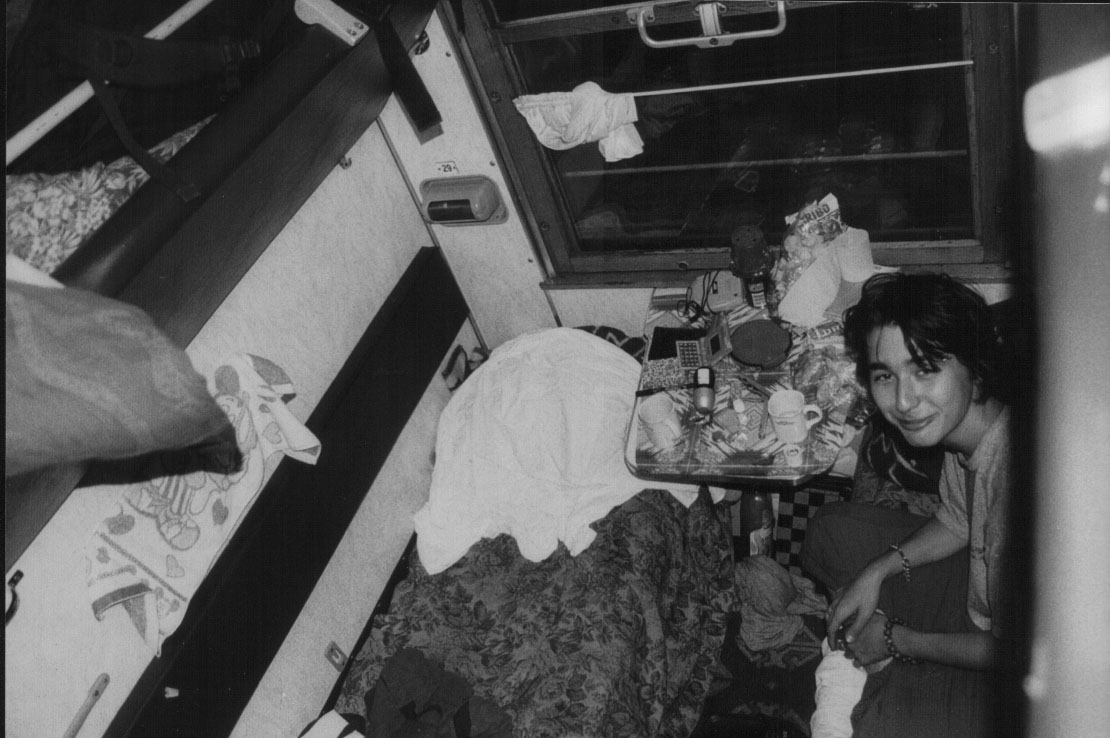
world. Life on the train is comfortable,
but this brief opportunity to get out and stretch my underused legs is
welcome. A whistle blows and I jump back
into the smoky, slightly fusty atmosphere of the East German-built carriage,
make my way to my cabin and lie back on my bunk. My time on the Trans-Siberian has been neatly
divided between sleep, conversation, books, chess and vodka, and the hundred
hours to Moscow pass quickly by to the steady rhythm of wheels on thousands of
miles of rail. Four days after leaving Ulaan Baatar, the train pulls
into Yaroslavski station, Moscow, on time to
the minute.
Randy, an old
friend of mine from Toronto, arranged to meet me at a hostel in Moscow, and on
my arrival, true to form, I find him in the hostel bar trying to seduce a
Russian waitress using very rudimentary Polish.
I manage to drag him away, and we spend the evening toasting my return
to Europe in the gritty bars and clubs of central Moscow. The following morning, we plan the next stage
of the trip, aiming to spend a month getting from Finland
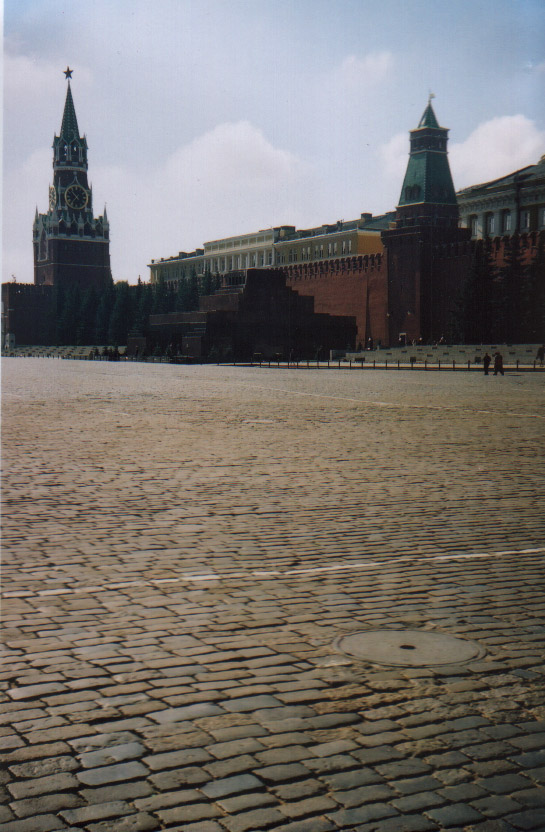
to the Ukraine via the Baltics and Belarus. The afternoon comprises a visit to St.
Basil’s cathedral with its characteristic colourful, twisting domes. Afterwards we visit the tomb of Vladimir
Lenin; the third embalmed communist I have solemnly filed past this
summer. This macabre hat-trick consisted
of Ho Chi Minh in Hanoi, Chairman Mao
in Beijing, and now the father of the great experiment himself, here in the
heart of Red Square.
In an internet
café in Kyiv I realise I’m out of money.
I convert twenty of my last sixty US dollars into Ukrainian
currency. We pay thirty hryvna for a fifteen hour train journey across the former
breadbasket of the Soviet Union, and awake in Lviv, administrative and
cultural centre of western Ukraine. The sister city of Polish
tourist-magnet Krakow, Lviv is a crumbling testament to more
decadent times. Lack of cash and more
than two months of life on the road has gradually increased my tolerance of
squalor, and I find myself sharing a run down room in central Lviv with Randy and Sophie, a French girl we met on a
tram. Our rusting sixth floor balcony
looks out over rows of overflowing rubbish bins, through which an elderly man
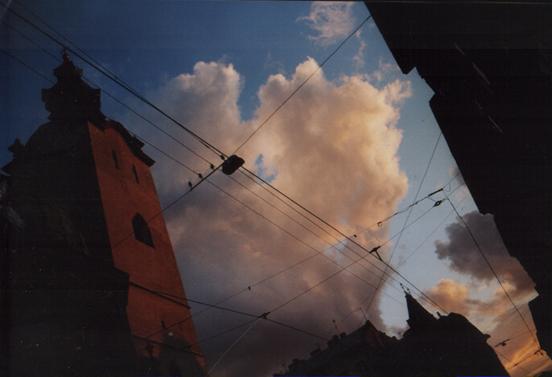
in an old, torn military uniform picks, looking for food. Above him, the spires of Lviv’s
orthodox churches are silhouetted by a majestic sunset, which drenches the
cobbles and the red bricks with crisp, intense rays. The three of us set off and roam the streets
together in the intoxicating light, taking photographs of old cars and placing
Lithuanian coins on the tramlines and standing by as the shuddering, clanking
streetcars flatten them. Sophie has
spent three months in Dnipropetrovsk in eastern Ukraine,
and speaks excellent Russian. I have
managed to convince her to hitch with me across Slovakia
to Bratislava. Randy is catching the bus
to Krakow tomorrow, and we chip in together for a bottle of vodka to
celebrate.
My final night
in the Ukraine was spent in the border town of Uzgorod. Romania, Poland, Hungary
and Slovakia all lie within a hundred kilometres of this crucible of Eastern
Europe, and it has been fought over for centuries. The Slovakian frontier is some five
kilometres from the town, so Sophie and I decide to walk to the border in the
hope of catching a ride from there at least as far as Kosice. In less than a year, this
will form the eastern limit of the European Union, and the contrast between the
two blocs is painfully apparent. The
decaying cobbled road plied by tractors and rusty Ladas ends at the border,
becoming a smooth highway of fresh tarmac to carry the brand new saloons and
people-carriers of affluent Slovakian “Europeans” westward. The exotic stamps in my passport causes some
amusement with the border guards and one of them offers to help us by asking
each car that comes through his post if they’ll give us a ride west. Offers abound, and before long we are on our
way, speeding along the motorway in the car of a Czech window salesman into the
setting sun.
A week later,
the spires of Bratislava, Vienna, Prague and Stuttgart behind me, I prop my hitching board, upon which Cologne is
emphatically scrawled in black marker pen, against a tree and stick out my
thumb. I quickly become sick of
eliciting nothing but embarrassed shakes of the head from lorry drivers, and lie
back in the midday sun to read. Two hours
later, the book is finished, the sun is lower, and still no ride has
materialised. A car pulls over and my
spirits are lifted, but it’s just the German police wanting to see my
documents. They have trouble believing
that I’ve come overland from Bangkok and they scrutinise my passport for what seems like an eternity
before handing it back and driving off, not even offering a lift to the next
junction. Bored and dejected, I squat
down and begin searching through a patch of clover for any with four leaves,
when the thick Welsh accent of a young blonde girl asks, “Are you looking for a
ride to Cologne?” The girl and her German
boyfriend, Franz, are heading my way and soon we’re pulling out of the rest
area and begin sharing our life stories.
My faith in the generosity of strangers restored, we cruise north-west
on the autobahn.
In Cologne, I offer
Franz three packets of Lithuanian cigarettes bought in Vilnius with the
intention of bribing Belarusian border guards, jump on a tram and find the
hostel. It’s a fancy, expensive
establishment, but I pay the man at reception a ten and he gives me change for
a twenty. He doesn’t notice, and, too
poor for morality, I pocket it. It means
I can get a train to Amsterdam instead of hitching. I am
tired, I feel like I’ve walked from Stuttgart. I clamber into bed, undressing in the dark so
as not to wake the faceless forms in the other bunks, and enter a dreamless
sleep. I leave before any of them wake
up, cross the Rhine at sunrise, and catch the train to Amsterdam.
The final night
of my journey is spent with Van, a friend whom I met back in Vietnam,
over two months ago. In Hoi An, she and
I spent several nights putting the world to rights on a balcony watching
thunderstorms in the distant Laotian mountains, and here we are eating in a
small Thai restaurant in a back street by the canals of Amsterdam. She had left Vietnam
with her family in a flimsy boat in 1985, was rescued by the Australian navy,
and settled in Holland. Her return this summer to
the land of her birth has made a profound impression on her, and tonight she is
full of plans to return and help build a school in a minority village near Ho Chi Minh City. She tells me all about it
as we wander around the canals and buzzing streets and I start to think, for
the first time, about what returning home will be like. I have been rushing headlong west for so long
now and suddenly I see this brick wall looming on my horizon. In twenty-four hours P&O will be carrying
me up the Tyne past the abandoned shipyards and trendy residential developments
for the upwardly mobile, before depositing me back on English soil for the
first time in a quarter of a year.
“Do you have somewhere to stay?”
“Sorry… oh. No. No
I haven’t.”
“We can go and stay with a friend of
mine. Do you like cats?”
The sound of
bagpipes woke me from a troubled sleep.
My cat allergy was particularly bad that night, and I spent most of it
sneezing, tossing and turning. I parted
the Venetian blind and looked down to see, fifteen storeys below, thousands of
runners assembled for the start of the Amsterdam
marathon. Serenading them with the
national caterwaul of Scotland, were a group of people dressed in full Highland garb. Van and her friend, a Turkish medical student
whose exceptionally bright and inquisitive two-year-old daughter was already
able to speak elements of Turkish, Dutch, English and Indonesian, cooked
breakfast while I packed my rucksack for the last time. The little girl watched with some amusement
as the strange Englishman struggled to overcome his troublesome laundry
bursting out from all sides. I looked up
at her, and for a second saw the bright eyes of a nameless Thai girl in the sick
infant’s ward eight thousand miles away in Bangkok sparkling
back at me. I realised she had probably
died some time ago, maybe while I was in China or Russia. Maybe she had held on till I reached Estonia,
I’ll never know. The crack of a starting
pistol brought me back to Holland, and the crowds cheered as the marathon runners set off.
I while away the
bus ride from Amsterdam to the North Sea ferry port of Ijmuiden shooting the breeze with a Dutch teacher. We talk of his plan to buy a car in Mexico
and about my time on the Trans-Siberian.
I wish him luck with his future travels as he gets off. The bus slowly empties, until I am left alone
with my thoughts. The grass becomes
longer, and the landscape more windswept as I near the North Sea, and the end of a
continent. Slowly, the funnels of the Newcastle ferry
appear behind the sand dunes.
http://www.geocities.com/m_spirello/image001.jpg
http://www.geocities.com/m_spirello/image003.jpg
http://www.geocities.com/m_spirello/image005.jpg
http://www.geocities.com/m_spirello/image007.jpg
http://www.geocities.com/m_spirello/image008.jpg
http://www.geocities.com/m_spirello/image010.jpg
http://www.geocities.com/m_spirello/image012.jpg
http://www.geocities.com/m_spirello/image013.jpg
http://www.geocities.com/m_spirello/image016.jpg
http://www.geocities.com/m_spirello/image018.jpg