Results:
Marble
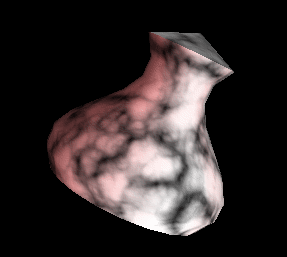
These are the models generated via this program. The first sequence is an implementation of the sharpened marble function. Here turbulence is scaled by a constant, called turbScale, such that its is between 0 and 1 (approximately 1). It is then passed through a hermitian spline mapping, h(t). h(t) is has a domain from 0 to 1, is such that h(0) = 0, h(1) = 1 and the derivative at t = 1 is 0. If the turbulence is greater then one the spline mapping returns 1. The other derivative (df0)is a parameter of the sequence. It controls the sharpens of the marble cracks. The turbulence scaling factor (turbScale) is the other parameter. The following are pictures of a solid of revolution with they applied marble texture. There are 3 light sources, 2 white light source and a red one. The parameter values are show with each picture:
turbScale = 8, df0 = 1.4
turbScale = 10, df0 = 2
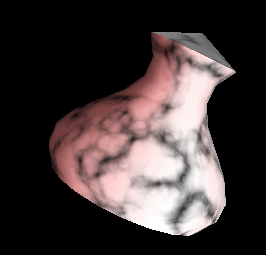
turbScale = 7, df0 = 1
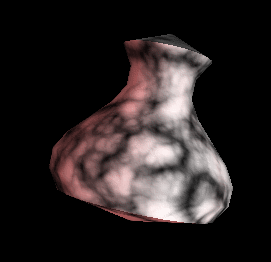
As we can see from these pictures increasing df0 controls the sharpness of the cracks and as we increase df0 the sharpness increases. turbScale also changes the appearance of marble. As we increase it the values of Marble(x,y,z) are generally larger and tend to be limited or clipped (by the spline mapping) to 1. Thus increase turbScale has the effect of making the marble more white.
In the above result we used a frequencies range of f = 4 to f = 32 (i = 2 to i =5 of turbulence function). To see the effects of different frequencies the following marble textures were produced for the regular marble function which is simply a scaled turbulence function.
freqRange = [4 32](i = 2 to i = 5), turbScale = 8
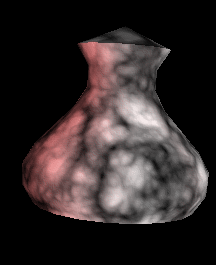
freqRang = [1,32] (i = 0,i = 5), turbScale = 1
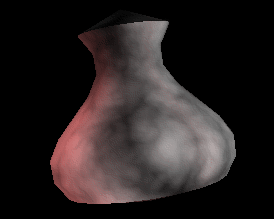
Here we see that adding lower frequencies made the marble smoother, with less defined cracks.
Wood
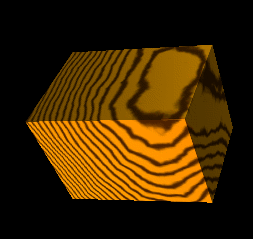
Here are the resluts of teh implementation of wood texturing . The colors used here are brown and yellow, indicating a stained furnishing. In these images the parameters for ring frequency scale and turbulence scale were varied. Here we see we don't want to add too much turbulence since the ring structure needs to be apparent, and we can't have too high a ring frequency to avoid aliasing during texture generation.
ringFreq = 15, turbScale =2
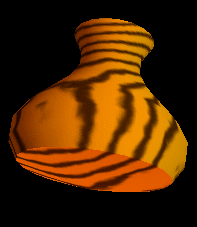
ringFreq = 15, turbScale =3
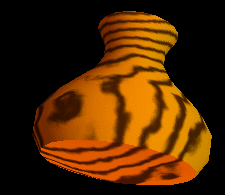
ringFreq = 15, turbScale =3
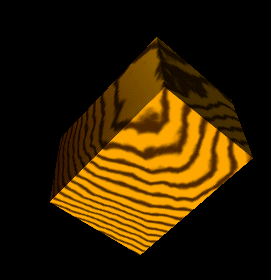
ringFreq = 20, turbScale =3
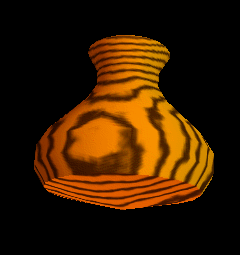
ringFreq = 20, turbScale = 3