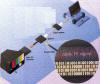
How Cable Modems Work
A coaxial cable (also called a “broadband wire”) comes into your home from a pole on the street. The cable is divided into two connections by a splitter inside your home. One part of the wire goes to your cable box for your cable TV access. The other half goes to your cable modem (also called a “broadband modem”).
The cable modem is attached to an Ethernet network card in your computer. The signals for sending and receiving data to and from the Internet travel through the coaxial cable, through the cable modem, and into your computer through the network card. The coaxial cable carries both cable TV and computer signals at the same time.
The cable company divides each city into neighbourhoods of about 500 homes, all of which are connected to the same local area network called a “node.” TV and internet data travel to and from all 500 homes to the node over coaxial cables. If many people access the Internet on the same node, Internet access would be slower than if only a few people were accessing the Internet. The nodes are connected to a head end cable facility by high-speed fibre-optic lines. One head end handles the nodes from about 4-10 towns, and provides TV programming and Internet to all customers. The head end receives television transmissions from satellites and Internet access from high speed links.
Proxy servers cache current versions of frequently visited sites on the Internet in their memory. A proxy server is a server located between a client, such as a Web browser, and the server the client is trying to contact, and which tries to fulfill the request before sending it to the server. A proxy server could be used to speed up the delivery of Web pages. This allows cable modem customers high speed access because they will get access to these sites through the coaxial cables instead of from the slower parts of the Internet.