
Karol Wojtyla was a man who did what he thought was best, even if it threatened his life. He studied to become a priest amidst the Nazi’s domination of Poland. He was dubbed by many as the man who ended Communism in Poland and also encouraged other oppressed peoples to redefine themselves.
Wojtyla was born on May 18, 1920, in Wadowice, Poland. When his mother died in 1929, his Father continued to support Karol so that he could continue his education. As a child, Karol was an athlete and had many Jewish friends, something that would affect him during the Nazi occupation of Poland. Wojtyla then studied further at Jagiellonian University in Krakow.
When the Nazi’s occupied Poland in 1938, Karol Wojtyla’s faith was tested. Most of his childhood friends, because they were Jewish, were put into concentration camps by the Nazis. But Karol did not falter and instead he sought priesthood in the Catholic Church, something that the Nazi’s were forbidding. Through an underground Catholic society, Karol Wojtyla studied for the priesthood and on November 1, 1946, he was ordained a priest. Although practicing the Catholic religion during the Nazi Occupation would have cost him his life, Karol followed his faith in his calling from God and became a priest. While a priest, Wojtyla earned a doctorate in theology at the Anglicum in Rome in 1948, served as a parish priest in the Krakow diocese till 1951, then taught at Krakow seminary and University of Lublin until 1958. On July 4, 1958, Karol was appointed an auxiliary bishop in Krakow and then about five years later, he became the Archbishop of Krakow on December 30, 1963.
On October 16, 1978, Karol Wojtyla became Pope John Paul II, the first non-Italian one for 455 years and the youngest in 132 years. John Paul II stuck to the teaching of his Faith and said no on issues like abortion, contraception, divorce, homosexuality and marriage of priests. He took trips to 120 countries and endured two assassination attempts. It is said that in his June 1979 trip to Poland, he sparked the nonviolent revolution against the Soviet Blocs. He challenged the people of Poland during a homily on this trip to rediscover their nationality, which led to the formation of Solidarity, a nonviolent resistance movement. Solidarity became responsible for the end of Communism in Poland and triggered revolutions all across Eastern Europe and Russia. After the Communist reign had ended, the Pope met with Mikhail Gorbachev, the Kremlin chief of the Communists in 1989. In this meeting, he established ties with Moscow. One of John Paul II’s most famous quotes regarding the fall of Communism was that “the claim to build a world without God has been shown to be an illusion.”
On April 2, 2005, John Paul II died at the age of 84. He had suffered from Parkinson’s disease and the effects from an attempted assassination.
Karol Wojtyla is a man of faith in many ways. He risked his life during the Nazi Occupation answering his call to God and becoming a priest. He exemplified his faith in the teachings of Catholicism when he rejected changes to issues on abortion, priest marriage, etc. He showed the most faith when he started the anti-Communist revolution. The Communist could have easily had him assassinated for his actions but he still preached his views. He showed faith in his struggle with health. Battling Parkinson’s disease and the effects of an assassination attempt for an estimated 13 years, John Paul II still kept tight control over the papacy. He also showed faith in his would-be-assassin when he pardoned him inside his jail cell. Throughout Karol Wojtyla’s life, while Pope and while not, he showed great faith.
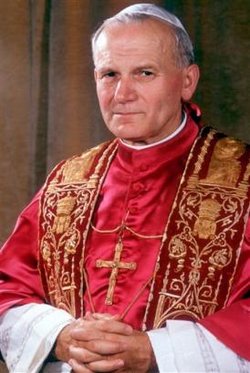
Chew, Robin. “Pope John Paul II Leader of the Roman Catholic Church.” Lucid Interactive. (May 1996): n. pag. Online. Internet. 29 May, 2005. Available "http://www.lucidcafe.com/library/96may/johnpaul.html" http://www.lucidcafe.com/library/96may/johnpaul.html
“Pope John Paul II.” n. pag. Online. Internet. 28 May, 2005. Available. http://en.wikipedia.org/wiki/Pope_John_Paul_II.
“Pope John Paul II and Communism.” n. pag. Online. Internet. 28 May, 2005. Available."http://religion-cults.com/pope/communism.htm" http://religion-cults.com/pope/communism.htm.