1. Write a summary of THE KEY idea of this section. State the KEY IDEA clearly in your first sentence.
The key idea of this section is the morality of Jesus. The morality of Jesus concerns the ways he taught men and women to live, especially in the Sermon on the Mount, as well as how much different he taught than the prophets in the Old Testament and the scribes and pharisees of that day. Jesus himself proclaimes, "Do not think that that i have come to abolish the law and the prophets. I have come, not to abloish them, but to fulfill them."(Matthew 5:17) By saying this, he both separated himself from the prophets and those who taught the law, and he connected himself to them by saying that he would fulfill their teachings. He taught against common laws such as "an eye for an eye" and instead taught to "turn the other cheek" instead. He taught to not only love your fellow countrymen, as the Old Testament had taught, but to love even your enemies. William O'Malley, S.J. pointed out in his article "The Moral Practice of Jesus" that Jesus enjoyed the company of prostitutes, tax collectors, and the all around sinners of the community, and instead disliked the msot awed and revered people of the Jewish community, the Pharisees. It was this anti-cultural behavior that made stand out from the Old Testament prophets and Pharisees and which sums up the moral teachings of Jesus.
2) Give and explain three of the most important ideas you want to remember from this week. Cite and explain the idea and tell why you think it is worth remembering. These must come from different parts of the section.
A) The Importance of the Beatitudes.
B)The People of Le Chambon
I think that the people of Le Chambon during the Nazi occupation exemplified Jesus' teachings in the Judgement of Nations very well by taking in the Jews. They are a perfect example of how one should treat other the way one's self would like to be treated. These people forgot about their lives and all their worldly goods they would be sacrificing to save the lives of the Jewish refugees.
C)William J. O'Malley's Notes on Forgiveness and Jesus
Another thing that I want to remember was something that Fr. O'Malley pointed out in his article, "The Moral Practice of Jesus." He pointed out, "the only requisite-- in the moral practice of Jesus--was admitting one's need of forgiveness." I think that this is important because I think that it is the hardest step to take in forgiveness. The hardest step towards going to reconciliation is admitting your sins. Not necessarily to the priest, but at least to the person you sinned against and to yourself. People say that the hardest step toward recovering from an addiction or going through any type of mental therapy is getting out of denial and admitting that your depressed or an alcoholic or whatever it may be. I think that what O'Malley is saying is like this. Jesus recognizes that the hardest and most important step is getting out of that denial in a way and going towards repentance.
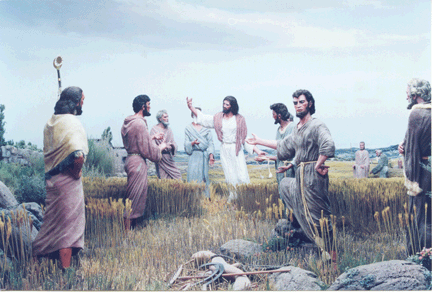
3) One image of that reminds you of the topic.
4) What is a Christian? Are you a Christian? What did your pre-sermon survey reveal? Did you show you know what Jesus taught, believed and try to follow His teachings? If so explain how being a Christian really affects your morality, If not, explain the base of your moral system.
A Christian is someone who fully lives and believes the teachings of Jesus Christ. Before this study in my survey, a couple of my responses to the questions would have indicated that I was not a Christian. Before this survey, I figured that some of the ways I lived conflicted with the teachings of Jesus, but I never put forth any surmountable effort to right these wrongs and I kept on doing them. I continued treating my enemies badly, ending arguements the wrong ways, and continued to put people down on occassion. This is not to say that I dont follow Jesus' teachings on other matters. But, since I have not totally strived to fulfill all of Jesus' teachings, I would say that I cannot completely consider myself a Christian.
5) What can a person do to try to do to make themselves a better Christian? If you are a Christian, please personalize this: What can you do to try to do to make yourself a better Christian?
To make myself a better Christian, I need to first of all start treating my enemies equally as good as my friends as well as avoiding the anger that leads to arguements and stop putting people down on occassion. Those are three basic things from Jesus' teachings that I dont follow at all times of my life. Once I start legitimetly trying to follow those teachings, I can say that I am trying to become a better Christian.