Journal 1
9/9/05
1) A summary of the key idea from this section, Misconception of Reality
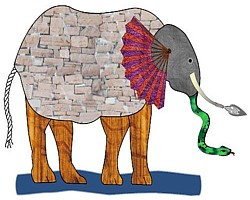
In this section, we talked alot about different misconceptions of reality. An example of misconception of reality is Plato's "Allegory of the Cave." In the "Allegory," men are chained so that they can only see the wall in front of them. Behind them is a fire and a tunnel out of the cave from which sunlight comes. In front of the fire is a stand that has different shapes on it. The fire and the sunlight combine to cast the shadows of the men and of the shapes on the wall in front of the men. These men believe that the shadows they see are real things and that they actually exist, and aren't just shadows of real things. Another example is in Buddha's "The Blind Men and the Elephant." All the blind men beleive that what they think is the elephant is real and they argue about it with each other. The misconception of reality is that they cannot know what the elephant is because they are blind and cannot actually see and know what the elephant is.Other examples of this misconception of reality can be found in the lives of Deion Sanders, Eric Clapton, and John Hormon.
2) 3 of the Most Important Ideas I Want to Remember
a) Five Foundational Lessons of Faith
I need to remember The Five Foundational lessons of Faith. It is a list of ideas that help us understand how we make decisions and how we should make decisions. They help us decipher the good decisions from the bad, and the important from the less significant.
- Lesson #1: I am necessarily and unavoidably making decisions all the time. These can and do affect me, others, and my world. By these decisions, I am determining who I am and the person I will become.
- Lesson #2: I see the world through "colored lenses." I am necessarily and unavoidable (to a greater or lesser degree) biased.
- Lesson #3: The value judgments I make determine my action. My mental health and happiness (and often those of many others) rests on the validity of these value judgments.
- Lesson #4: Any change in the particular beliefs that control my life cannot help but change and modify my life. It will affect the quality and texture of all that I experience.
- Lesson #5: The most significant decisions I make in my life need to be faith decisions. Faith is an opinion based on evidence to which I am committed.
b) "Man for Others" in Gates of Fire
I need to remember the ideal of "Man for Others" in Gates of Fire. In the book Gates of Fire, Bruxeius tells Xeo that everyman needs a city to belong to. Xeo finds his city in Sparta, where he becomes part of the brotherhood of the Spartan's in the Battle at Thermopylae. In battle, we find out that the soldiers not only carry their shields for their protection, but also for the person next to them. This brotherhood is related to the Jesuit ideal of "Man for Others."
c) Icarus and Daedelus
I need to remember the story of "Icarus and Daaedelus." In this story, Daedelus tells his son Icarus not to do two things when he flies away. He tells Icarus not to fly too low because he might touch the water and the wings of feather and wax would fall apart. He also tells him not to fly to high because the wax might melt if it got too close to the sun. But Icarus becomes overjoyed and flies too close to the sun, causing his wings to melt and him to fall to his death into the sea. This shows us that we can sometimes get too excited and forget things, putting ourselves and others in danger.
One Good Question I should keep with me...
Am I making good, conciencious decisions all the time? Am I aware that what I do can and will affect myself and others?
The question I just asked myself above is what I need to do make myself a better person. By constantly asking myself this question I could prevent myself from doing alot of things right now as well as in the future. Sometimes I drive a little fast or don't take stop signs as seriously as I should. Sometimes I drink way too much caffinated soda and have to rely on it to keep myself awake at night. These are all things that I can stop doing if I start asking myself this question. Also, sometimes when your caught up in the heat of an arguement, You find yourself thinking of something to say, and sometimes these things are bad and can hurt the other person or persons. If I stop and ask myself the question I can prevent myself from saying bad things and prevent myself from having the arguement in the first place. This question can help myself be a better friend, student, son, and brother.