|
|
Laboratory
Diagnosis
1.
Approaches to Diagnosis of Viral
diseases
a.
Virus Isolation:
i.
the clinical virologist provides living systems in which viruses will
proliferate.
ii.
cell cultures are the living system used in most clinical laboratories.
iii.
although the viral particles cannot be seen as they replicate in cell
cultures, their presence is signaled by changes in the appearance of the
virus-infected cells.
iv.
these changes, called cytopathogenic effect (CPE), can be detected when
cells are viewed with an ordinary light microscope.
v.
CPE may be detectable in 24 to 48 hours with viruses such as herpes
simplex virus and some of the enteroviruses; however, many viruses require 7 to
10 days or more for detection.
b.
Viral antigen detection:
i.
use of immunological techniques, which rely on the specific reactivity of
known viral antibodies with their antigens, to demonstrate that viral antigens
are present.
ii.
the binding of antibodies and antigens is signaled to the clinical
virologist through reactions such as agglutination, fluorescence, or color
change, which can be observed visually or measured using a spectrophotometer.
iii.
viral antigens present within infected cells in viral cultures or in
samples taken directly from the infected individual can be detected and
identified.
iv.
the process usually takes a few hours to complete.
c.
Viral serology:
i.
use of standard serological methods to detect specific antibodies that
have been produced by the host in response to viral infection or exposure.
ii.
by demonstrating that antibodies are present or that there is a change to
antibody level, the virologist can provide valuable information concerning viral
disease status.
iii.
this approach is useful in circumstances in which the virus cannot be
conveniently isolated in cell culture nor its antigens detected by routine viral
antigen detection methods.
d.
Molecular diagnostics:
i.
through application of molecular probes, which are labeled DNA sequences
that are complementary to unique portions of viral DNA, viral nucleic acids
within infected cells can be detected and identified.
ii.
this technology paired with polymerase chain reaction, allows detection
of minuscule quantities of viral nucleic acids that may be missed by traditional
viral assays.
2.
Need for Laboratory Diagnosis
a.
Precise diagnosis needed for prescription of appropriate antiviral
chemotherapy.
b.
Management of the patient or prognosis is influenced by the diagnosis –
abortion is recommended if rubella is diagnosed in the first trimester of
pregnancy.
c.
Infections may demand public health measures to prevent spread to others
– blood banks routinely screen for HIV and hepatitis B and C viruses which may
be present in blood donated by symptomless carriers.
d.
Surveillance of viral infections may determine their significance,
natural history, and prevalence in the community, with a view to establishing
priorities and means of control, and monitoring and evaluating immunization
programs.
e.
Continuous surveillance of the community may provide evidence of new
epidemics, new diseases, new viruses, or new virus-disease associations.
3.
Collection, Packaging and Transport of
Specimens
a.
Successful isolation and identification of a viral agent from clinical
material depend on proper care in selecting, collecting and transporting the
specimen to the laboratory.
b.
Time of Collection:
i.
virus shedding is greatest during the acute stage of illness; therefore,
specimens should be collected as soon as possible after the onset of illness.
ii.
the chance of viral recovery is best during the first 3 days after onset
and is greatly reduced with many viruses beyond 5 days.
c.
Site of collection:
i.
the selection of the specimen is based on the site of infection or
clinical syndrome or the virus suspected.
ii.
specimens such as blood, throat swabs, spinal fluid, stools, vesicle
fluid, lesion scrapings, and urine are usually submitted for virus isolation.
iii.
swabs are used for collection of many types of samples, such as those
from the nose or throat or from skin or genital lesions.
iv.
cerebrospinal fluid may yield virus in cases of meningitis.
v.
biopsy or autopsy specimens may be taken by needle or knife from any part
of the body for virus isolation, or snap-frozen for immunofluorescence.
d.
Collection of Specimens:
|
Syndrome |
Specimen |
|
Respiratory |
Nasal
or throat swab; nasopharyngeal aspirate; sputum |
|
Enteric |
Feces |
|
Genital
|
Genital
swab |
|
Eye |
Conjunctival
(and/or corneal) swab |
|
Skin |
Vesicle
swab/scraping; biopsy solid lesion |
|
Central
nervous system |
Cerebrospinal
fluid |
|
Generalized |
Throat
swab, feces, blood leukocytes |
|
Autopsy/biopsy |
Relevant
organ |
|
Any |
Blood
for serology |
e.
Packaging of specimens:
i.
because of the lability of many viruses, specimens intended for virus
isolation must always be kept cold and moist.
ii.
immediately after collection the swab should be swirled around in a small
screw-capped bottle containing virus transport medium.
iii.
this medium consists of a buffered balanced salt solution, to which has
been added protein (e.g. gelatin or albumin) to protect the virus against
inactivation, and antibiotics to prevent the multiplication of bacteria and
fungi.
iv.
the swab stick is then broken off aseptically into the fluid, the cap is
tightly fastened and secured with adherent tape to prevent leakage.
f.
Transport of specimens:
i.
if a transit time of more than an hour is anticipated the container
should be sent refrigerated with ‘cold packs’ (4C) or ice in a thermos flask
or styrofoam box.
ii.
international or transcontinental transport of important specimens,
particularly in hot weather, generally requires that the container be packed in
dry ice to maintain the virus in a frozen state.
4.
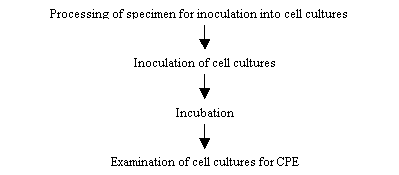
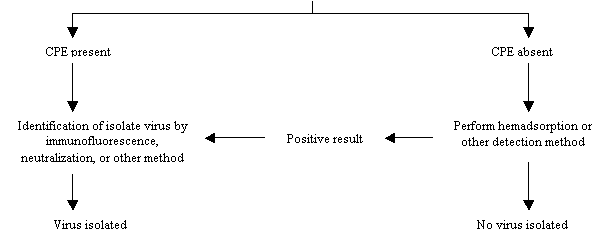
Sequence of Viral isolation Procedures

5.
Microscopic Identification
a.
Viruses can be detected and identified by direct microscopic examination
of clinical specimens such as biopsy material or skin lesions.
b.
Light microscopy:
i.
light microscopy can reveal characteristic inclusion bodies or
multinucleated giant cells.
ii.
the Tzanck smear shows herpesvirus-induced multinucleated giant cells in
vesicular skin lesions.
iii.
largion virions, e.g. Guarnieri bodies of poxviruses.
iv.
inclusion bodies representing viral aggregates.
v.
detection of viral antigen, e.g. by immunofluorescent mononuclear
antibody.
c.
UV microscopy is used for fluorescent-antibody staining of the virus in
infected cells.
d.
Electron microscopy detects virus particles, which can be characterized
by their size and morphology.
6.
Cytopathogenic Effect
a.
Many viruses infect susceptible cell cultures and produce degenerative
cellular changes, which can be observed microscopically – these changes are
called cytopathogenic effect (CPE) of the virus.
b.
CPE appears because the virus integrates itself into the cellular nucleic
acid and then directs the cell to manufacture viral components rather than the
cellular components needed by the cell for its own maintenance.
c.
Without the needed components, the cell degenerates, and the cellular
morphology changes – these changes are viral CPE.
d.
The CPE of a virus may involves all parts of the cell and is usually
constant for a specific virus and type of cell culture.
e.
Types of CPE:
|
CPE
type |
Description |
|
Vacuoles |
Large,
frothy, bubble-like areas usually in the cytoplasm of infected cells. |
|
Syncytia |
Large
cell masses that may contain up to 100 nuclei. Result
from fusion of virus-infected cells. Fusion
may result from changes in protein synthesis in the infected cells and
facilitates cell-to-cell spread of the virus. |
|
General
morphological changes |
Cells
may become rounded, swell, shrink, or form grapelike clusters. |
|
Loss
of adherence |
Infected
cells often lose their ability to adhere to the culture vessel. They
may float free in the culture medium, leaving clear areas or fine
prolongations. |
|
Cellular
granulation |
Cells
have a dark, rough, finely speckled appearance. |
6.
Detecting Cytopathogenic
effect-negative Viruses
a.
Because some viruses may produce CPE slowly or not at all, alternative
methods have been devised for detecting the presence of viruses when CPE is
absent.
b.
Hemadsorption:
i.
during replication, some viruses may discretely alter cell surfaces.
ii.
viral hemagglutinating proteins, specified by the viral genome, are
expressed on the plasma membranes of virus-infected cells.
iii.
these same hemagglutinating proteins are present on the envelope of the
infecting viruses and are responsible for the affinity for erythrocytes that
occurs in infected cells.
iv.
the hemadsorption procedure is used to test cell culture cells for their
affinity for erythrocytes.
c.
Hemadsorption testing:
i.
the cell culture medium is removed from infected cell cultures and
replaced with a suspension of erythrocytes (usually guinea pig).
ii.
the culture is refrigerated for 30 minutes at 4C and observed
microscopically; then the tubes are incubated at 35C for 30 minutes and observed
again.
iii.
if a hemadsorbing virus has altered the surfaces of the cells, the
erythrocytes will not adhere to uninfected cells.
iv.
it is used as a screening method for respiratory viruses such as
influenza and parainfluenza during seasons when the respiratory viruses are
prevalent.
d.
Plaquing:
i.
a viral suspension is added to a monolayer of cultured cells.
ii.
the cell culture is then covered with a nutrient agar mixture containing
a vital dye, usually neutral red, which is taken up by living cells.
iii.
as the virus replicates and destroys the cells, the neutral red is
released by dead or dying cells, leaving cleared areas called plaques.
e.
Hemagglutination:
i.
some viruses, or an antigen derived from them, are capable of binding to
erythrocytes through complementary receptor sites on the erythrocyte surface.
ii.
the binding of virus and erythrocyte is called viral hemagglutination.
iii.
in hemagglutination testing, a viral suspension is diluted and mixed with
a suspension of erythrocytes of the appropriate species.
iv.
the mixture is incubated and the erythrocytes settle to the bottom of the
tube.
v.
unagglutinated erythrocytes form a pellet in the center of the bottom of
the tube; agglutinated erythrocytes make a layer of small clumps, which covers
the bottom of the tube.
7.
Enzyme Immunoassay
a.
Enzyme immunoassay (ELA) or enzyme-linked immunosorbent assay (ELISA) are
designed in different formats to detect antigen or antibody.
b.
Most are solid-phase ELAs; the ‘capture’ antibody is attached (by
simple absorption or by covalent bonding) to a solid substrate, typically the
wells of polystyrene or polyvinyl microtiter plates, so facilitating washing
steps.
c.
Direct ELA:
i.
virus and soluble viral antigens from the specimen are allowed to
adsorbed to the capture antibody.
ii.
after unbound antigen has been washed away, an enzyme-labeled antiviral
antibody is added.
iii.
various enzymes can be linked to the antibody; horseradish peroxidase and
alkaline phosphatase are commonly used.
iv.
after a final washing step, readout is based on the color change that
follows addition of an appropriate organic substrate for the particular enzyme.
v.
the test can be made quantitative by serially diluting the antigen to
obtain an end point, or by using spectrophotometry to measure the amount of
enzyme-conjugated antibody bound to the captured antigen.
d.
Indirect ELA:
i.
they are widely used because of their greater sensitivity and avoidance
of the need to label each antiviral antibody in the laboratory repertoire.
ii.
here, the detector antibody is unlabeled, and a further layer, labeled
(species-specific) anti-immunoglobulin, is added as the ‘indicator’
antibody.
e.
Radioimmunoassay:
i.
the only significance is that the label is not an enzyme but a
radioactive isotope such as I-125, and the bound antibody is measured in a gamma
counter.
ii.
the RIA is a highly sensitive and reliable assay that lends itself well
to automation, but the cost of the equipment and the health hazard of working
with radioisotopes argue against its use in small laboratories.
8.
Immunofluorescence
a.
Principles:
i.
the antibody is labeled with a fluorochrome.
ii.
the antigen-antibody complex, when excited by light of short wavelength,
emits light of a particular longer wavelength.
iii.
the emitted light is visualized as fluorescence in an ordinary microscope
when lights of all other wavelengths is filtered out.
b.
Direct Immunofluorescence:
i.
a frozen tissue section, or an acetone-fixed cell smear or monolayer on a
coverslip, is exposed to fluorescein-tagged antiviral antibody.
ii.
unbound antibody is then washed away, and the cells are inspected by
light microscopy using a powerful ultraviolet / blue light source.
iii.
the apple-green light emitted from the specimen is revealed (against a
black background) by incorporating filters in the eyepieces that absorb all the
blue and ultraviolet incident light.
c.
Indirect Immunofluorescence:
i.
it differs in that the antiviral antibody is untagged.
ii.
it binds to antigen and is itself recognized by fluorescein-conjugated
anti-immunoglobulin.
iii.
the high affinity of avidin for biotin can also be exploited in
immunofluorescence by coupling biotin to antibody and flurescein to avidin.
d.
Advantages:
i
.though technically demanding, immunofluorescence has proved to be of
great value in the early identification of viral antigens in infected cells
taken from patients with diseases with a small number of possible etiological
agents.
ii.
there is no difficulty in removing partly detached infected cells from
the mucous membrane of the upper respiratory tract, genital tract, eye, or from
the skin, simply by swabbing or scraping the infected area with reasonable
firmness.
iii.
cells are also present in mucus aspirated from the nasopharynx.
e.
Respiratory infections with paramyxoviruses, orthomyxoviruses,
adenoviruses, and herpesviruses are particularly amendable to rapid diagnosis by
immunofluorescence.
f.
Immunofluorescence can also be applied to infected tissue, for example,
brain biopsies for the diagnosis of herpes simplex encephalitis or measles SSPE.
9.
Virus Neutralization
a.
The neutralization test is based on the principle that a live virus, when
acted on by its specific antibody, will be neutralized and thus incapable of
infecting susceptible cells.
b.
The neutralization procedure is performed in two stages:
i.
first stage: live virus and antibodies are reacted.
ii.
second stage: aliquots of stage one mixture are inoculated into
susceptible cell cultures.
c.
After a suitable incubation period of 5 to 7 days, the host tissue is
examined for the presence of cytopathogenic effect.
d.
If antibodies bind to the virus in stage one, the virus is neutralized
and prevented from infecting the susceptible cell culture to produce a
cytopathogenic effect.
e.
If antibodies do not bind to the virus in stage one, the virus remains
active and infects the susceptible cells to produce a cytopathogenic effect.
f.
Neutralization can be used for identification of either unknown virus or
viral antibodies:
i.
when an unknown virus is to be identified, a suspension of the unknown
virus is mixed with antibodies of known specificity in stage one of testing.
ii.
if unknown antibodies are to be identified, a suspension of known virus
is mixed with the patient’s serum that contains the antibodies of unknown
specificity.
10.
Complement Fixation
a.
It is used to identify viral antigens or viral antibodies.
b.
The complement fixation assay is based on the principle that complement,
a lytic agent, is bound (fixed) by antigen-antibody complexes.
c.
Complement fixation is a two-stage examination:
i.
stage one: antibody, antigen, and complement are mixed and incubated for
18 to 24 hours; if the antibody is specific for the antigen, antigen-antibody
complexes form, and the complement is fixed.
ii.
stage two: antibody-coated erythrocytes, which serve as antigen-antibody
complexes, are added to the stage one mixture and incubated for 1 to 2 hours.
iii.
if the complement was fixed by antigen-antibody complexes in stage one,
it is no longer active or available to act on the antibody-coated erythrocytes,
and the erythrocytes remain intact and are not hemolyzed.
d.
Therefore, an absence of hemolysis indicates that the antigen and
antibody of stage one were specific for each other.
e.
Clinical Application
i.
when complement fixation is used for identification of unknown
antibodies, the antigen in stage one is a suspension of known virus, and the
antibody is supplied by adding the patient’s serum.
ii.
it is commonly used for measurement of antibodies against influenza and
parainfluenza viruses.
11.
Hemagglutination Inhibition
a.
The hemagglutinating capacity of a virus is blocked when the virus is
reacted with specific antibody.
b.
Hemagglutination inhibition assays are two-stage assays.
c.
Stage 1:
i.
the live hemagglutinating virus is mixed with antibody.
ii.
if this antibody is specific for the virus, the antibody attaches to the
virus and inhibits it so that it is unable to hemagglutinate.
d.
Stage 2:
i.
erythrocytes are added to the stage one mixture.
ii.
the antibody-coated (inhibited) viruses are unable to hemagglutinate the
erythrocytes.
iii.
when the antibodies in stage one are not specific for the virus, there is
no binding, and the virus remains active and uninhibited.
iv.
when erythrocytes are added in stage two, the active (uninhibited) virus
hemagglutinates the erythrocyte.
e.
This technique is applicable only to viruses with hemagglutinating
ability.
f.
The most common application of hemagglutination inhibition is in the
identification of viral antibodies, including measles, mumps, and rubella
antibodies.
12.
Immunoblotting
a.
Also known as Western blotting, it is the ultimate refinement to test for
antibodies against all of the proteins present in a particular virus.
b.
Principles:
i.
combines electrophoretic separation techniques with antibody detection
methods.
ii.
blotting refers to the transfer of DNA, RNA, or protein from
electrophoretic gels to a membrane.
iii.
blotting is used to prepare the antigen, and an immunoassay method is
used to react antibodies with the blotted antigen, to identify, or characterize
either the blood antigen or the antibodies.
c.
Steps to Western blotting:
i.
purified virus is solubilized with the anionic detergent sodium dodecyl
sulfate (SDS) and the constituent proteins separated into discrete bands
according to molecular size by polyacrylamide gel electrophoresis (SDS-PAGE).
ii.
the separated proteins are electrophoretically transferred
(‘blotted’) onto a nitrocellulose membrane to immobilize them.
iii.
finally, the test serum is allowed to bind to the viral proteins on the
membrane, and their presence is demonstrated using a radio-labeled or
enzyme-labeled anti-species antibody.
d.
Evaluation of Results:
i.
reactivity is signaled by the presence of colored bands at appropriate
positions and of sufficient intensity on the strip.
ii.
the test bands are compared with bands produced by positive control
samples to characterize the bands.
iii.
the immunoblotting technique is used extensively in clinical virology in
the confirmatory testing for HIV-1 antibodies.
e.
Immunoblotting permits demonstration of antibodies to some or all of the
proteins of any given virus and can be used to:
i.
discriminate between infection with closely related viruses sharing
certain antigens.
ii.
monitor the presence of antibodies to different antigens at different
stages of infection.
13.
Applications of Serology
a.
A significant rise in antibody titer between serum samples is indicative
of recent infection:
i.
a serum sample is obtained as soon as a viral etiology is suspected
(acute-phase).
ii.
a second sample is obtained 10-14 days later (convalescent-phase).
iii.
if the antibody titer in the convalescent-phase serum sample is at least
4-fold higher than the titer in the acute-phase serum sample, the patient is
considered to be infected.
iv.
an antibody titer on a single sample does not distinguish between a
previous infection and a current one.
b.
Because of the necessary interval between the two specimens, a diagnosis
is provided only in retrospect.
c.
However, there are two situations when serology is still the diagnostic
method of choice despite the delay involved in waiting for a rising titer to
make itself apparent:
i.
when it is not practicable to attempt cultivation of viruses that are
notoriously difficult to isolate, e.g. some togaviruses and bunyaviruses.
ii.
management of the case is not urgent, e.g. in a woman with a rash during
the first 4 months of pregnancy a clear demonstration of a rising antibody titer
against rubella virus constitutes a strong indication for abortion.
d.
There are also a number of situations when finding antibody in a single
specimen of serum can be diagnostic:
i.
when specific antibody of the IgM class is found.
ii.
when a seriously ill patient recently returned from abroad is found to
have antibodies against an exotic virus, such as Lassa or Ebola virus.
iii.
in the case of certain persistent infections, e.g. HIV, where it is known
that most or all infections progress, the presence of antibody can be used as a
reliable diagnostic marker of ongoing infection.
14.
IgM class-specific Antibody Assays
a.
A rapid diagnosis can be made on the basis of a single acute-phase serum
by demonstrating virus-specific antibody of the IgM class.
b.
Because IgM antibodies appear early after infection but drop to low
levels within 1-2 months and generally disappear within 3 months, they are
diagnostic of recent (or chronic) infection.
c.
Moreover, if found in a newborn baby, they are diagnostic of intrauterine
infection, because maternal IgM, unlike IgG, does not cross the placenta.
d.
ELA, RIA, and immunofluorescence are the generally employed immunoassays
to render IgM class-specific.
e.
A particular problem with IgM assays is interference by the rheumatoid
factor (RF), which is antibody, mainly of the IgM class, directed against
the constant region (Fc) of normal IgG.
f.
RF produces false positives in IgM immunoassays, because it binds to
antiviral IgG in human serum, forming IgM-IgG complexes, which in turn bind the
anti-human IgM employed as detector antibody in the assay format.
g.
To minimize the impact of RF, it is advisable to employ a reverse IgM
assay, in the simplest form of which monoclonal anti-human IgM is used as
the capture antibody and labeled virus as the detector/indicator.
15.
Serological
Procedures used in Virology
|
Technique |
Principle |
|
Enzyme
immunoassay |
Antibody
binds to antigen. Enzyme-labeled
anti-Ig binds to antibody Substrate
changes color. |
|
Radioimmunoassay |
Antibody
binds to antigen. Radio-labeled
anti-Ig binds to antibody. |
|
Western
blot |
Virus
disrupted, proteins separated by gel electrophoresis and transferred onto
nylon membrane. Antiserum
binds to viral proteins. Labeled
anti-Ig binds to particular bands. Revealed
by EIA or autoradiography. |
|
Virus
neutralization |
Antibody
neutralizes infectivity of virion. CPE
inhibition, plaque reduction, or protection of animals. |
|
Hemagglutination
inhibition |
Antibody
inhibits viral hemagglutination. |
|
Immunofluorescence |
Antibody
binds to intracellular antigen. Fluorescein-labeled
anti-Ig binds. Fluoresces
by UV microscopy. |
|
Immunodiffusion |
Antibodies
and soluble antigens produce visible lines of precipitate in a gel. |
|
Complement
Fixation |
Antigen-antibody
complex binds complement, which is thereafter unavailable for lysis of
sheep RBC in presence of antibody to RBC. |
16.
Advantages and Disadvantages of various
diagnostic methods
|
Diagnostic
method |
Advantages |
Disadvantages |
|
Virus
isolation |
Permits
study of agent Highly
sensitive Readily
available |
Slow,
time-consuming, can be difficult. Useless
for nonviable virus. Selection
of cell type, etc. may be critical. |
|
Direct
observation by electron microscopy |
Rapid Detects
viruses that cannot be isolated. Detects
nonviable virus. |
Relatively
insensitive. Limited
to a few viral infections. |
|
Serological
identification of virus or antigen, e.g. ELA |
Rapid
and sensitive. Provides
information on serotypes. Readily
available, often as diagnostic kits. |
Not
applicable to all viruses. Interpretation
may be difficult. |
|
Nucleic
acid probes (with or without gene amplification by PCR). |
Rapid. Very
sensitive. Potentially
applicable to all viruses. |
May
not be readily available. Risk
of DNA contamination in PCR. |
|
Antibody
conversion (acute and convalescent sera) |
Useful
in relating cases to a disease outbreak. |
Slow,
late (retrospective) Interpretation
may be difficult. |
|
IgM
serology |
Rapid |
False
positives may occur |