| Q1) Draw a picture of an imaginary wild animal. Give it a name and describe some interesting features of the animal. |
| a) Draw your animal |
| b) Give it a name |
| c) What interesting feature it has? |
| E.g. Does it move by flying, crawling, gliding, walking? |
| ������ What is its outer covering? Fur, scales, hair? |
| ������ What else is so special about the animal you imagined? |
| Q3) Visit the cat enclosure at the Singapore Zoological Gardens and observe the different species of cats there. Write down the difference between them. |
| Animals |
| Patterns/Colours on outer covering; where they came from |
| Puma |
 |
| Its fur is usually tawny colour, ranging to silvery-grey or reddish. It has lighter patches on the under body including the jaws, chin, and throat. |
| Pumas come from Yukon in Canada or southern Andes of South America. |
| Caracal |
 |
| The colour of its fur may be wine-red, grey or sand-coloured. |
| Caracal can be found in Africa and western Asia. |
| Leopard |
 |
| Its fur has rosettes rather than spots |
| Leopards can be found in many parts of Sub-Saharan Africa, the Middle East, India, Pakistan, China, Siberia and Sri Lanka. |
| Jaguar |
 |
| The Jaguar resembles the leopard physically, although it is of sturdier build |
| Jaguar can be found in many countries from Mexico through Central America and into South America. These countries include Brazil, Costa Rica, Venezuela and Paraguay. |
| �Q5) Write an account of a pet you have. |
| Write a short paragraph to tell me more about your pet/ a pet you have when you were younger / a pet you hope to have. You can include a photo or draw a picture if you want to. |
| E.g. A pet I have |
| �I have a hamster. Her name is cherry. She is very playful and fierce when being disturbed. She is very fat because she likes to eat. She is light grey in colour. She has black eyes. She has two darker grey strips beside her eyes. She gave birth to 6 little hamsters when she was one year old. |
| E.g. A pet I have when I was younger |
| When I was 6 years old, I have two gold fish. I put them in a round fish tank. The scales on their body are made up of orange and white colour. When I first bought them, they are very small. They grew bigger and fatter over the years. They like to swim one behind another. |
| E.g. A pet I hope to have |
| I wished I have a pet dog. I would name my dog Whisky. He has a coat of long golden fur. He likes to play fetch. He will always fetch anything that I throw to him. He likes to eat meat. He sleeps beside me every night. In the morning, he will lick my face to wake me up for school. When I come home, he will bark happily and jump towards me. |
| ��Q7) Observe animals in the Singapore Zoological Gardens and make a simple poster to show examples of one land animal with hair, one aquatic animal with hair, one land animal with feathers, one aquatic animal with features, one land animal with scales, and one aquatic animal with scales. |
| Show at least 2 examples of each of the following animals: |
| Land animals with hair: |
| Apes and Hippopotamus |
 |
 |
| Aquatic animals with hair: |
| Whale and Dolphin |
 |
| � |
 |
| Land animals with feathers: |
| Chicken and Goose |
| Aquatic animals with feathers: |
| Penguin and Duck |
| Land animals with scales: |
| Snake and Komodo Dragon� |
 |
| Aquatic animals with scales: |
| Crocodile and Fish |
| ��Q8) Read up and write short notes on 3 extinct animals. |
| Examples of extinct animals: |
| Dodo Bird |
 |
 |
| The Dodo was a metre-high (three feet). It cannot fly. It has been extinct since the mid-late 17th century. It feeds on fruits. � |
| Falkland Island Fox |
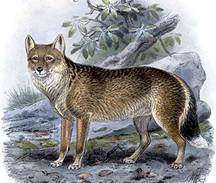 |
| The Falkland Island Fox became extinct in 1876. Its fur had a tawny colour. The tip of its tail was white. It was a very tame animal. It fed on geese, penguin and insects. |
| Great Auk |
 |
| In the past, a large number of the Great Auk was found on islands off eastern Canada, Greenland, Iceland, Norway, Ireland and Great Brtitian. They were hunted on a large scale for food and for its eggs. In the end, it was hunted to extinction. It is 75cm tall and weighs around 5kg. It cannot fly. It has white and glossy black feathers. There was an area of white feathers on both sides of the head between the beak and each eye. They are excellent swimmers. |
| ��Q11) Visit the local fish market and learn to identify 10 or more different fishes. Make notes and sketches to enable you to explain to your classmates. |
| Name of Fish |
| Drawing of Fish |
| Blue-spotted Stingray Dasyatiskuhlii (M�ller & Henle) Dasyatidae Disc kite-shaped with rounded snout and smooth dorsum; tail with narrow skin fold, brown above with dark-edged blue spots. Benthic, in coastal waters. To 40 cm disc width. With venomous spine, often used for human consumption. |
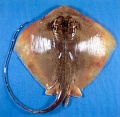 |
| 22 cm, disc width |
| Black Pomfret Parastromateusniger (Bloch) Carangidae Rhomboid shape, no pelvic fins when over 10 cm in total length, small scutes on caudal peduncle. Open-water, in schools over mud banks in coastal areas. To 55 cm. Often used for human consumption |
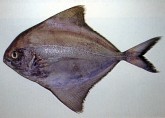 |
| 20.5 cm, standard length |
| LargeheadHairtail Trichiuruslepturus Linnaeus Trichiuridae Snout long, jaws with barbed fang-like teeth, lower edge of gill cover concave, pectoral spine smooth, anal fin mostly buried in skin, no slit on underside of lower jaw, sides silver. Pelagic, in schools near substrate in coastal areas, feeds mainly on prawns and small fish. To 1.2 m. Often used for human consumption. |
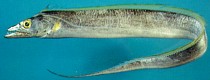 |
| 45 cm, total length |
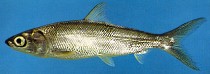
| Milkfish Chanoschanos (Forssk�l) Chanidae Body silver, mouth small, tail fin scissor-like. Pelagic, schooling, often farmed in floating cages from fingerlings imported from neighbouring areas. To over 1 m. Often used in human consumption, often reared in floating cages for market. |
 |
| 11 cm, standard length |
| Mangrove Red Snapper Lutjanusargentimaculatus (Forssk�l) Lutjanidae Scale rows on back parallel to lateral line, back and sides reddish or greenish-brown, juveniles with blue lines on cheek and about eight narrow white bars on sides. Carnivores in estuaries and reefs. To over 1 m. Often used for human consumption, often reared in floating cages for market, popular game fish. |
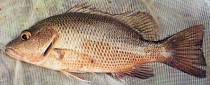 |
| about 16 cm, standard length |
| Squaretail Mullet Ellochelonvaigiensis (Quoy & Gaimard) Mugilidae Tail truncate, adipose eyelid little-developed, pectoral fins dusky, series of dusky stripes on sides. Omnivorous, solitary or in groups in coastal areas including reefs and estuaries. To 55 cm. Often used for human consumption. |
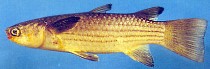 |
| 12 cm, standard length |
| Orange-spotted Grouper Epinepheluscoioides (Hamilton) Serranidae 11 dorsal fin spines, brown with darker bars and small orange spots on sides. Solitary carnivore in coastal areas including estuaries. Along with the Malabar Grouper, it has been misidentified as Epinephelustauvina. To 95 cm. Often used for human consumption, often reared in floating cages for market. |
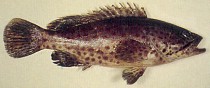 |
| about 21 cm, standard length |
| Indian Mackerel orKembong Rastrelligerkanagurta (Cuvier) Scombridae Rear half of second dorsal fin with 5 separated finlets, dark spot behind pectoral fin, adipose eyelids present. In large schools over coastal areas, pelagic planktivore. To 35 cm. Often used for human consumption. |
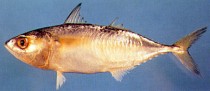 |
| 12.5 cm, standard length |
| Barramundi or Sea Bass orSiakap Latescalcarifer (Bloch) Centropomidae Mouth large, upper jaw reaching beyond eye; lower edge of preopercleserrated;dark grey on back, silvery on sides. Solitary piscivore in coastal areas, including estuaries. An important food fish. To 2 m. Often used for human consumption, often reared in floating cages for market, popular game fish. |
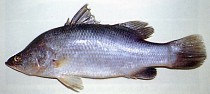 |
| 24 cm, standard length |
| Yellowtail Scad Atule mate (Cuvier) Carangidae Adipose eyelid covers eye except for vertical slit; last dorsal and anal fin rays somewhat separated. Open water schooling planktivore in coastal areas. To 30 cm. Often used for human consumption. |
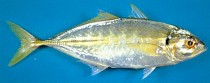 |
| 18.5 cm, standard length |
| Redspine Threadfin Bream Nemipterusnemurus (Bleeker) Nemipteridae Forked tail fin with upper lobe produced into filament, body pink, red spot between first and second dorsal fin spines. Carnivore over mud or sandy areas. To 21 cm. Often used for human consumption. The locally common Notched Threadfin Bream (Nemipterusperonii) is unique among its genus in having deep notches along the margin of its dorsal fin between the spines. |
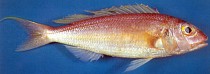 |
| 18.5 cm, standard length |
| � � |
| ��Q13) Make a poster to show the difference between monkeys and apes, and show the variety of monkey and apes. Use examples from the Singapore Zoological Gardens and include drawings of what you observe or pictures you have taken of them. |
| Monkeys |
| Apes |
| - Monkeys have a tail |
| - Monkeys run and jump along the tops of branches or on the ground using their arms and legs. |
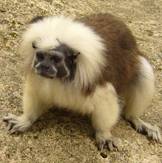
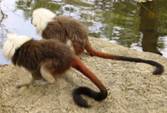
| Tamarin |
 |
 |
| Mandrill |
 |
 |
| Hamadryas Baboon |
 |
| - Apes do not have a tail |
| - Apes have mobile, rotary shoulder joints which allows them to hang from their arms |
| - Apes are larger and more intelligent |
| Orang-utan |
|
| Chimpanzee |
 |
| Gorilla |
 |
 |
| ��Q15)Draw 5 kinds of flightless birds found at the Singapore Zoological |
| orJurongBirdPark and write an interesting feature of each. |
| Draw a picture of each bird and write a few sentences to tell me about each bird. |
| Ostrich |
 |
 |
| It has a very long neck. Its eyes are larger than its brain |
| It stands on two toes. Ostrich eggs are the largest of all eggs and weigh 1.3 kg. |
| Kiwi |
 |
| Kiwi are shy and usually nocturnal (sleeps in the day and active at night). They have a good sense of smell which most birds do not have. Unlike other birds, the kiwi can track insects and worms underground without seeing or feeling them. This is due to their long beaks, with nostrils at the end of them. |
| Penguins������ |
 |
| Penguins live in the ice region. |
| They spend half of their life on land and half in the oceans. |
| On land, penguins use their tails and wings to maintain balance. They have an excellent sense of hearing and are nearsighted. |
| Emu������ |
 |
 |
| Their calls consist of loud booming, drumming and grunting sounds that can be heard up to two kilometres away. Their feet have only three toes and they help to disperse large viable seeds |
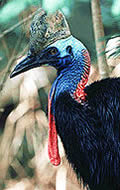 |
| One of the most striking features about the cassowary is its long and unusual black feathers. Cassowary feathers differ from other birds in that they have a quill that splits in two. |
| ��Q17) Observe in your school garden or around your home 10 different animals without backbone and 5 with backbone. Make simple drawings and notes of where you found them and what they were dong. |
| Without Backbone: |
| Snail |
 |
| Earthworm |
 |
| Bee |
 |
| Caterpillar |
 |
| Hornet |
 |
| Centipede |
 |
| Millipede |
 |
| Spider |
 |
| Butterfly |
 |
| Lady Bird |
 |
| Grasshopper |
 |
| With backbone: |
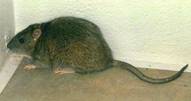
| Rat |
 |
| birds |
 |
| frog |
 |
| cat |
 |
| dog |
 |
| ��Q19) Learn to identify 10 hoofed animals in the SingaporeZoological Garden |
 |
 |
 |
| Camel |
 |
| Nilghai |
 |
| Cow |
 |
| Eland |
 |
| Giraffe |
 |
| Nyala |
 |
| Zebra |
 |
| Gnu |
 |
| Greater Kudu |
 |
| Horse |
 |
| Cassowary |
 |
|