Market Survey of Potential
Use of TeleVend’s m-ABLE™ Technology
by Students and Non-students in
Bloomington Indiana
A Research Proposal
Submitted by Linda Zambenini
Table of Contents
I. Introduction
II. Problem Statement
III. Purpose of Study
IV. Scope of the Study and Limitations
a. Budget
V. Significance of the Study
VI. Literature Review
a. Scope of the Review
b. M-commerce
c. TeleVend m-ABLE™
d. Summary of the Literature
VII. Methodology
a. Inquiry Method
b. Population
c. Questionnaire
d. Data Analysis
VIII. Appendix
Abstract
This study will survey the potential market for TeleVend’s m-ABLE™ cell phone technology by both university students and non-students (both of American origin) in Bloomington. This technology allows for payment of machines which vend products or services - applications such as in: parking meterrs, vending machines, copiers and laundromats, by simply using one’s cell phone, thus creating a “changeless society.” Since the United States is about two years behind Europe, Scandinavia and Asia in cellular technology, little is known about how the American public will use the upcoming services/applications that are currently available overseas. TeleVend’s technology will soon be coming to the US for use in vending machines and parking meters and sundry other applications and this study would show specifically the potential popularity of each individual application. Additionally, it would demonstrate if there were any differences in the market between the university population’s use of TeleVend’s service and the non-university use. Data will be collected via self-administered questionnaires distributed through the Cellular One local office to new customers who purchase a cellular phone. To ensure a statistically significant study a sample size of at least 30 is needed, therefore, the store manager will be given 100 questionnaires along with an accompanying letters of explanation and self-stamped self-addressed envelopes to give to each new customer. He/she will be distributing 50 to (non- international) university students and 50 to non-students. Quantitative methods will be used and descriptive statistics will used to report and compare the findings of both groups.
I. Introduction
Today we are moving in to what Nokia has called the “Mobile Information Society” (MIS) which they describe as: “Enabling users access to all forms of information in a seamless and transparent way, regardless of time and place. Being able to access and transfer information between devices and over any form of network access will bring true mobility to the user and will drive society towards new ways of working, playing and keeping in touch by increasing individual freedom and productivity” (Nokia, 2000). One aspect of the MIS is what Nokia has coined “m-commerce” which is really e-commerce on acid – access to purchasing goods or services anytime, anyplace and anywhere. According to TeleVend an exciting new m-commerce upstart mobile commerce is "the delivery of electronic commerce capabilities directly into the consumer's hand, anywhere, via wireless technology" and "putting a retail outlet in the customer's hand--anywhere". (TeleVend, 2000). Cellular Telecommunications Industry Association officials cite estimates that within five years 830 million wireless devices around the world will be capable of connecting to the Internet (Howe, 2000) Not so long ago, most people thought of wireless phones as little more than, well, phones. But the U.S. is at the cusp of a huge growth curve in wireless usage - "We'll stop thinking of this as a wireless phone, it will be a child finder, it will be a road map, it will be a wallet." (Burns, 2000) And m-commerce is on the cusp along with it: The respected consulting firm, Strategy Analytics, stated: “mobile commerce market is set to soar to US$200 billion by the year 2004, while 130 million customers, in the USA alone, will be generating almost $14 billion of transactions per annum…successful mobile commerce applications, he said, would include electronic ticketing, vending machine payments and, in the longer term, the use of wireless devices for on-line shopping and payment for various goods and services , as well as financial transactions and other banking needs.” (TeleVend, 2000)
However, the US is about 2 years
behind Scandinavia, the EU and Asia when it comes to wireless and little is
known which applications of this new technology Americans will embrace. Crouch,
(2000) states:
“What we're seeing is a new
industry emerging. The wireless industry remains in its infancy, however. Many
companies are simply testing which gadgets will draw interest, while others are
more certain.” (Crouch, 2000)
Drummand (2000) states that the
industry is wrestling with what types of information consumers want:
"They'll have to step back and look at what makes sense for the wireless environment…The killer app will always be voice, but
e-mail will be a no-brainer and limited e-commerce." (NB: Americans are so
far behind the times they don’t even use the current terminology the rest of
the civilized world uses – “m-commerce” – not “e-commerce”)
But, so far Americans don’t
seem that interested. A poll by Peter D. Hart Research Associates of 812 US
wireless subscribers found that they seem considerably less
interested in using the phone for e- commerce than in getting reliable voice
service. “The most important feature
they would look for in a new phone, 46 percent of respondents cited nationwide
coverage and 31 percent a long-life battery, compared to only 9 percent citing
e- mail and Internet access. Twenty-five percent said they have a great deal or quite a bit of interest in wireless data
services, compared to 44 percent expressing very little interest. Overall, just
13 percent of wireless users said they want to use the phone to shop over the
Net. (Howe, 2000) Even Jeff Bezos of
Amazon.com muses that it may be “difficult to persuade people to toggle around
a cell-phone screen to make purchases.”
But “shopping” over the phone sounds a lot more complicated and less
immediately rewarding what TeleVend proposes with their technology: being able
to punch up a 7 digit number on your cell phone getting a cold Coke from a
vending machine on a hot day or adding minutes to your meter when you are late
for class or when the meter maid is coming to ticket your expired car and you
don’t have change in your pocket. So,
TeleVend may be on to something much easier, more immediate, impulsive, and
gratifying – something that just could be the killer app for m-commerce.
II. Problem Statement
Americans have
had little experience with cell phone m-commerce and are behind in cellular in
general. Despite one study on the possible use of new cell phone applications
here little is known about how US customers will respond to new cell phone
technologies. Only statistics about potential e-commerce and email use was
obtained and the study did not mention the TeleVend application at all. Specifically it would be important to know
how US consumers would receive TeleVend’s m-ABLE technology.
III. The Purpose of the Study
The purpose of
this humble study is to, in a small way, learn how TeleVend’s m-ABLE™
technology would be received by US consumers. By studying the potential use of
this technology in Bloomington by students and non-students, one could 1.)
Discover the acceptance of this technology in general 2) find out if there are
any significant differences in usage between populations of university and
non-university wireless users and 2) discover if there are any significant
differences in types of usage between and non-university populations (for
example: students may use it in laundromats more than non-students and so on).
IV. Scope and
Limitations of Study
Due to
virtually no budget and no time, the study is restricted to a small,
mid-western city – Bloomington Indiana - and it is a small study with a
population size of only 100.
a. Budget
Who are you kidding? I’m a grad-student, so this is going to be dirty and
cheap. Taking into account my
time is absolutely worthless to anyone but myself and I don’t have money to pay
myself for my hard work - salary will be $0. Postage for 100 self-stamped
self–addressed envelopes will be…let’s see…$33. Hmmm…I’d like to pay my light
bill this month - maybe I should consider doing this via email instead. J
V. Significance of the Study
This study will
help to encourage and target implementation of TeleVend’s system in the
US. That is, if differences in usage of
applications by group/area is apparent, it will help demonstrate to the company
which applications would be best accepted and highly used in which areas
theoretically helping them more precisely target installation of devices in
receptive populations.
VI. Literature Review
a. Scope of the Review
This area will very briefly review the literature pertaining to consumer use of m-commerce, TeleVend, and their m-ABLE™ technology.
b.
M-Commerce
Already, since the
mid-90’s, the Finns could use their digital cell phones to get a car wash, and
have a Coke from a vending machine while they wait. In fact they were the first
in the world to do this (and much, much, more). But Finland is “the most wireless place in the world” – a
cellular shrine. Next summer they will be surfing the Internet at 56K on their
Nokia’s. (Quistgaard, 1999).
But the US situation
for cellular is like TV in the 50’s said John Zeglis, president of AT&T Wireless: "we're still at the
black and white stage…wireless
carriers should not expect the wireless
Internet till 2002”. Only in mid-February this year have some
Bell Atlantic cellular users been able to send and receive email, or check a
stock quote, (Darce, 2000) but only at 14.4kbps on an expensive $400 phone-way outside the
mass-consumer budget. But Amazon.com founder and eternal optimist Jeff Bezos thinks cell phones
could become a major way for people to do business with his company and other
e-commerce firms. (Drummand, 2000) Mark Lowenstein of
the Yankee Group a market research firm thinks the market will be small at
first: “He estimates that about 5% of subscribers will take advantage of such
features within 12 to 18 months, because of the expected cost…and the fact that
networks to handle the data aren't finished (in the US!). (Haring, 2000)
Hillary Rettig, editor of Technocopia, thinks for new technologies to really
catch on consumers have to find them “useful”, and be “satisfied”
with their interaction with “Palm devices didn't become popular until consumers
found uses for them.” A computerized vending machine that automatically
charges more money for a soda when the weather is hot…no one needs that…consumers
have to be convinced this new technology is friendly. ” (Evangalista, 1999)
But, obviously she hasn’t heard about the TeleVend technology which would sell you a soda on a hot day when your pockets are
empty, without charging you a penny extra. TeleVend plans to make its money not on transactions, but by selling the
vending machine automation boxes. (Barrett, 1999) And if that
doesn’t make you happy the TeleVend owners states: ‘”you can kiss long queues
goodbye as public transport tickets get delivered electronically into your
mobile on request. Once in the phone, “smart environment” ticket barriers will
automatically read your m-ticket.” So the potential “usefulness and
satisfaction index” of this technology seems enormous - even if ordering
a book on your cell phone from Amazon.com still seems a little daunting.
b. TeleVend
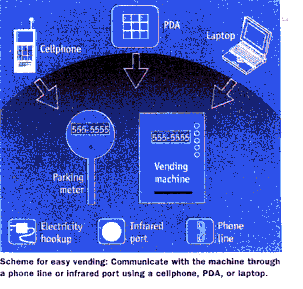 Founded by five young Israeli army buddies in February 1999, the team
started developing those solutions most needed for the newborn m-commerce
industry. TeleVend Inc. created a unique technology using middleware to
communicate with vending machines, parking meters, gas station pumps, and so
on, using the mobile phone to buy anything from a Coke, to tickets for sporting
events. It's based on something called m-ABLETM, which allows a consumer
to be electronically billed through his/her cell phone or PDA. It amounts to “cashless vending”. Imagine:
This means you can “refill your parking
meter” from class or while you’re shopping. The meter (with m-ABLE™) even calls
your cell phone to let you know your time is running out so you can punch in
some more minutes! Voila! No more tickets. Many of these solutions are currently in
testing and verification stages (TeleVend, 2000) One part of their technology also depends on “a good dose of military
know-how said chief scientist, Chaim Edel, (who was with the Israeli aircraft
industry and at the Ministry of Defense). (Barett, 1999)
Founded by five young Israeli army buddies in February 1999, the team
started developing those solutions most needed for the newborn m-commerce
industry. TeleVend Inc. created a unique technology using middleware to
communicate with vending machines, parking meters, gas station pumps, and so
on, using the mobile phone to buy anything from a Coke, to tickets for sporting
events. It's based on something called m-ABLETM, which allows a consumer
to be electronically billed through his/her cell phone or PDA. It amounts to “cashless vending”. Imagine:
This means you can “refill your parking
meter” from class or while you’re shopping. The meter (with m-ABLE™) even calls
your cell phone to let you know your time is running out so you can punch in
some more minutes! Voila! No more tickets. Many of these solutions are currently in
testing and verification stages (TeleVend, 2000) One part of their technology also depends on “a good dose of military
know-how said chief scientist, Chaim Edel, (who was with the Israeli aircraft
industry and at the Ministry of Defense). (Barett, 1999)
Although they have
signed a contract with the city of New York to start installing their
technology in NYC this summer and they are in ongoing negotiations with a major
American soft drink manufacturer as well. (Personal Communication, 1/20/2000)
The owner won’t say which one but he has recently had meetings with a number of
major players in the US: Coca-Cola, Pepsi, Sprint, and Walt Disney Co. Some ofthe world’s largest beverage
manufacturers, casino owners and subway operators, TeleVend said, are ogling
the wireless billing mechanism. (Walker, 1999)
He explained the
details of the technology:
“…you dial a seven-digit number
using a mobile phone or a keypad on the vending machine. That signals a remote
server, which identifies the customer, does a credit check, sends billing
information to the phone company—and bounces the signal back to the vending
machine. Out comes a cola. The server
also accesses a database of an individual’s buying habits—impossible to do when
you just pop quarters into a machine. It then spits out a discount coupon, for,
say, a meal at your favorite restaurant, or projects a tailor-made commercial
on the ATM-like screen on the vending machine…Let’s say the machine was right by a 7-Eleven, and you printed out a
coupon with each soda you sold from the machine, saying ‘Go use this coupon in
7-Eleven.’”
Then he demonstrated
the technology on a m-ABLE™ soda machine:
“Hi, welcome to TeleDrink. Your drink will be automatically billed to your home phone. Press one for cola. Press two for diet cola. Press three for orange…(he pressed 1, then clunkety-clunk of a can dropped and the voice continued) …Hungry? Take this can to Pizza Home for a free slice.” (Walker, 1999)
OwnerAbraham Gurfein
is hoping his company's technology will become as popular as debit cards and
magnetic-stripe readers.
Already TeleVend has agreed to deliver the first 100 of what could be “tens of thousands of kiosks” (for airports, train stations and newsstands in Israel and the EU) over the next four months for an unspecified sum—but a lot more than $16million. (Gordon, 1999)
c.
Summary
Even though the US is behind the rest of the world in cellular technology the tidal wave is coming within the next year or two. M-commerce is a hopeful application for cellular phones that is so far untested in the US, unlike abroad. TeleVend’s concept presents a unique, practical and seemingly “satisfying” technology that could be the next “killer app” for cellular even before other types of m-commerce catch on. Questions of usage beg to be studied further.
Vll. Methodology
a.
Inquiry Method
Survey materials (as described in the abstract) will be dispensed to the Cellular One store in Bloomington, and the manager/clerk will be asked to kindly randomly dispense them to new cellular customers (but only if they are interested in participating). They will be instructed by the manager/clerk, and in writing on the introductory letter included with the survey, to mail the surveys back to the author in a timely manner – in say 1 month. Fifty are to be dispensed to IU students and fifty to non-students (the owner will ascertain this through inquiring).
b.
Population
Population will consist of 100 randomly chosen cellular clients – 50 students and 50 non-students – in Bloomington Indiana, who purchase cell phones at Cellular One. For this reason they may be of different ages and social backgrounds. The students however, should not be international students, as this would mislead the purpose of the study, which is attempting to get a feel for the US market for TeleVend.
c.
Questionnaire
The study had 3 objectives: 1) discover the acceptance of this technology in general, 2) find out if there are any significant differences in usage between the populations of university and non-university wireless users, and 3) discover if there are any significant differences in types of usage between and non-university populations (for example: students may use it in laundromats more than non-students and so on).
d.
Data Analysis
The data analysis will be performed thusly:
1) The data of each group (i.e. student vs.
non-student) will be dealt with separately. That means two sets of data will be
collected.
2) The answers of each set will be analyzed and
tabulated and include: standard deviation, mean, median and mode and a Z-test.
3) Tables will be made to show the frequencies and
percentages for each question for each group.
4) The data will be used to assess the popularity of
each application for each (sub) population. Then an overall calculation could
be made for the entire population.
5) A comparison on data will be used to find the
similarities and differences between the two demographic groups.
6) Go out for a beer – its over!
Barrett, Randy. (August 23, 1999). Cashless cows. Inter@ctive Week.
Retrieved 4/20/2000 on the World Wide Web at:
http://www.televend.com/int_week.html
Burns, Jonathan. (February 2, 2000). Cos discuss mobile phone, net convergence at convention Dow Jones News Service. Retrieved 4/22/2000 on the Dow Jones Interactive
Database at: http://www.djinteractive.com/
Crouch, Cameron. (April 26, 2000). Web sites eye phone sales. PCWorld.com Retrieved 4/20/2000 on the World
Wide Web at: http://www.pcworld.com/pcwtoday/article/0,1510,15492+1+1,00.html
Darce, Keith. (February 29, 2000). Cutting the cord the world’s gone
wireless convention highlights the industry’s rise joint wireless ventures
announced. The New Orleans Times-Picayune. Retrieved on 4/22/2000 on the Dow Jones Interactive Database at: http://
www.djinteractive.com/
Drummond, Mike. (March 1, 2000). Trade show foreshadows coming wireless age. The San Diego Union-Tribune. Retrieved on 4/23/2000 from the Lexis-Nexis Database at: http://web.lexis-nexis.com/universe/
Evangelista, Benny. (DECEMBER 30, 1999). Consumers are comforted when technology is personal. San Francisco Chronicle. Retrieved from the Lexis –Nexis Database 4/23/99 at: http://web.lexis-nexis.com/universe/
Gordon, Joanne. (November 1, 1999). The accidental deal. Forbes. Retrieved 4/20/2000 on the World Wide Web at: http://www.televend.com/forbes.html
Haring, Bruce. (July 7, 1999). Cell phone to take on new roles. USA TODAY.
Retrieved 4/20/2000 on the World Wide Web at: http://www.televend.com/USATODAY.htm
Howe, Peter
J. (March 4, 2000). Wireless devices viewed as major conduit for e-commerce in
future. The Boston Globe. Retrieved 4/22/2000 on the Lexis-Nexis Database at: http://web.lexis-nexis.com/universe/
Nokia. (2000). The mobile information society. Retrieved 4/20/2000 on the World Wide Web at: http://www.nokia.com/networks/data
Quistgaard, Kaitlin. (January 7, 1999). Valhalla. Wired Online. Retrieved 4/23/2000 on the World Wide Web at: http://www.wired.com/wired/archive/7.01/cellphone.html?pg=3
Senger, Nancy. (September 1999). Zooming into a new market. Business Solutions Retrieved 4/23/2000 on the World Wide Web at: http://www.businesssolutionsmag.com/Articles/1999_09/990904.htm
Walker,
Leslie. (June 24, 1999). A sales pitch
with that soda?
Washington Post. Retrieved
4/20/2000 on the World Wide Web at:
http://www.televend.com/wp_business.html
APPENDIX
Dear Cellular
One Customer,
I am conducting
a study to ascertain the potential consumer usage of a new technology for cell
phones called TeleVend m-ABLE™ which allows customers to use their cell phone
to purchase goods or services from vending machines, parking meters, car
washes, copiers, laundromats, rather than using change or cash. The system debits your phone bill instead.
TeleVend is not yet available in the US but will be coming soon. Your answers
could be invaluable in deciding which features to provide.
You have been
selected at random as either a university student or a non-student to answer 6
brief questions regarding your potential usage of this technology if you had
access to it now.
If you wish to have a copy of the
study when its completed, please write me or
drop me an Email.
Sincerely,
Linda Zambenini
4060 W. Forrest Park Drive
Bloomington, Indiana 47401
Please check
those that apply to you and return with your survey.
1.
Gender: Female___ Male___
2.
Age: Less than 20___ 20-40___ 40-60___ 60-??___
3. University student____ Non-Student_____
3.
What kind
(make/model) of cell phone do you have?
4. Have you heard about TeleVend m-Able™? Yes___ NO___
5.
If so, how?
Newspaper___Journal___Online___Friends___
TV___ Other____
6.
*Have you ever smoked
a joint? Yessssss___
Yes, but I never inhaled____
Yes, but please don’t tell my mother- it would KILL her____
No_____
No, Definitely NOT! ____
Geez… have I?? _____
(*Professor Davis: Just kidding…I imagine you
are as tired of reading this right
now as I am of writing it since I haven’t slept in about 24 hours. So I am just
throwing in an example of how one should “warm-up” to those “delicate”
questions in a survey J)
Questionnaire
The purpose of this study is to
determine the potential consumer usage of a new technology for cell phones
called TeleVend m-ABLE™ which allows customers to use their cell phone to
purchase goods or services from vending machines, parking meters, car washes,
copiers, laundromats, rather than using change or cash. The system debits your phone bill instead.
Please take your time. Even
though TeleVend isn’t in the US yet please answer these questions as if you had
access to it now. There are 5 possible choices to each question please refer to
the choices directly below. Then answer each question by circling the number
that best matches how you feel. Thank
You. _______________________________________________________________
NEVER VERY LOW LOW HIGH VERY HIGH
_______________________________________________________________
a) The probability of using my cell phone
to make a purchase from a vending machine is…
0 1 2 3 4
b) The
probability of using my cell phone at the Laundromat for the washer and dryer is…
0 1 2 3 4
c) The probability
of using my cell phone at the automatic carwash is…
0 1 2 3 4
d) The probability of
using my cell phone to put time on the parking meter is…
0 1 2 3 4
_______________________________________________________________
NEVER VERY LOW LOW HIGH VERY HIGH
_______________________________________________________________
e) The
probability of using my cell phone to pay for gas at the gas pump is…
0 1 2 3 4
f)
The probability of using my cell phone to make copies at the
copy machine is…
0 1 2 3 4
You are done! TeleVend and I thank you for
helping out!
Please put this questionnaire in the
self-stamped self-addressed envelope and send it back to me.