|
| |
The Nobel Prize in Literature 1996
"for poetry that with
ironic precision allows the historical and biological
context to come to light in fragments of human reality"
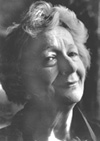
Wislawa Szymborska
Poland. b. 1923
Wislawa Szymborska – Nobel Lecture
The Poet and the World
They say the first sentence in any
speech is always the hardest. Well, that one's behind me, anyway. But I have
a feeling that the sentences to come - the third, the sixth, the tenth, and
so on, up to the final line - will be just as hard, since I'm supposed to
talk about poetry. I've said very little on the subject, next to nothing, in
fact. And whenever I have said anything, I've always had the sneaking
suspicion that I'm not very good at it. This is why my lecture will be
rather short. All imperfection is easier to tolerate if served up in small
doses.
Contemporary poets are skeptical and
suspicious even, or perhaps especially, about themselves. They publicly
confess to being poets only reluctantly, as if they were a little ashamed of
it. But in our clamorous times it's much easier to acknowledge your faults,
at least if they're attractively packaged, than to recognize your own
merits, since these are hidden deeper and you never quite believe in them
yourself ... When filling in questionnaires or chatting with strangers, that
is, when they can't avoid revealing their profession, poets prefer to use
the general term "writer" or replace "poet" with the name of whatever job
they do in addition to writing. Bureaucrats and bus passengers respond with
a touch of incredulity and alarm when they find out that they're dealing
with a poet. I suppose philosophers may meet with a similar reaction. Still,
they're in a better position, since as often as not they can embellish their
calling with some kind of scholarly title. Professor of philosophy - now
that sounds much more respectable.
But there are no professors of poetry.
This would mean, after all, that poetry is an occupation requiring
specialized study, regular examinations, theoretical articles with
bibliographies and footnotes attached, and finally, ceremoniously conferred
diplomas. And this would mean, in turn, that it's not enough to cover pages
with even the most exquisite poems in order to become a poet. The crucial
element is some slip of paper bearing an official stamp. Let us recall that
the pride of Russian poetry, the future Nobel Laureate
Joseph
Brodsky was once sentenced to internal exile precisely on such grounds.
They called him "a parasite," because he lacked official certification
granting him the right to be a poet ...
Several years ago, I had the honor and
pleasure of meeting Brodsky in person. And I noticed that, of all the poets
I've known, he was the only one who enjoyed calling himself a poet. He
pronounced the word without inhibitions. Just the opposite - he spoke it
with defiant freedom. It seems to me that this must have been because he
recalled the brutal humiliations he had experienced in his youth.
In more fortunate countries, where
human dignity isn't assaulted so readily, poets yearn, of course, to be
published, read, and understood, but they do little, if anything, to set
themselves above the common herd and the daily grind. And yet it wasn't so
long ago, in this century's first decades, that poets strove to shock us
with their extravagant dress and eccentric behavior. But all this was merely
for the sake of public display. The moment always came when poets had to
close the doors behind them, strip off their mantles, fripperies, and other
poetic paraphernalia, and confront - silently, patiently awaiting their own
selves - the still white sheet of paper. For this is finally what really
counts.
It's not accidental that film
biographies of great scientists and artists are produced in droves. The more
ambitious directors seek to reproduce convincingly the creative process that
led to important scientific discoveries or the emergence of a masterpiece.
And one can depict certain kinds of scientific labor with some success.
Laboratories, sundry instruments, elaborate machinery brought to life: such
scenes may hold the audience's interest for a while. And those moments of
uncertainty - will the experiment, conducted for the thousandth time with
some tiny modification, finally yield the desired result? - can be quite
dramatic. Films about painters can be spectacular, as they go about
recreating every stage of a famous painting's evolution, from the first
penciled line to the final brushstroke. Music swells in films about
composers: the first bars of the melody that rings in the musician's ears
finally emerge as a mature work in symphonic form. Of course this is all
quite naive and doesn't explain the strange mental state popularly known as
inspiration, but at least there's something to look at and listen to.
But poets are the worst. Their work is
hopelessly unphotogenic. Someone sits at a table or lies on a sofa while
staring motionless at a wall or ceiling. Once in a while this person writes
down seven lines only to cross out one of them fifteen minutes later, and
then another hour passes, during which nothing happens ... Who could stand
to watch this kind of thing?
I've mentioned inspiration.
Contemporary poets answer evasively when asked what it is, and if it
actually exists. It's not that they've never known the blessing of this
inner impulse. It's just not easy to explain something to someone else that
you don't understand yourself.
When I'm asked about this on occasion,
I hedge the question too. But my answer is this: inspiration is not the
exclusive privilege of poets or artists generally. There is, has been, and
will always be a certain group of people whom inspiration visits. It's made
up of all those who've consciously chosen their calling and do their job
with love and imagination. It may include doctors, teachers, gardeners - and
I could list a hundred more professions. Their work becomes one continuous
adventure as long as they manage to keep discovering new challenges in it.
Difficulties and setbacks never quell their curiosity. A swarm of new
questions emerges from every problem they solve. Whatever inspiration is,
it's born from a continuous "I don't know."
There aren't many such people. Most of
the earth's inhabitants work to get by. They work because they have to. They
didn't pick this or that kind of job out of passion; the circumstances of
their lives did the choosing for them. Loveless work, boring work, work
valued only because others haven't got even that much, however loveless and
boring - this is one of the harshest human miseries. And there's no sign
that coming centuries will produce any changes for the better as far as this
goes.
And so, though I may deny poets their
monopoly on inspiration, I still place them in a select group of Fortune's
darlings.
At this point, though, certain doubts
may arise in my audience. All sorts of torturers, dictators, fanatics, and
demagogues struggling for power by way of a few loudly shouted slogans also
enjoy their jobs, and they too perform their duties with inventive fervor.
Well, yes, but they "know." They know, and whatever they know is enough for
them once and for all. They don't want to find out about anything else,
since that might diminish their arguments' force. And any knowledge that
doesn't lead to new questions quickly dies out: it fails to maintain the
temperature required for sustaining life. In the most extreme cases, cases
well known from ancient and modern history, it even poses a lethal threat to
society.
This is why I value that little phrase
"I don't know" so highly. It's small, but it flies on mighty wings. It
expands our lives to include the spaces within us as well as those outer
expanses in which our tiny Earth hangs suspended. If Isaac Newton had never
said to himself "I don't know," the apples in his little orchard might have
dropped to the ground like hailstones and at best he would have stooped to
pick them up and gobble them with gusto. Had my compatriot
Marie
Sklodowska-Curie never said to herself "I don't know", she probably
would have wound up teaching chemistry at some private high school for young
ladies from good families, and would have ended her days performing this
otherwise perfectly respectable job. But she kept on saying "I don't know,"
and these words led her, not just once but twice, to Stockholm, where
restless, questing spirits are occasionally rewarded with the Nobel Prize.
Poets, if they're genuine, must also
keep repeating "I don't know." Each poem marks an effort to answer this
statement, but as soon as the final period hits the page, the poet begins to
hesitate, starts to realize that this particular answer was pure makeshift
that's absolutely inadequate to boot. So the poets keep on trying, and
sooner or later the consecutive results of their self-dissatisfaction are
clipped together with a giant paperclip by literary historians and called
their "oeuvre" ...
I sometimes dream of situations that
can't possibly come true. I audaciously imagine, for example, that I get a
chance to chat with the Ecclesiastes, the author of that moving lament on
the vanity of all human endeavors. I would bow very deeply before him,
because he is, after all, one of the greatest poets, for me at least. That
done, I would grab his hand. "'There's nothing new under the sun': that's
what you wrote, Ecclesiastes. But you yourself were born new under the sun.
And the poem you created is also new under the sun, since no one wrote it
down before you. And all your readers are also new under the sun, since
those who lived before you couldn't read your poem. And that cypress that
you're sitting under hasn't been growing since the dawn of time. It came
into being by way of another cypress similar to yours, but not exactly the
same. And Ecclesiastes, I'd also like to ask you what new thing under the
sun you're planning to work on now? A further supplement to the thoughts
you've already expressed? Or maybe you're tempted to contradict some of them
now? In your earlier work you mentioned joy - so what if it's fleeting? So
maybe your new-under-the-sun poem will be about joy? Have you taken notes
yet, do you have drafts? I doubt you'll say, 'I've written everything down,
I've got nothing left to add.' There's no poet in the world who can say
this, least of all a great poet like yourself."
The world - whatever we might think
when terrified by its vastness and our own impotence, or embittered by its
indifference to individual suffering, of people, animals, and perhaps even
plants, for why are we so sure that plants feel no pain; whatever we might
think of its expanses pierced by the rays of stars surrounded by planets
we've just begun to discover, planets already dead? still dead? we just
don't know; whatever we might think of this measureless theater to which
we've got reserved tickets, but tickets whose lifespan is laughably short,
bounded as it is by two arbitrary dates; whatever else we might think of
this world - it is astonishing.
But "astonishing" is an epithet
concealing a logical trap. We're astonished, after all, by things that
deviate from some well-known and universally acknowledged norm, from an
obviousness we've grown accustomed to. Now the point is, there is no such
obvious world. Our astonishment exists per se and isn't based on comparison
with something else.
Granted, in daily speech, where we
don't stop to consider every word, we all use phrases like "the ordinary
world," "ordinary life," "the ordinary course of events"... But in the
language of poetry, where every word is weighed, nothing is usual or normal.
Not a single stone and not a single cloud above it. Not a single day and not
a single night after it. And above all, not a single existence, not anyone's
existence in this world.
It looks like poets will always have
their work cut out for them.
Translated from Polish by
Stanislaw Baranczak and Clare Cavanagh
Wislawa Szymborska –
Biography
Wislawa Szymborska was born in
Kornik in Western Poland on 2 July 1923. Since 1931 she has been living in
Krakow, where during 1945-1948 she studied Polish Literature and Sociology
at the Jagiellonian
University. Szymborska made her début in March 1945 with a poem "Szukam
slowa" (I am Looking for a Word) in the daily "Dziennik Polski".
During 1953-1981 she worked as poetry editor and columnist in the Kraków
literary weekly "Zycie Literackie" where the series of her essays "Lektury
nadobowiazkowe" appeared (the series has been renewed lately in the addition
to "Gazeta Wyborcza"-"Gazeta o Ksiazkach"). The collection "Lektury
nadobowiazkowe" was published in the form of a book four times.
Szymborska has published 16 collections of poetry: Dlatego zyjemy
(1952), Pytania zadawane sobie (1954), Wolanie do Yeti (1957),
Sól (1962), Wiersze wybrane (1964), Poezje wybrane
(1967), Sto pociech (1967), Poezje (1970), Wszelki wypadek
(1972), Wybór wierszy (1973), Tarsjusz i inne wiersze (1976),
Wielka liczba (1976), Poezje wybrane II (1983), Ludzie na
moscie (1986). Koniec i poczatek (1993, 1996), Widok z
ziarnkiem piasku. 102 wiersze (1996) . Wislawa Szymborska has also
translated French poetry.
Her poems have been translated (and published in book form) in English,
German, Swedish, Italian, Danish, Hebrew, Hungarian, Czech, Slovakian,
Serbo-Croatian, Romanian, Bulgarian and other languages. They have also been
published in many foreign anthologies of Polish poetry.
Wislawa Szymborska is the Goethe Prize winner (1991) and Herder Prize winner
(1995). She has a degree of Honorary Doctor of Letters of Poznan University
(1995). In 1996 she received the Polish PEN Club prize.
Wislawa Szymborska –
Poetry
Utopia
Island where all becomes clear.
Solid ground beneath your feet.
The only roads are those that offer access.
Bushes bend beneath the weight of proofs.
The Tree of Valid Supposition grows here
with branches disentangled since time immemorial.
The Tree of Understanding, dazzlingly straight and simple,
sprouts by the spring called Now I Get It.
The thicker the woods, the vaster the vista:
the Valley of Obviously.
If any doubts arise, the wind dispels them instantly.
Echoes stir unsummoned
and eagerly explain all the secrets of the worlds.
On the right a cave where Meaning lies.
On the left the Lake of Deep Conviction.
Truth breaks from the bottom and bobs to the surface.
Unshakable Confidence towers over the valley.
Its peak offers an excellent view of the Essence of Things.
For all its charms, the island is uninhabited,
and the faint footprints scattered on its beaches
turn without exception to the sea.
As if all you can do here is leave
and plunge, never to return, into the depths.
Into unfathomable life.
By
Wislawa
Szymborska
From "A large number", 1976
Translated by S. Baranczak & C. Cavanagh
© Wislawa Szymborska, S. Baranczak & C. Cavanagh
On Death, without Exaggeration
It can't take a joke,
find a star, make a bridge.
It knows nothing about weaving, mining, farming,
building ships, or baking cakes.
In our planning for tomorrow,
it has the final word,
which is always beside the point.
It can't even get the things done
that are part of its trade:
dig a grave,
make a coffin,
clean up after itself.
Preoccupied with killing,
it does the job awkwardly,
without system or skill.
As though each of us were its first kill.
Oh, it has its triumphs,
but look at its countless defeats,
missed blows,
and repeat attempts!
Sometimes it isn't strong enough
to swat a fly from the air.
Many are the caterpillars
that have outcrawled it.
All those bulbs, pods,
tentacles, fins, tracheae,
nuptial plumage, and winter fur
show that it has fallen behind
with its halfhearted work.
Ill will won't help
and even our lending a hand with wars and coups d'etat
is so far not enough.
Hearts beat inside eggs.
Babies' skeletons grow.
Seeds, hard at work, sprout their first tiny pair of leaves
and sometimes even tall trees fall away.
Whoever claims that it's omnipotent
is himself living proof
that it's not.
There's no life
that couldn't be immortal
if only for a moment.
Death
always arrives by that very moment too late.
In vain it tugs at the knob
of the invisible door.
As far as you've come
can't be undone.
The Three Oddest Words
When I pronounce the word Future,
the first syllable already belongs to the past.
When I pronounce the word Silence,
I destroy it.
When I pronounce the word Nothing,
I make something no non-being can hold.
Possibilities
I prefer movies.
I prefer cats.
I prefer the oaks along the Warta.
I prefer Dickens to Dostoyevsky.
I prefer myself liking people
to myself loving mankind.
I prefer keeping a needle and thread on hand, just in case.
I prefer the color green.
I prefer not to maintain
that reason is to blame for everything.
I prefer exceptions.
I prefer to leave early.
I prefer talking to doctors about something else.
I prefer the old fine-lined illustrations.
I prefer the absurdity of writing poems
to the absurdity of not writing poems.
I prefer, where love's concerned, nonspecific anniversaries
that can be celebrated every day.
I prefer moralists
who promise me nothing.
I prefer cunning kindness to the over-trustful kind.
I prefer the earth in civvies.
I prefer conquered to conquering countries.
I prefer having some reservations.
I prefer the hell of chaos to the hell of order.
I prefer Grimms' fairy tales to the newspapers' front pages.
I prefer leaves without flowers to flowers without leaves.
I prefer dogs with uncropped tails.
I prefer light eyes, since mine are dark.
I prefer desk drawers.
I prefer many things that I haven't mentioned here
to many things I've also left unsaid.
I prefer zeroes on the loose
to those lined up behind a cipher.
I prefer the time of insects to the time of stars.
I prefer to knock on wood.
I prefer not to ask how much longer and when.
I prefer keeping in mind even the possibility
that existence has its own reason for being.
The Joy of Writing
Why does this written doe bound through these written
woods?
For a drink of written water from a spring
whose surface will xerox her soft muzzle?
Why does she lift her head; does she hear something?
Perched on four slim legs borrowed from the truth,
she pricks up her ears beneath my fingertips.
Silence - this word also rustles across the page
and parts the boughs
that have sprouted from the word "woods."
Lying in wait, set to pounce on the blank page,
are letters up to no good,
clutches of clauses so subordinate
they'll never let her get away.
Each drop of ink contains a fair supply
of hunters, equipped with squinting eyes behind their sights,
prepared to swarm the sloping pen at any moment,
surround the doe, and slowly aim their guns.
They forget that what's here isn't life.
Other laws, black on white, obtain.
The twinkling of an eye will take as long as I say,
and will, if I wish, divide into tiny eternities,
full of bullets stopped in mid-flight.
Not a thing will ever happen unless I say so.
Without my blessing, not a leaf will fall,
not a blade of grass will bend beneath that little hoof's full stop.
Is there then a world
where I rule absolutely on fate?
A time I bind with chains of signs?
An existence become endless at my bidding?
The joy of writing.
The power of preserving.
Revenge of a mortal hand.
By
Wislawa
Szymborska
From "No End of Fun", 1967
Translated by S. Baranczak & C. Cavanagh
Thư viện tiếp tục giới thiệu các tác giả & chuyên mục
|
|

