|
| |
The Nobel Prize in Literature 1970
"for the ethical force with which
he has pursued the
indispensable traditions of Russian literature"
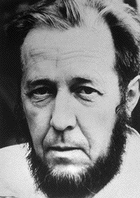
Aleksandr Isaevich Solzhenitsyn USSR. b. 1918
Alexander Solzhenitsyn –
Nobel Lecture
Nobel Lecture in Literature 1970*
1
Just as that puzzled savage who has
picked up - a strange cast-up from the ocean? - something unearthed from the
sands? - or an obscure object fallen down from the sky? - intricate in
curves, it gleams first dully and then with a bright thrust of light. Just
as he turns it this way and that, turns it over, trying to discover what to
do with it, trying to discover some mundane function within his own grasp,
never dreaming of its higher function.
So also we, holding Art in our hands, confidently consider ourselves to be
its masters; boldly we direct it, we renew, reform and manifest it; we sell
it for money, use it to please those in power; turn to it at one moment for
amusement - right down to popular songs and night-clubs, and at another -
grabbing the nearest weapon, cork or cudgel - for the passing needs of
politics and for narrow-minded social ends. But art is not defiled by our
efforts, neither does it thereby depart from its true nature, but on each
occasion and in each application it gives to us a part of its secret inner
light.
But shall we ever grasp the whole of that light? Who will dare to say that
he has DEFINED Art, enumerated all its facets? Perhaps once upon a time
someone understood and told us, but we could not remain satisfied with that
for long; we listened, and neglected, and threw it out there and then,
hurrying as always to exchange even the very best - if only for something
new! And when we are told again the old truth, we shall not even remember
that we once possessed it.
One artist sees himself as the creator of an independent spiritual world; he
hoists onto his shoulders the task of creating this world, of peopling it
and of bearing the all-embracing responsibility for it; but he crumples
beneath it, for a mortal genius is not capable of bearing such a burden.
Just as man in general, having declared himself the centre of existence, has
not succeeded in creating a balanced spiritual system. And if misfortune
overtakes him, he casts the blame upon the age-long disharmony of the world,
upon the complexity of today's ruptured soul, or upon the stupidity of the
public.
Another artist, recognizing a higher power above, gladly works as a humble
apprentice beneath God's heaven; then, however, his responsbility for
everything that is written or drawn, for the souls which perceive his work,
is more exacting than ever. But, in return, it is not he who has created
this world, not he who directs it, there is no doubt as to its foundations;
the artist has merely to be more keenly aware than others of the harmony of
the world, of the beauty and ugliness of the human contribution to it, and
to communicate this acutely to his fellow-men. And in misfortune, and even
at the depths of existence - in destitution, in prison, in sickness - his
sense of stable harmony never deserts him.
But all the irrationality of art, its dazzling turns, its unpredictable
discoveries, its shattering influence on human beings - they are too full of
magic to be exhausted by this artist's vision of the world, by his artistic
conception or by the work of his unworthy fingers.
Archeologists have not discovered stages of human existence so early that
they were without art. Right back in the early morning twilights of mankind
we received it from Hands which we were too slow to discern. And we were too
slow to ask: FOR WHAT PURPOSE have we been given this gift? What are we to
do with it?
And they were mistaken, and will always be mistaken, who prophesy that art
will disintegrate, that it will outlive its forms and die. It is we who
shall die - art will remain. And shall we comprehend, even on the day of our
destruction, all its facets and all its possibilities?
Not everything assumes a name. Some things lead beyond words. Art inflames
even a frozen, darkened soul to a high spiritual experience. Through art we
are sometimes visited - dimly, briefly - by revelations such as cannot be
produced by rational thinking.
Like that little looking-glass from the fairy-tales: look into it and you
will see - not yourself - but for one second, the Inaccessible, whither no
man can ride, no man fly. And only the soul gives a groan...
2
One day Dostoevsky threw out the
enigmatic remark: "Beauty will save the world". What sort of a statement is
that? For a long time I considered it mere words. How could that be
possible? When in bloodthirsty history did beauty ever save anyone from
anything? Ennobled, uplifted, yes - but whom has it saved?
There is, however, a certain peculiarity in the essence of beauty, a
peculiarity in the status of art: namely, the convincingness of a true work
of art is completely irrefutable and it forces even an opposing heart to
surrender. It is possible to compose an outwardly smooth and elegant
political speech, a headstrong article, a social program, or a philosophical
system on the basis of both a mistake and a lie. What is hidden, what
distorted, will not immediately become obvious.
Then a contradictory speech, article, program, a differently constructed
philosophy rallies in opposition - and all just as elegant and smooth, and
once again it works. Which is why such things are both trusted and
mistrusted.
In vain to reiterate what does not reach the heart.
But a work of art bears within itself its own verification: conceptions
which are devised or stretched do not stand being portrayed in images, they
all come crashing down, appear sickly and pale, convince no one. But those
works of art which have scooped up the truth and presented it to us as a
living force - they take hold of us, compel us, and nobody ever, not even in
ages to come, will appear to refute them.
So perhaps that ancient trinity of Truth, Goodness and Beauty is not simply
an empty, faded formula as we thought in the days of our self-confident,
materialistic youth? If the tops of these three trees converge, as the
scholars maintained, but the too blatant, too direct stems of Truth and
Goodness are crushed, cut down, not allowed through - then perhaps the
fantastic, unpredictable, unexpected stems of Beauty will push through and
soar TO THAT VERY SAME PLACE, and in so doing will fulfil the work of all
three?
In that case Dostoevsky's remark, "Beauty will save the world", was not a
careless phrase but a prophecy? After all HE was granted to see much, a man
of fantastic illumination.
And in that case art, literature might really be able to help the world
today?
It is the small insight which, over the years, I have succeeded in gaining
into this matter that I shall attempt to lay before you here today.
3
In order to mount this platform from
which the Nobel lecture is read, a platform offered to far from every writer
and only once in a lifetime, I have climbed not three or four makeshift
steps, but hundreds and even thousands of them; unyielding, precipitous,
frozen steps, leading out of the darkness and cold where it was my fate to
survive, while others - perhaps with a greater gift and stronger than I -
have perished. Of them, I myself met but a few on the Archipelago of GULAG1,
shattered into its fractionary multitude of islands; and beneath the
millstone of shadowing and mistrust I did not talk to them all, of some I
only heard, of others still I only guessed. Those who fell into that abyss
already bearing a literary name are at least known, but how many were never
recognized, never once mentioned in public? And virtually no one managed to
return. A whole national literature remained there, cast into oblivion not
only without a grave, but without even underclothes, naked, with a number
tagged on to its toe. Russian literature did not cease for a moment, but
from the outside it appeared a wasteland! Where a peaceful forest could have
grown, there remained, after all the felling, two or three trees overlooked
by chance.
And as I stand here today, accompanied by the shadows of the fallen, with
bowed head allowing others who were worthy before to pass ahead of me to
this place, as I stand here, how am I to divine and to express what THEY
would have wished to say?
This obligation has long weighed upon us, and we have understood it. In the
words of Vladimir Solov'ev:
Even in chains we ourselves must
complete
That circle which the gods have mapped out for us.
Frequently, in painful camp seethings,
in a column of prisoners, when chains of lanterns pierced the gloom of the
evening frosts, there would well up inside us the words that we should like
to cry out to the whole world, if the whole world could hear one of us. Then
it seemed so clear: what our successful ambassador would say, and how the
world would immediately respond with its comment. Our horizon embraced quite
distinctly both physical things and spiritual movements, and it saw no
lop-sidedness in the indivisible world. These ideas did not come from books,
neither were they imported for the sake of coherence. They were formed in
conversations with people now dead, in prison cells and by forest fires,
they were tested against THAT life, they grew out of THAT existence.
When at last the outer pressure grew a little weaker, my and our horizon
broadened and gradually, albeit through a minute chink, we saw and knew "the
whole world". And to our amazement the whole world was not at all as we had
expected, as we had hoped; that is to say a world living "not by that", a
world leading "not there", a world which could exclaim at the sight of a
muddy swamp, "what a delightful little puddle!", at concrete neck stocks,
"what an exquisite necklace!"; but instead a world where some weep
inconsolate tears and others dance to a light-hearted musical.
How could this happen? Why the yawning gap? Were we insensitive? Was the
world insensitive? Or is it due to language differences? Why is it that
people are not able to hear each other's every distinct utterance? Words
cease to sound and run away like water - without taste, colour, smell.
Without trace.
As I have come to understand this, so through the years has changed and
changed again the structure, content and tone of my potential speech. The
speech I give today.
And it has little in common with its original plan, conceived on frosty camp
evenings.
4
From time immemorial man has been made
in such a way that his vision of the world, so long as it has not been
instilled under hypnosis, his motivations and scale of values, his actions
and intentions are determined by his personal and group experience of life.
As the Russian saying goes, "Do not believe your brother, believe your own
crooked eye." And that is the most sound basis for an understanding of the
world around us and of human conduct in it. And during the long epochs when
our world lay spread out in mystery and wilderness, before it became
encroached by common lines of communication, before it was transformed into
a single, convulsively pulsating lump - men, relying on experience, ruled
without mishap within their limited areas, within their communities, within
their societies, and finally on their national territories. At that time it
was possible for individual human beings to perceive and accept a general
scale of values, to distinguish between what is considered normal, what
incredible; what is cruel and what lies beyond the boundaries of wickedness;
what is honesty, what deceit. And although the scattered peoples led
extremely different lives and their social values were often strikingly at
odds, just as their systems of weights and measures did not agree, still
these discrepancies surprised only occasional travellers, were reported in
journals under the name of wonders, and bore no danger to mankind which was
not yet one.
But now during the past few decades, imperceptibly, suddenly, mankind has
become one - hopefully one and dangerously one - so that the concussions and
inflammations of one of its parts are almost instantaneously passed on to
others, sometimes lacking in any kind of necessary immunity. Mankind has
become one, but not steadfastly one as communities or even nations used to
be; not united through years of mutual experience, neither through
possession of a single eye, affectionately called crooked, nor yet through a
common native language, but, surpassing all barriers, through international
broadcasting and print. An avalanche of events descends upon us - in one
minute half the world hears of their splash. But the yardstick by which to
measure those events and to evaluate them in accordance with the laws of
unfamiliar parts of the world - this is not and cannot be conveyed via
soundwaves and in newspaper columns. For these yardsticks were matured and
assimilated over too many years of too specific conditions in individual
countries and societies; they cannot be exchanged in mid-air. In the various
parts of the world men apply their own hard-earned values to events, and
they judge stubbornly, confidently, only according to their own scales of
values and never according to any others.
And if there are not many such different scales of values in the world,
there are at least several; one for evaluating events near at hand, another
for events far away; aging societies possess one, young societies another;
unsuccessful people one, successful people another. The divergent scales of
values scream in discordance, they dazzle and daze us, and in order that it
might not be painful we steer clear of all other values, as though from
insanity, as though from illusion, and we confidently judge the whole world
according to our own home values. Which is why we take for the greater, more
painful and less bearable disaster not that which is in fact greater, more
painful and less bearable, but that which lies closest to us. Everything
which is further away, which does not threaten this very day to invade our
threshold - with all its groans, its stifled cries, its destroyed lives,
even if it involves millions of victims - this we consider on the whole to
be perfectly bearable and of tolerable proportions.
In one part of the world, not so long ago, under persecutions not inferior
to those of the ancient Romans', hundreds of thousands of silent Christians
gave up their lives for their belief in God. In the other hemisphere a
certain madman, (and no doubt he is not alone), speeds across the ocean to
DELIVER us from religion - with a thrust of steel into the high priest! He
has calculated for each and every one of us according to his personal scale
of values!
That which from a distance, according to one scale of values, appears as
enviable and flourishing freedom, at close quarters, and according to other
values, is felt to be infuriating constraint calling for buses to be
overthrown. That which in one part of the world might represent a dream of
incredible prosperity, in another has the exasperating effect of wild
exploitation demanding immediate strike. There are different scales of
values for natural catastrophes: a flood craving two hundred thousand lives
seems less significant than our local accident. There are different scales
of values for personal insults: sometimes even an ironic smile or a
dismissive gesture is humiliating, while for others cruel beatings are
forgiven as an unfortunate joke. There are different scales of values for
punishment and wickedness: according to one, a month's arrest, banishment to
the country, or an isolation-cell where one is fed on white rolls and milk,
shatters the imagination and fills the newspaper columns with rage. While
according to another, prison sentences of twenty-five years, isolation-cells
where the walls are covered with ice and the prisoners stripped to their
underclothes, lunatic asylums for the sane, and countless unreasonable
people who for some reason will keep running away, shot on the frontiers -
all this is common and accepted. While the mind is especially at peace
concerning that exotic part of the world about which we know virtually
nothing, from which we do not even receive news of events, but only the
trivial, out-of-date guesses of a few correspondents.
Yet we cannot reproach human vision for this duality, for this dumbfounded
incomprehension of another man's distant grief, man is just made that way.
But for the whole of mankind, compressed into a single lump, such mutual
incomprehension presents the threat of imminent and violent destruction. One
world, one mankind cannot exist in the face of six, four or even two scales
of values: we shall be torn apart by this disparity of rhythm, this
disparity of vibrations.
A man with two hearts is not for this world, neither shall we be able to
live side by side on one Earth.
5
But who will co-ordinate these value
scales, and how? Who will create for mankind one system of interpretation,
valid for good and evil deeds, for the unbearable and the bearable, as they
are differentiated today? Who will make clear to mankind what is really
heavy and intolerable and what only grazes the skin locally? Who will direct
the anger to that which is most terrible and not to that which is nearer?
Who might succeed in transferring such an understanding beyond the limits of
his own human experience? Who might succeed in impressing upon a bigoted,
stubborn human creature the distant joy and grief of others, an
understanding of dimensions and deceptions which he himself has never
experienced? Propaganda, constraint, scientific proof - all are useless. But
fortunately there does exist such a means in our world! That means is art.
That means is literature.
They can perform a miracle: they can overcome man's detrimental peculiarity
of learning only from personal experience so that the experience of other
people passes him by in vain. From man to man, as he completes his brief
spell on Earth, art transfers the whole weight of an unfamiliar, lifelong
experience with all its burdens, its colours, its sap of life; it recreates
in the flesh an unknown experience and allows us to possess it as our own.
And even more, much more than that; both countries and whole continents
repeat each other's mistakes with time lapses which can amount to centuries.
Then, one would think, it would all be so obvious! But no; that which some
nations have already experienced, considered and rejected, is suddenly
discovered by others to be the latest word. And here again, the only
substitute for an experience we ourselves have never lived through is art,
literature. They possess a wonderful ability: beyond distinctions of
language, custom, social structure, they can convey the life experience of
one whole nation to another. To an inexperienced nation they can convey a
harsh national trial lasting many decades, at best sparing an entire nation
from a superfluous, or mistaken, or even disastrous course, thereby
curtailing the meanderings of human history.
It is this great and noble property of art that I urgently recall to you
today from the Nobel tribune.
And literature conveys irrefutable condensed experience in yet another
invaluable direction; namely, from generation to generation. Thus it becomes
the living memory of the nation. Thus it preserves and kindles within itself
the flame of her spent history, in a form which is safe from deformation and
slander. In this way literature, together with language, protects the soul
of the nation.
(In recent times it has been fashionable to talk of the levelling of
nations, of the disappearance of different races in the melting-pot of
contemporary civilization. I do not agree with this opinion, but its
discussion remains another question. Here it is merely fitting to say that
the disappearance of nations would have impoverished us no less than if all
men had become alike, with one personality and one face. Nations are the
wealth of mankind, its collective personalities; the very least of them
wears its own special colours and bears within itself a special facet of
divine intention.)
But woe to that nation whose literature is disturbed by the intervention of
power. Because that is not just a violation against "freedom of print", it
is the closing down of the heart of the nation, a slashing to pieces of its
memory. The nation ceases to be mindful of itself, it is deprived of its
spiritual unity, and despite a supposedly common language, compatriots
suddenly cease to understand one another. Silent generations grow old and
die without ever having talked about themselves, either to each other or to
their descendants. When writers such as Achmatova and Zamjatin - interred
alive throughout their lives - are condemned to create in silence until they
die, never hearing the echo of their written words, then that is not only
their personal tragedy, but a sorrow to the whole nation, a danger to the
whole nation.
In some cases moreover - when as a result of such a silence the whole of
history ceases to be understood in its entirety - it is a danger to the
whole of mankind.
6
At various times and in various
countries there have arisen heated, angry and exquisite debates as to
whether art and the artist should be free to live for themselves, or whether
they should be for ever mindful of their duty towards society and serve it
albeit in an unprejudiced way. For me there is no dilemma, but I shall
refrain from raising once again the train of arguments. One of the most
brilliant addresses on this subject was actually
Albert
Camus' Nobel speech, and I would happily subscribe to his conclusions.
Indeed, Russian literature has for several decades manifested an inclination
not to become too lost in contemplation of itself, not to flutter about too
frivolously. I am not ashamed to continue this tradition to the best of my
ability. Russian literature has long been familiar with the notions that a
writer can do much within his society, and that it is his duty to do so.
Let us not violate the RIGHT of the artist to express exclusively his own
experiences and introspections, disregarding everything that happens in the
world beyond. Let us not DEMAND of the artist, but - reproach, beg, urge and
entice him - that we may be allowed to do. After all, only in part does he
himself develop his talent; the greater part of it is blown into him at
birth as a finished product, and the gift of talent imposes responsibility
on his free will. Let us assume that the artist does not OWE anybody
anything: nevertheless, it is painful to see how, by retiring into his
self-made worlds or the spaces of his subjective whims, he CAN surrender the
real world into the hands of men who are mercenary, if not worthless, if not
insane.
Our Twentieth Century has proved to be more cruel than preceding centuries,
and the first fifty years have not erased all its horrors. Our world is rent
asunder by those same old cave-age emotions of greed, envy, lack of control,
mutual hostility which have picked up in passing respectable pseudonyms like
class struggle, racial conflict, struggle of the masses, trade-union
disputes. The primeval refusal to accept a compromise has been turned into a
theoretical principle and is considered the virtue of orthodoxy. It demands
millions of sacrifices in ceaseless civil wars, it drums into our souls that
there is no such thing as unchanging, universal concepts of goodness and
justice, that they are all fluctuating and inconstant. Therefore the rule -
always do what's most profitable to your party. Any professional group no
sooner sees a convenient opportunity to BREAK OFF A PIECE, even if it be
unearned, even if it be superfluous, than it breaks it off there and then
and no matter if the whole of society comes tumbling down. As seen from the
outside, the amplitude of the tossings of western society is approaching
that point beyond which the system becomes metastable and must fall.
Violence, less and less embarrassed by the limits imposed by centuries of
lawfulness, is brazenly and victoriously striding across the whole world,
unconcerned that its infertility has been demonstrated and proved many times
in history. What is more, it is not simply crude power that triumphs abroad,
but its exultant justification. The world is being inundated by the brazen
conviction that power can do anything, justice nothing. Dostoevsky's DEVILS
- apparently a provincial nightmare fantasy of the last century - are
crawling across the whole world in front of our very eyes, infesting
countries where they could not have been dreamed of; and by means of the
hijackings, kidnappings, explosions and fires of recent years they are
announcing their determination to shake and destroy civilization! And they
may well succeed. The young, at an age when they have not yet any experience
other than sexual, when they do not yet have years of personal suffering and
personal understanding behind them, are jubilantly repeating our depraved
Russian blunders of the Nineteenth Century, under the impression that they
are discovering something new. They acclaim the latest wretched degradation
on the part of the Chinese Red Guards as a joyous example. In shallow lack
of understanding of the age-old essence of mankind, in the naive confidence
of inexperienced hearts they cry: let us drive away THOSE cruel, greedy
oppressors, governments, and the new ones (we!), having laid aside grenades
and rifles, will be just and understanding. Far from it! . . . But of those
who have lived more and understand, those who could oppose these young -
many do not dare oppose, they even suck up, anything not to appear
"conservative". Another Russian phenomenon of the Nineteenth Century which
Dostoevsky called SLAVERY TO PROGRESSIVE QUIRKS.
The spirit of Munich has by no means retreated into the past; it was not
merely a brief episode. I even venture to say that the spirit of Munich
prevails in the Twentieth Century. The timid civilized world has found
nothing with which to oppose the onslaught of a sudden revival of barefaced
barbarity, other than concessions and smiles. The spirit of Munich is a
sickness of the will of successful people, it is the daily condition of
those who have given themselves up to the thirst after prosperity at any
price, to material well-being as the chief goal of earthly existence. Such
people - and there are many in today's world - elect passivity and retreat,
just so as their accustomed life might drag on a bit longer, just so as not
to step over the threshold of hardship today - and tomorrow, you'll see, it
will all be all right. (But it will never be all right! The price of
cowardice will only be evil; we shall reap courage and victory only when we
dare to make sacrifices.)
And on top of this we are threatened by destruction in the fact that the
physically compressed, strained world is not allowed to blend spiritually;
the molecules of knowledge and sympathy are not allowed to jump over from
one half to the other. This presents a rampant danger: THE SUPPRESSION OF
INFORMATION between the parts of the planet. Contemporary science knows that
suppression of information leads to entropy and total destruction.
Suppression of information renders international signatures and agreements
illusory; within a muffled zone it costs nothing to reinterpret any
agreement, even simpler - to forget it, as though it had never really
existed. (Orwell understood this supremely.) A muffled zone is, as it were,
populated not by inhabitants of the Earth, but by an expeditionary corps
from Mars; the people know nothing intelligent about the rest of the Earth
and are prepared to go and trample it down in the holy conviction that they
come as "liberators".
A quarter of a century ago, in the great hopes of mankind, the United
Nations Organization was born. Alas, in an immoral world, this too grew up
to be immoral. It is not a United Nations Organization but a United
Governments Organization where all governments stand equal; those which are
freely elected, those imposed forcibly, and those which have seized power
with weapons. Relying on the mercenary partiality of the majority UNO
jealously guards the freedom of some nations and neglects the freedom of
others. As a result of an obedient vote it declined to undertake the
investigation of private appeals - the groans, screams and beseechings of
humble individual PLAIN PEOPLE - not large enough a catch for such a great
organization. UNO made no effort to make the Declaration of Human Rights,
its best document in twenty-five years, into an OBLIGATORY condition of
membership confronting the governments. Thus it betrayed those humble people
into the will of the governments which they had not chosen.
It would seem that the appearance of the contemporary world rests solely in
the hands of the scientists; all mankind's technical steps are determined by
them. It would seem that it is precisely on the international goodwill of
scientists, and not of politicians, that the direction of the world should
depend. All the more so since the example of the few shows how much could be
achieved were they all to pull together. But no; scientists have not
manifested any clear attempt to become an important, independently active
force of mankind. They spend entire congresses in renouncing the sufferings
of others; better to stay safely within the precincts of science. That same
spirit of Munich has spread above them its enfeebling wings.
What then is the place and role of the writer in this cruel, dynamic, split
world on the brink of its ten destructions? After all we have nothing to do
with letting off rockets, we do not even push the lowliest of hand-carts, we
are quite scorned by those who respect only material power. Is it not
natural for us too to step back, to lose faith in the steadfastness of
goodness, in the indivisibility of truth, and to just impart to the world
our bitter, detached observations: how mankind has become hopelessly
corrupt, how men have degenerated, and how difficult it is for the few
beautiful and refined souls to live amongst them?
But we have not even recourse to this flight. Anyone who has once taken up
the WORD can never again evade it; a writer is not the detached judge of his
compatriots and contemporaries, he is an accomplice to all the evil
committed in his native land or by his countrymen. And if the tanks of his
fatherland have flooded the asphalt of a foreign capital with blood, then
the brown spots have slapped against the face of the writer forever. And if
one fatal night they suffocated his sleeping, trusting Friend, then the
palms of the writer bear the bruises from that rope. And if his young fellow
citizens breezily declare the superiority of depravity over honest work, if
they give themselves over to drugs or seize hostages, then their stink
mingles with the breath of the writer.
Shall we have the temerity to declare that we are not responsible for the
sores of the present-day world?
7
However, I am cheered by a vital
awareness of WORLD LITERATURE as of a single huge heart, beating out the
cares and troubles of our world, albeit presented and perceived differently
in each of its corners.
Apart from age-old national literatures there existed, even in past ages,
the conception of world literature as an anthology skirting the heights of
the national literatures, and as the sum total of mutual literary
influences. But there occured a lapse in time: readers and writers became
acquainted with writers of other tongues only after a time lapse, sometimes
lasting centuries, so that mutual influences were also delayed and the
anthology of national literary heights was revealed only in the eyes of
descendants, not of contemporaries.
But today, between the writers of one country and the writers and readers of
another, there is a reciprocity if not instantaneous then almost so. I
experience this with myself. Those of my books which, alas, have not been
printed in my own country have soon found a responsive, worldwide audience,
despite hurried and often bad translations. Such distinguished western
writers as Heinrich Böll have undertaken critical analysis of them. All
these last years, when my work and freedom have not come crashing down, when
contrary to the laws of gravity they have hung suspended as though on air,
as though on NOTHING - on the invisible dumb tension of a sympathetic public
membrane; then it was with grateful warmth, and quite unexpectedly for
myself, that I learnt of the further support of the international
brotherhood of writers. On my fiftieth birthday I was astonished to receive
congratulations from well-known western writers. No pressure on me came to
pass by unnoticed. During my dangerous weeks of exclusion from the Writers'
Union the WALL OF DEFENCE advanced by the world's prominent writers
protected me from worse persecutions; and Norwegian writers and artists
hospitably prepared a roof for me, in the event of my threatened exile being
put into effect. Finally even the advancement of my name for the Nobel Prize
was raised not in the country where I live and write, but by Francois
Mauriac and his colleagues. And later still entire national writers' unions
have expressed their support for me.
Thus I have understood and felt that world literature is no longer an
abstract anthology, nor a generalization invented by literary historians; it
is rather a certain common body and a common spirit, a living heartfelt
unity reflecting the growing unity of mankind. State frontiers still turn
crimson, heated by electric wire and bursts of machine fire; and various
ministries of internal affairs still think that literature too is an
"internal affair" falling under their jurisdiction; newspaper headlines
still display: "No right to interfere in our internal affairs!" Whereas
there are no INTERNAL AFFAIRS left on our crowded Earth! And mankind's sole
salvation lies in everyone making everything his business; in the people of
the East being vitally concerned with what is thought in the West, the
people of the West vitally concerned with what goes on in the East. And
literature, as one of the most sensitive, responsive instruments possessed
by the human creature, has been one of the first to adopt, to assimilate, to
catch hold of this feeling of a growing unity of mankind. And so I turn with
confidence to the world literature of today - to hundreds of friends whom I
have never met in the flesh and whom I may never see.
Friends! Let us try to help if we are worth anything at all! Who from time
immemorial has constituted the uniting, not the dividing, strength in your
countries, lacerated by discordant parties, movements, castes and groups?
There in its essence is the position of writers: expressers of their native
language - the chief binding force of the nation, of the very earth its
people occupy, and at best of its national spirit.
I believe that world literature has it in its power to help mankind, in
these its troubled hours, to see itself as it really is, notwithstanding the
indoctrinations of prejudiced people and parties. World literature has it in
its power to convey condensed experience from one land to another so that we
might cease to be split and dazzled, that the different scales of values
might be made to agree, and one nation learn correctly and concisely the
true history of another with such strength of recognition and painful
awareness as it had itself experienced the same, and thus might it be spared
from repeating the same cruel mistakes. And perhaps under such conditions we
artists will be able to cultivate within ourselves a field of vision to
embrace the WHOLE WORLD: in the centre observing like any other human being
that which lies nearby, at the edges we shall begin to draw in that which is
happening in the rest of the world. And we shall correlate, and we shall
observe world proportions.
And who, if not writers, are to pass judgement - not only on their
unsuccessful governments, (in some states this is the easiest way to earn
one's bread, the occupation of any man who is not lazy), but also on the
people themselves, in their cowardly humiliation or self-satisfed weakness?
Who is to pass judgement on the light-weight sprints of youth, and on the
young pirates brandishing their knives?
We shall be told: what can literature possibly do against the ruthless
onslaught of open violence? But let us not forget that violence does not
live alone and is not capable of living alone: it is necessarily interwoven
with falsehood. Between them lies the most intimate, the deepest of natural
bonds. Violence finds its only refuge in falsehood, falsehood its only
support in violence. Any man who has once acclaimed violence as his METHOD
must inexorably choose falsehood as his PRINCIPLE. At its birth violence
acts openly and even with pride. But no sooner does it become strong, firmly
established, than it senses the rarefaction of the air around it and it
cannot continue to exist without descending into a fog of lies, clothing
them in sweet talk. It does not always, not necessarily, openly throttle the
throat, more often it demands from its subjects only an oath of allegiance
to falsehood, only complicity in falsehood.
And the simple step of a simple courageous man is not to partake in
falsehood, not to support false actions! Let THAT enter the world, let it
even reign in the world - but not with my help. But writers and artists can
achieve more: they can CONQUER FALSEHOOD! In the struggle with falsehood art
always did win and it always does win! Openly, irrefutably for everyone!
Falsehood can hold out against much in this world, but not against art.
And no sooner will falsehood be dispersed than the nakedness of violence
will be revealed in all its ugliness - and violence, decrepit, will fall.
That is why, my friends, I believe that we are able to help the world in its
white-hot hour. Not by making the excuse of possessing no weapons, and not
by giving ourselves over to a frivolous life - but by going to war!
Proverbs about truth are well-loved in Russian. They give steady and
sometimes striking expression to the not inconsiderable harsh national
experience:
ONE WORD OF TRUTH SHALL OUTWEIGH THE WHOLE WORLD.
And it is here, on an imaginary fantasy, a breach of the principle of the
conservation of mass and energy, that I base both my own activity and my
appeal to the writers of the whole world.
*Delivered only to the
Swedish Academy
and not actually given as a lecture.
1. The Central Administration of Corrective Labour
Camps.
From
Nobel Lectures, Literature 1968-1980.
Alexander Solzhenitsyn –
Autobiography
I was born at Kislovodsk on 11th
December, 1918. My father had studied philological subjects at Moscow
University, but did not complete his studies, as he enlisted as a volunteer
when war broke out in 1914. He became an artillery officer on the German
front, fought throughout the war and died in the summer of 1918, six months
before I was born. I was brought up by my mother, who worked as a
shorthand-typist, in the town of Rostov on the Don, where I spent the whole
of my childhood and youth, leaving the grammar school there in 1936. Even as
a child, without any prompting from others, I wanted to be a writer and,
indeed, I turned out a good deal of the usual juvenilia. In the 1930s, I
tried to get my writings published but I could not find anyone willing to
accept my manuscripts. I wanted to acquire a literary education, but in
Rostov such an education that would suit my wishes was not to be obtained.
To move to Moscow was not possible, partly because my mother was alone and
in poor health, and partly because of our modest circumstances. I therefore
began to study at the Department of Mathematics at
Rostov
University, where it proved that I had considerable aptitude for
mathematics. But although I found it easy to learn this subject, I did not
feel that I wished to devote my whole life to it. Nevertheless, it was to
play a beneficial role in my destiny later on, and on at least two
occasions, it rescued me from death. For I would probably not have survived
the eight years in camps if I had not, as a mathematician, been transferred
to a so-called sharashia, where I spent four years; and later, during
my exile, I was allowed to teach mathematics and physics, which helped to
ease my existence and made it possible for me to write. If I had had a
literary education it is quite likely that I should not have survived these
ordeals but would instead have been subjected to even greater pressures.
Later on, it is true, I began to get some literary education as well; this
was from 1939 to 1941, during which time, along with university studies in
physics and mathematics, I also studied by correspondence at the Institute
of History, Philosophy and Literature in Moscow.
In 1941, a few days before the outbreak of the war, I graduated from the
Department of Physics and Mathematics at Rostov University. At the beginning
of the war, owing to weak health, I was detailed to serve as a driver of
horsedrawn vehicles during the winter of 1941-1942. Later, because of my
mathematical knowledge, I was transferred to an artillery school, from
which, after a crash course, I passed out in November 1942. Immediately
after this I was put in command of an artillery-position-finding company,
and in this capacity, served, without a break, right in the front line until
I was arrested in February 1945. This happened in East Prussia, a region
which is linked with my destiny in a remarkable way. As early as 1937, as a
first-year student, I chose to write a descriptive essay on "The Samsonov
Disaster" of 1914 in East Prussia and studied material on this; and in 1945
I myself went to this area (at the time of writing, autumn 1970, the book
August 1914 has just been completed).
I was arrested on the grounds of what the censorship had found during the
years 1944-45 in my correspondence with a school friend, mainly because of
certain disrespectful remarks about Stalin, although we referred to him in
disguised terms. As a further basis for the "charge", there were used the
drafts of stories and reflections which had been found in my map case.
These, however, were not sufficient for a "prosecution", and in July 1945 I
was "sentenced" in my absence, in accordance with a procedure then
frequently applied, after a resolution by the OSO (the Special Committee of
the NKVD), to eight years in a detention camp (at that time this was
considered a mild sentence).
I served the first part of my sentence in several correctional work camps of
mixed types (this kind of camp is described in the play, The Tenderfoot
and the Tramp). In 1946, as a mathematician, I was transferred to the
group of scientific research institutes of the MVD-MOB (Ministry of Internal
Affairs, Ministry of State Security). I spent the middle period of my
sentence in such "SPECIAL PRISONS" (The First Circle). In 1950 I was
sent to the newly established "Special Camps" which were intended only for
political prisoners. In such a camp in the town of Ekibastuz in Kazakhstan (One
Day in the Life of Ivan Denisovich), I worked as a miner, a bricklayer,
and a foundryman. There I contracted a tumour which was operated on, but the
condition was not cured (its character was not established until later on).
One month after I had served the full term of my eight-year sentence, there
came, without any new judgement and even without a "resolution from the
OSO", an administrative decision to the effect that I was not to be released
but EXILED FOR LIFE to Kok-Terek (southern Kazakhstan). This measure was not
directed specially against me, but was a very usual procedure at that time.
I served this exile from March 1953 (on March 5th, when Stalin's death was
made public, I was allowed for the first time to go out without an escort)
until June 1956. Here my cancer had developed rapidly, and at the end of
1953, I was very near death. I was unable to eat, I could not sleep and was
severely affected by the poisons from the tumour. However, I was able to go
to a cancer clinic at Tashkent, where, during 1954, I was cured (The
Cancer Ward, Right Hand). During all the years of exile, I taught
mathematics and physics in a primary school and during my hard and lonely
existence I wrote prose in secret (in the camp I could only write down
poetry from memory). I managed, however, to keep what I had written, and to
take it with me to the European part of the country, where, in the same way,
I continued, as far as the outer world was concerned, to occupy myself with
teaching and, in secret, to devote myself to writing, at first in the
Vladimir district (Matryona's Farm) and afterwards in Ryazan.
During all the years until 1961, not only was I convinced that I should
never see a single line of mine in print in my lifetime, but, also, I
scarcely dared allow any of my close acquaintances to read anything I had
written because I feared that this would become known. Finally, at the age
of 42, this secret authorship began to wear me down. The most difficult
thing of all to bear was that I could not get my works judged by people with
literary training. In 1961, after the 22nd Congress of the U.S.S.R.
Communist Party and Tvardovsky's speech at this, I decided to emerge and to
offer One Day in the Life of Ivan Denisovich.
Such an emergence seemed, then, to me, and not without reason, to be very
risky because it might lead to the loss of my manuscripts, and to my own
destruction. But, on that occasion, things turned out successfully, and
after protracted efforts, A.T. Tvardovsky was able to print my novel one
year later. The printing of my work was, however, stopped almost immediately
and the authorities stopped both my plays and (in 1964) the novel, The
First Circle, which, in 1965, was seized together with my papers from
the past years. During these months it seemed to me that I had committed an
unpardonable mistake by revealing my work prematurely and that because of
this I should not be able to carry it to a conclusion.
It is almost always impossible to evaluate at the time events which you have
already experienced, and to understand their meaning with the guidance of
their effects. All the more unpredictable and surprising to us will be the
course of future events.
Thư viện tiếp tục giới thiệu các tác giả & chuyên mục
|
|

