LYNDON GENEALOGY
MY FATHER THE TRADE UNIONIST
A Tribute to Ainslie George Manning
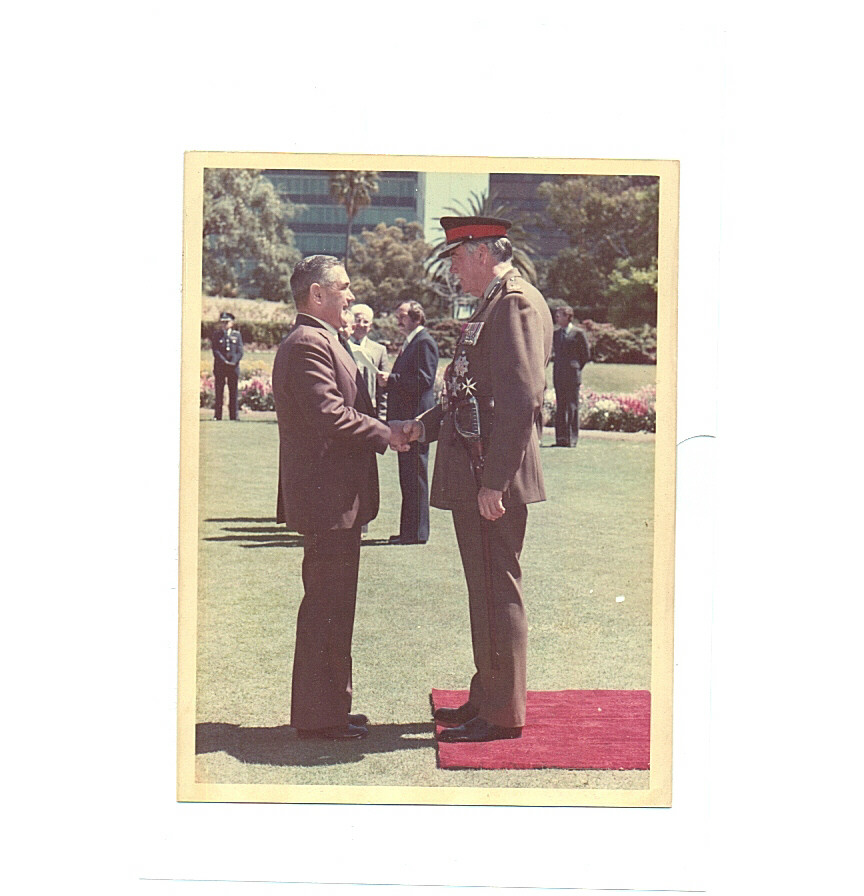
Ainslie Manning being presnted with his Service Medal by Sir Roden Cutler at Government House, Sydney
Ainslie George Manning, my father, was born in Muswellbrook on 28 December 1917 to Benjamin Arthur Manning and May Gwyndoline Armstrong. He was a large baby weighing over 10 lbs at birth and was the eldest of 6 children.
The Manning family lived in Muswellbrook, Aberdeen and then Adamstown before they settled in Cardiff a suburb of Newcastle, NSW. The family lived in a temporary dwelling on the land at Cardiff and eventually moved into the home that stands today at 49 Queens Avenue, Cardiff. Ainslie's schooling started at Aberdeen for a brief time then Adamstown and finally Cardiff Public School, which was within easy walking distance of Queen Street. Later Ainslie attended Newcastle Boys High School until he gained an apprenticeship on the NSW Railways as a Boilermaker.
During the depression the Manning family went into the egg producing business to supplement the family's income. Ainslie, being the eldest became contracted to the Egg Board and would walk long distances to see that the eggs were delivered safely to a waiting truck in a designated area. He never saw this as an imposition but as a means of supporting his family. These early lessons were to be carried over into his adult life.
While attending Newcastle Boys High School where he had planned to do his Leaving Certificate he was offered an apprenticeship with the NSW Railways and as jobs were hard to come by he grabbed the opportunity. He topped the last year of his apprenticeship and narrowly missed the opportunity for a scholarship at university. He began his apprenticeship at Cardiff Workshops in 1937 where his father already worked and when he had finished his apprenticeship in 1940 his papers were stamped "dispensed with". This was routinely done to all apprentices but it meant he was technically without a job and as Australia was at war, he decided to join the Royal Australian Navy.
He enlisted in the Royal Australian Navy in March 1940 as a Petty Officer doing his trade of boilermaking. He did his initial training in Sydney and then went to Flinders Naval Base in Melbourne. After his training at Flinders he was assigned to the "HMAS Canberra". He met my mother Edna Jessie Davies who was working as a Nurse's Aid at the TB hospital in Melbourne while being stationed at Flinders Naval Base. Of course he had to go off to sea, but they kept up a correspondence. Codes were used in his letters to my mother and his family to inform them of when he would be next in port. It was after Edna received one of these letters that Ainslie called in at the hospital to surprise her and took her to a jeweller to buy an engagement ring. My mother went home to Ballarat to prepare for their marriage which would be the next time Ainslie was back in port. The port was not Melbourne this time but Sydney. So Edna, her mother and two nieces packed up the wedding clothes and trained it to Sydney to await Ainslie’s arrival. Ainslie duly arrived in port and they organised the marriage for that afternoon, but suddenly he was called back to duty, causing the wedding to be called off. A few hours later, Ainslie reappeared. It had been a false alarm and so the marriage was on again. The minister threatened to marry them then and there but they declined and waited until that evening to be married in all their finery. They were married on 10 December 1941 and Ainslie left on the "HMAS Canberra" the next day. Edna did not see him for another 6 weeks. When Ainslie came back from sea in February, 1942 he was suffering from asthma and was medically retired from the Navy. The hot conditions of the boiler room and then the colder environment on deck triggered his asthma. Ainslie and Edna had two children, both born while in Annandale, Lynette Anne born on 25 February 1943 and Robert Ainslie born on 10 July 1944.
He began work at Eveleigh Carriage Workshop, NSW Railways on 31 March, 1942. It was here that Ainslie’s career as a trade unionist resumed, having been involved when he worked at Cardiff Workshops. Ainslie became a delegate and kept incident books. From early days it can be seen that he was concerned about his working conditions and those of his fellow workmates. Recently I met a lady who remembered being helped by my father’s actions even though she had never met him. Her husband had worked with Ainslie at Eveleigh during the early 1950s, when this man contracted rheumatic fever and was consequently unable to attend work for some time. My father, bless his heart, took up a collection and fought for this man to be granted sick leave. His wife tells of how there was this mysterious money in the bank and on investigation it turned out that Ainslie(or George as he was known in the workplace) was responsible for the extra money being there via his collection and his agitation for sick leave. This story is one of many such incidents.
In 1949 our family moved from renting The Methodist Manse at 81 Johnson Street, Annandale to live in a garage on the block of land at Lot 40 Gungah Bay Road, Oatley which my father had bought when he left the navy. Ainslie built a house on this land with the help of family and friends. My memories are of Ainslie coming home from work, having his tea, changing his clothes and be back off out again to a union meeting in the city. Searches in the Mitchell Library of the Redfern Branch of the Boilermaker's and Blacksmith's Union show that he was an active member of the union, going to bat for his fellow workers on many occasions supporting safe and fair work practices. There was also evidence of him helping with a May Day Procession and I can vividly remember my brother Bob, Mum and I standing on the corner of Hyde Park near St. James Station in Sydney to watch him participate in a May Day march. We cheered, clapped and waved and were very proud of our Dad. He kept his trade unionism going until 1960 when he was confronted at a union meeting by a man pointing a hand gun at him with the warning to keep his mouth shut or else. It would seem that there was some misappropriating of funds and he was asking too many questions as to where it had gone. This again was typical of Ainslie, very honest and not afraid to bring dishonesty out in the open. After this incident though, Ainslie withdrew from his active union service, still being a member until he was promoted to a Safety Officer in the NSW Railways in 1961. He resigned from the Boilermaker’s and Blacksmith’s Union in 1961 because he was no longer working as a Boilermaker.
In his job of Safety Officer Ainslie travelled all over New South Wales instructing Railway staff on job safety. He thoroughly enjoyed this job and his employment card tells of quite a few letters of commendation for his lectures. Ainslie retired in 1978 as a Senior Safety Officer and in 1979 he was presented with a Service Medal by the Governor of NSW, Sir Roden Cutler, the NSW Governor. It was a very proud moment for us, his family.
My mother, Edna died in 1992 of Legionella in St. George Hospital. At the time Ainslie was admitted to hospital with chronic airway disease. Not long after Edna’s death he developed severe stomach pains which turned out to be adhesions and this resulted in him losing his spleen and some of his pancreas. His health from that point on was not good and he was having constant lung infections with a specific antibiotic being prescribed which caused liver damage. This liver damage and the chronic airway disease finally ended his life on 8 January 1996. He had turned 78 just 10 days before. My father’s death was slow and painful and I would have wished better for him. His death was a release from the pain and indignity that goes with being chronically ill. His strength of character and his generosity is something that his family will always hold dear.
ã
Copyright Lyn Vincent 2001