

LYNDON GENEALOGY
CHILDHOOD MEMORIES OF EDNA MANNING
(NEE DAVIES)
Edited by Lyn Vincent
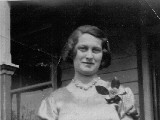
Edna Davies aged 18 years
To preface these writings of my mother, Edna Manning, I would like to say as her daughter I have pieced these papers together in the hope that they will survive as a living memory to a mother who sacrificed much to see her children get on this world. After my mother's death my father was quite surprised, to say the least, to find all her memoirs and letters to her family hidden away in a drawer. He did say that she spent many hours writing at the desk but he thought she was writing letters to friends and family. The following is the first part of a larger work produced on the life of Edna Manning.
I was born on November 11th 1915 at Ross Creek (formerly Roffs Creek) 9 miles from the famous gold mining town (now a city) of Ballarat (formerly spelt Ballaarat) in Victoria. I was the third child of Oliver Thomas Davies and Clara Jane Davies (nee Browning). I had a sister Florence Ernestine 11 years older and a brother Herbert David Thomas 9 years older than myself. My grandfather worked in the mine-fields [gold] for some time. There is a replica village in Sovereign Hill now.
Ross Creek was a small place where draying, wheat and sheep farming were the main industries and consisted of a Methodist church and a small post office where letters were delivered from Smythesdale and collected mostly by the school children on their way home from the local primary school which went from 1st grade to 8th grade. Children left school at 14 years but if possible could go to a high school in Ballarat which meant boarding in Ballarat. There was no public transport. Some rode bikes and some pupils from Ross Creek went to Smythesdale at 6th grade and sat for the Qualifying Certificate and at 8th grade the same for the Merit Certificate. Our school was about 11/2 miles from our home. Mostly we walked but sometimes Bert took me in front of him on the pony, or in the gig. The school was on about a one acre block, two shelter sheds and toilets each end of the school. The school consisted of a large room and a big fireplace and an annex for bags and coats. There would be something like 20-22 pupils. I started school at 41/2 years. We started at 9am and finished at 3.30pm. The school was surrounded by pine trees and we did all sorts of things with the cones and needles. Sports days at the school involved all the family taking part. Dad and Bert excelled in the broad jump. I was a good runner and myself and Glad (Alma) Cox always came 1st or 2nd. The day ended in a dance at the local hall. Sometimes we were allowed to pick up the teacher's mail in the lunch hour and if the teacher was new we would be all curious to see what their christian name was.
I was very venturesome and if anyone dared me I would have a go at climbing trees, crossing a running creek and one time I grounded a boy and sat on him for a bet. The school had an inspector visit twice a year to view our work. Smythesdale was a bigger town consisting of a court chambers, council, police station, doctor and a few shops and a local hall. Scarsdale was about 11/2 miles further on and much the same but had a private hospital and cemetery. Linton had a general hospital. The doctor would make house calls when needed or patients could drive to see him at his surgery. I had a nasty abscess on my throat lanced in his surgery. The first doctor I can remember was a very old doctor named Dr. Vise but the one after him who we all liked was Dr. Ranleigh Clarke. I was born at home with a midwife named Mrs. Crooks in attendance. She came a few weeks before and helped in the house and stayed a few weeks after the birth.
When we were young, New Years day was quite an event. We were up early, Mum having packed sandwiches, cakes and drinks and we set off for Lake Wendouree in Ballarat. We would leave in the wagon at 7am and often arrive home at 7pm. We would visit the zoo and go for steamer rides and a real luxury was to have 2 or 3 ice creams. There was also a local hall (opposite our home) where dances and socials were held about once a month. Mum was the caretaker. Children were taken as babies and put to sleep in the cloak room or even behind the piano while the parents enjoyed themselves. These dances always ended in a sit down supper, all home cooked. Fancy dress parties were popular and fun. The music for the local dances was supplied by the Bennett family. Dad [Mr. Bennett] and son Bob on violins and sister Hilda on the piano. There were dances like two step, barn dance, Scottish, waltzes and sets (like square dancing). I was allowed to go to the dances when quite young but Nanna (Mum's sister Georgina) would come at 9.30 to take me home to bed. Dances were also held at Smythesdale, Scarsdale and Haddon. Lots of people walked to these dances and it was just like a bobbing fairyland with all their lanterns. We went by gig and pony until we were older and Bert and Bill (Bill Dalgleish) had a truck and we all piled on the back and sang and told jokes all the way there and home. Later people came with Bert from Ballarat. We sat on cushions and one night the Ballarat crowd got to the truck before us and sat on our cushions. Bert asked them to get off as he couldn't see to back out. They refused so he operated the tip on the truck and slid them out. One couple were going to walk the distance to Ballarat but decided against it. We didn't see them again. We had another episode when the brakes failed as we backed out of the yard but the hotel manager was very helpful and relayed us all home by cars. When I worked in Ballarat I went to these dances by bus.
On the other side of Ross Creek was Cambrian Hill, Napoleons, Enfield and Black Lead. We often walked to Cambrian Hill to church and dances. Then in another direction was Sebastopol and Ballarat. Sebastopol was quite a big place with shops and hotels. The trams ran to Ballarat. We often walked to Sebastopol and caught the tram into Ballarat. There were big stores in Ballarat as well as numerous hotels, a town hall, library and a base hospital as well as a few private hospitals. Golden Point, Black Hill and Sovereign Hill were big names in the gold rush days. Some hotels were Southern Cross, Atlanta and Bunch of Grapes. Sovereign Hill has been made into a tourist village with the old shops, blacksmith, horses and carriages and even the panning for gold. It is in a lovely position. Ballarat can be seen at all points. The horses [at Sovereign Hill] were called Diamond and Star. Diamond was a bay and Star was a pure white with dark star on the forehead. They were thick set draught horses used for the wagon and ploughing. The first pony gig horse I remember was Dolly, a light chestnut colour and very gentle. She had a foal. That was Bert's horse and he called her Della Ribbons. The father was a race horse called Blue Ribbons. When he got older and she needed exercise he sold her to a man in Ballarat, but she kept coming back for quite some time. I learnt to ride on the next horse we bought. Temperamental Dandy was hard to catch and very moody. I had got to know the signs when he was going to prop, otherwise I would land on the ground. I stopped to give him a drink and I would have to have patience and wait for him to make up his mind when to go on, not when I wanted.
One time when we picked the black and red currants we ate as much as we picked and couldn't look at currants after that. Mum would set her jellies on the cool concrete floor of the dairy which was shaded by trees. I was always hungry and if anything was left over I would say 'it's mine'. I suffered a lot from bilious attacks and mum used to say I ate too much. Dad worked for the Forestry in the winter months when things were slack as well as selling wood in Ballarat by leasing a block of land from the Forestry Commission. I would go with into Ballarat in the holidays and sometimes after school. I used to help him make up twigs which were sold as bundles for starting a fire. A block of land with timber on it could be had for 6 months. Royalties were paid on it and it was not a big sum and as much wood could be cut off it as long as the stumps were left to spring up again. We were never short of wood. I had asthma when I was 4 years old but seemed to grow out of it. When I was 14 I got rheumatic fever. I used to catch cold easily too. Dad was a very patient and gentle man and wouldn't argue, just put on his hat and walk out but we all knew when he was angry with us. I never remember him hitting me but Mum often gave us a clip.
Friday was Ballarat shopping day and all the country people came in and we knew them all. When I went in I thought it a treat to have lunch at a hotel or café and have an ice cream. We always had fish for Friday night tea. When I was at school I would come home, light the fire, prepare the table and start milking. Mum always brought a big bag of lollies that had to last us all the week. Saturday was Mum's baking day and no one dared to open the kitchen door and let a draught in and spoil her cooking. She made lovely cream puffs (pastry), sponges and scones also home made bread was enjoyed by all the neighbours. The bread was made with yeast from the brewery and it often ran over the dish. Mum also made horehound beer and soda water. I remember a glass syphon around it. We grew apples, pears, quinces, plums, gooseberries, red and blackcurrants, raspberries, younger berries, loganberries, and four beds of lovely big strawberries. When we had visitors in strawberry time, that would be dessert with lashings of cream and we could just go and pick them. Besides this Mum's flower garden was always a picture. Violets, pansies, anemones, lilies, poppies, standard roses as well as other shrubs and the maiden hair fern in an old tin tub was lovely and there was a border at the back fence and it was clarkia which was pink and blue forget-me-nots.
Dad ploughed up the vegetable garden and planted them but the flower garden was strictly Mum's. I remember walking behind Dad when he was ploughing and he must have looked tired and I said poor old dad. I liked milking time when I was young. I would take a tin mug and get the milk straight from the cow and drink it. Some of the cows were leg roped or else the bucket of milk would be sent flying all over the bail. Another job I liked was to separate the cream from the milk. The milk was put in a bowl (steel) and then a handle was turned. There were two spouts one on top of the other. Skim milk came out of one and cream the other. It all depended how quick the handle was turned for the thickness of the cream. It was kept in cans until Fridays and taken into Ballarat to the butter factory and sold. One Friday, Dandy decided to bolt and tipped the cans out of the gig and all over the paddock. I guess we went a bit short that week. When we had visitors my seat was Dad's knee and when I was about 14 or 15 he said my poor old knees seem to be getting weak but Mum said its not your knees getting weak its someone getting heavier. Dad was a gentle man but could say his mind when something really annoyed him. Once when I swallowed a rubber at school the teacher said to go home, he didn't want me to die there. Dad gave him a tongue lashing and said if it happened again he'd give him a belting. I also swallowed a marble when with Flo. She turned me upside down but that wasn't any good. Mum gave me a good dose of castor oil and that did the trick. We had no sewage and had to take a lantern at night. Dad emptied the pan twice a week in a big pit near the pig sty. I had to scrub the pine seat every Saturday. We also had a pine table that had to be scrubbed white. The toilet was in the outer yard near the stables. I had two bantam hens and we had to have four of their eggs to one ordinary hen egg. They were tame and followed me like a dog. A creek went through our property and I used to catch tadpoles there and watch them grow into frogs. There were about 22 families living in the area and quite a few related. Sam and Florence Bray (Mum's sister) Mr. and Mrs. Spratling (Dad's cousin) Mr. and Mrs. Hally (Dad's cousin and Mrs. Spratling's sister, 2 families of Williams, 2 families of Tudor, 2 families of Morrissy, Tuddenham family, Watson family, Kirk family, Madden family, Deans (Dad's cousin) Arthur Peach, Morris family, Bennett family, Aunty Ivy (Dad's sister) and Uncle George, Lyle family (Mrs. Lyle was brought up by Sam and Florence Bray), Cox family (Dad's cousin) and Dad's brother Uncle Dave, [Editor's note: When Edna was married and living Sydney Uncle Dave was burnt to death in his home and his sister Mary Satchell nearly went with him. Before the family could let Edna know it was reported in the Sydney Morning Herald and Edna was greatly shocked] Ida and Frank Browning (Mum's brother), Georgina and Andrew Browning (Mum's sister and brother) also Satchell's (Dad's sister). Mum's brother Frank and his wife Ida lived next door to Nanna [Aunt Jessie Browning] across the road from us. There was a paddock between us. I was a bit in awe of Uncle Andy and I do not know why. He was never nasty to me but I found him hard to talk to. My cousin Heather (daughter of Frank and Ida) could get anything she wanted from him. Aunty Ida was fond of cats. They milked cows and Uncle Frank worked for the Forestry Commission. Aunty Ida would not bear to get rid of the cats. There was only one allowed inside and the others stayed in the shed. It was nothing to see about 15 cats trailing after Aunty when she went to the milking bails. My mates at home were Alma Cox, Heather Browning (my cousin) and Daisy Kirk. At school Dave, Bill, Bladwyn and Laurie Williams, Ern Satchell (my cousin) Jack Halley, Ella and Hilda Bennett, Ed and Bill Morrissey, Mollie and Herb Tuddenham, Harold, Stan and Nellie Madden and Mavis Lyle. [Editor's note: In July 1965 Edna returned to the centenary celebrations of Ross Creek School where she managed to get her photo in a Ballarat paper]
My brother Bert was a real prankster. The Morissey's were very suspicious people so Bert and Allan Cox would scare them by telling ghost stories.
At school every Monday morning the flag would be put up the flag pole and we would all salute to honour the King. When we had the truck we would go into Ballarat to the pictures. I can remember silent movies and also was very excited when the sound was brought in. We called them talkies. When dad was with us he would be very excited to hear the voices on the film the same when he first heard the wireless. Aunty Ida and Uncle Frank were the first around to get a telephone and we had great fun ringing friends in Ballarat. Sometimes the boy next door would given me a dink (sitting on the back of his bike) to the pictures. One night my foot went to sleep and when we had to get off to push it up the hill I had lost my shoe and I had to go back about 11/4 miles to find it. If I walked into town I would wear old shoes up to the main road and then change into good shoes and leave the old ones under a bush, until one day when I came back someone had taken them. I must have been a clumsy kid and when I first went into long stockings I was always tripping over and putting holes in them. Mum threatened to put me back into socks. Our family was used to cuts and bruises. Dad and Bert being axemen often had to have a cut stitched. One chore I hated for Dad, although not hard, but long and tiring was the turning of the big emery wheel to sharpen the axes. Water was put on the stone and Dad was so particular about the sharpness of the blade. We did not go with partners to the dances, the girls all sat around the hall and waited for a boy to ask most of them. One night we had been up to see Uncle Dave and coming home around 9pm we heard this blood curdling wail. It was something like a baby screaming. Flo took off leaving me to follow slamming the door behind her. Dad had heard it and told her it was a curlew. There had been a drought and it was looking for water. They were rarely heard in our parts. It was a terrifying sound. Fires were dreaded and often came close to the homes. All the men would be out fighting them and there would be very little water. They had wet bags. The women would be there too with drinks and eats. The men would be dead beat and sometimes have to go out again next day. One close one before Flo was married - she had taken her glory box and was going to stand in the dam. The winters out there were very long and cold. I learnt to swim the hard way in a big muddy dam and pulled down and made to swim by Bert but he was always close by. I did not like the fresh water very much as I always caught a cold, but I enjoyed the beach when we went to St. Kilda in Melbourne. On Sundays we went to Sunday school at the Methodist church. It was before church. Most Sundays either we went to someone's place for tea or they came to ours.
I had a very happy carefree childhood. There was not a great deal of money but we were always well, had, plenty of food, love and friendships. I had the usual childhood ailments and had rheumatic fever when I was 14. We had been in Melbourne and came home, there was no one to meet us and we got soaking wet. My grandparents came from the United Kingdom. My Dad's side from Carmarthenshire in Wales and Mum's side from Paisley and Somerset. Dad said I was a gum sucker (small branch of a tree). Dad had a great sense of humour and had many funny sayings and was a very lovable dad. Both mum and dad had lived around the district all their lives. Mum came from a family of 13 and dad from a family of 7. We had a small farm about twenty acres with an average of twenty cows, five horses, fowls, pigs and numerous cats and dogs. One dog, Lassie would round up the cows at milking time and bring them to the bails. She also knew the prize cow and would bring her down if we mentioned her name. We had to be careful not to let the dogs stray as people laid baits for foxes. We lost a prize Pomeranian dog that way. She had been born on a ship from Borneo and had been given to Bert with a pure Persian cat. The cat fretted and died soon after.
We always had plenty of milk, fruit and vegetables. Mum made all her own jams, pickles and sauces also cheese. We had a butter mould which was engraved with the name Heather and when the butter came out it was imprinted on it. This was the name of our house too. Which was a weatherboard house. When Flo was five months old and while Mum was milking the wind blew clothes that were airing into the fire and burnt the house to the ground. The new house consisted of rooms from Dad's family home and two other rooms and a veranda were built on the back. This was the home Bert and myself would have been born in and I also remember two pennies with gold that had melted together in the fire. The house and dairy were fenced off from the out buildings (toilet, barn, pig sties, fowl houses and cow bails). The pig sties were well away from the other buildings. The toilet was the pan system and we made sure we went out before dark because we would have to light the lantern and go out. Dad employed two men at Xmas to help with the harvesting which was done with a reaper and two horses. It was then stoked up and let dry and it was then that the mice had a good time but the dogs had a greater time when the stokes were gathered up and put into one big pyramid haystack to be used throughout the year. I had an infected finger trying to catch a mouse in a bin. It gave a nasty bite. Our house had two fire places and a huge fuel stove in the kitchen. We could use the fire in the dining room to cook on. It had a bar across to hang a kettle and you could put pots on a bar also. Mum used to put the flat irons for ironing to heat in front of a big fire and irons were worked over with a bees wax cloth. In those days sheets and tablecloths were heavily starched, then damped down so imagine the work. Also washing was done by washing in a big tub (this served as a bath as well). On Saturday nights we had a bath and other times we had sponge baths in a big basin and big jug for water to match. The clothes were soaked the night before then washed in Sunlight soap on a scrubbing board then put in an open kerosene tin (kerosene bought in bulk for the lighting of the lamps) then boiled with washing soda and sunlight soap, then rinsed in clear water again with a blue bag in the water. Often on frosty nights Mum left the clothes out to whiten them even more. Our clothes line was two long ropes on poles each end and the ropes held up in the middle by forked sticks. The clothes line was in the paddock near the fowl pens. This was fenced off so the fowls could not wander round. Once when I was quite young I followed Mum into the yard and we had a vicious rooster and he flew at me and put his claws into my temple. I think we had him for Sunday dinner which also brings to mind the 1st fowl I killed when I was around twelve. Mum was sick and wanted chicken broth and Dad forgot to kill the chook. Poor thing, I had about three goes to chop its head off. I kept turning my head away. Eventually I got it killed, plucked and cooked. Our place was lined by cypress trees which dad kept very neat and some in different shapes. We had a long front driveway lined with cypress trees but at the back we drove straight into back paddock near the stables.
I never knew Dad's parents. They died before I was born and also Mum's father. I have vague memories of my Grandmother Browning. I remember the room she slept in. I was three years when she died. Mum told me I kept wanting to see her and she heard me and said let the little darling come in. My grandfather Davies died three years before I was born. She [Grandmother Browning] made me a black doll made of stockings and I believe I was upset when one of the dogs tore it up. We spent our Xmas in Melbourne with Auntie Jess and Auntie Georgina in Ilwick Street Prahran and they had a grocery shop opposite their home. I would sit on a box near the lolly tin until they found out it was quite easy to slip my hand in. They had an old tabby cat and when it died we had a procession up the yard to bury it and put up a cross. Another early memory was when Bert used to come to Melbourne with us and his mates and himself putting chewing gum and cotton on the coins and when anyone went to pick them up they would pull them away. Bert was a wonderful brother and took great care of me and also Flo. He would take me to the dances even if he had a girl friend but if one of his boy mates were going he was cautious of taking me. I missed him greatly when he was killed on his motor bike at the age of 32. He was married then to Maisie Wrigley but only for three years and no children. Aunty Nanna had made over her home to him and lived with them after they married. Dad and Bert were very close and Dad never seemed get over his death. [Editor's note: A funeral notice states that the funeral was held in his late residence and that he was buried on a Thursday in Smythesdale cemetery. The service was conducted by Rev. L. Hartshorn and was attended by a multitude of friends and relatives.]
Our home was an open house for visitors and Bert and Flo and myself as I got older would bring our friends home for the weekend from Ballarat. The tricks that were played these times, things in the bed sheets, shortsheeting, pyjamas tied up. One of our cousins Eve Spratling got dressed up as a tramp one night and went round the neighbours begging for food. She fooled quite a few. We had dress up nights in the local hall with prizes for the best character. They were real fun nights. Bert and Allan Cox were always playing jokes on the other boys. They rigged up a kerosene tin (empty) with a light in it and made a face on the top and as one of the boys rode by on his bike stuck it up over the fence. He jumped off his bike and ran with it to Allan's place and rushed inside, bike and all. Another night there were two missionaries speaking at the hall and they had motor bikes. One poor chap had to stay with the bikes all night as guess who was honking the horns. Mum said I know who had a hand in that. Dad had beehives and could rob them without getting bitten. One day a chap next door was watching and Dad gave him some honeycomb and a bee landed on his neck and forgetting the honeycomb put his hands to his neck. Was he in a sweet way. Reading of course was one our main pastimes but when I was younger I loved to cut furniture out of magazines and make a home on the table, then I would change the rooms around. If any one of our neighbours was sick Mum would be there to help (mostly washing and ironing) and they all would do the same for us. The school used to celebrate a day called Arbor Day. The whole school would go into the bush and observe natural flowers and shrubs. Eggs would be taken twice a year for the hospital and children's home. When I was twelve Mum got a piano and I started lessons with the lady next door. They had a big mulberry tree and when I had finished she would take me to have as many [mulberries] as I liked. Another happy memory were the get togethers around the organ and later the piano, mainly in winter at our place or Cox's or Kirk's. Summer evenings we would play games outside until dark or in the moonlight. Guy Fawkes night on the 5th November was special. Weeks before we would gather wood for one big bonfire and buy crackers each week. When we finished we would dress up a scarecrow in some old clothes. One boy at school boasted he had bought a huge cracker. Bert decided he would fix that and put gelignite in a tin and did it go off with a bang. There was always a cup of cocoa waiting when I got home from school on a winter's day. I had a couple of accidents when I was young apart from the rooster episode. We had a little house dog and while we were having tea one night Dad gave him a bone not knowing the outside dog had sneaked in and they jumped up on the sofa and I got bitten on the arm. When I was sixteen I hit my ankle bone on a seat and knocked the cap off. While I was recovering from it I ran a needle into my toe and luckily it came out on the other side. I caught colds and bronchitis easily. The winters were so very cold. I had asthma until I was seven and Mum said she used to burn a lamp at night. I had a severe attack when I was seven but later grew out of it. I had long hair I could sit on and Mum made me brush it about 50 times before I went to bed. I had it done in two long plaits. It was always lovely and shiny. There were no shampoos either just pure sunlight soap. When I was thirteen or fourteen I pestered Mum and Dad to have it cut. It took some persuading but brother Bert did the trick again and said all the girls were having it cut short. In the end they gave in and I had it cut in the shingle cut. Dad liked us to go out and enjoy ourselves and his parting words were enjoy yourself and look after yourself. Saturday afternoons we went for a walk in the bush. There were about eight of us girls and boys and four of us took a wrong turning and got lost. We kept coming back to the same spot but eventually got on to the main road. Flo and Bill had also got lost in the same spot. Our fireplaces had to be cleaned out every day and back and sides brushed over with whitening and water (this whitening was dug out of the hill opposite us also red ochre another substance). The fuel stove had to be cleaned of soot and blackened with black lead. This was bought from the store. When I was fourteen I went to work at house work for Spratlings. I stayed there and came home weekends. Eve Spratling married my cousin Roy Bray and they lived with her bachelor brother Dave. Another brother Perc lived next door with his family and helped with the farm. They had sheep as well as cows. I was up most mornings by 4 oclock to get Roy away to his work and then to get Dave Spratling his breakfast before he did the milking. I very rarely got to bed before 9 pm. There was washing and ironing and cleaning. I did not cook there, except for Dave's breakfast.
After I had left school at 14 and worked for Eve and Roy Spratling (they were expecting their first child) I then went to work for Flo and Bill in the dairy they were running but I had to go back home because Mum was sick and needed help in the house. When she was better I got a job looking after two children at the manse at St. Peters Church of England (Barbara and Barry). [Editor's note: A reference from Elspeth Fettell who was the wife of the Vicar at St. Peters Church of England states that Edna "takes great pains in her work, is trustworthy and patient with her two little children. She recommends Edna to be "a diligent girl of high moral character".]
I was there for quite some time until I got sick myself. They were very good to me and took me on their holidays with them when I was better. The bells at St. Peters almost deafened you if you opened the door. The next job was again with children. I was almost seventeen by now. There were four children but I only had to care for two. Mary, 3 and Barry, 9 months. The mother went on a holiday for a fortnight and I had full charge until she came back. Their grandmother was there but never did anything. This was upstairs from the father's chemist shop. They were lovely kids. I stayed their for quite some time until the mother was able to cope and they were good to me. Then I got a job with a Mr. Sim in Sturt Street, Ballarat. His wife had died and he had a housekeeper. He did a lot for the children, Marg and Dawn who were very spoilt but grew up to be nice girls and I still keep in touch. Also the housekeeper. Mr. Sim came from a line of timber people (3 generations) and had money and loved the races and on a good day we would get a tip.
I always liked looking after children and had a chance to be in charge of a three year old and another one expected. Greg was a lovely boy and no trouble. While I was here there came the shattering news of Bert's accident and death. Everyone was so shocked especially as Bert had only been married 3 years. It affected Mum and Dad and took a long time to recover. Dad and Bert were very close pals as well as father and son. I was very restless after this and decided to venture out to Melbourne.
I had the chance of a job at Gresswell Hospital (TB hospital) and better pay. There were three hospitals, The Mont Park Mental Hospital, The Repatriation Hospital as well Gresswell. Also there was the Fairfield Infectious Diseases Hospital that I worked at but it was really hard work and not much money. At Gresswell we had more time off. There were dances for patients at the mental hospital. The hospital liked people to go and look on. Only normal [Editor's note: not dangerous] patients went. One was a beautiful blonde lady who was affected in childbirth. She dressed in black but never smiled. She always danced with a man whose mind cracked while studying law. He dressed in tails and a bow tie. He too was very sober. He was the son of a very wealthy man called Danks. They handed round scones and one of the patients, every time she took one, she put it up the leg of her pants. I made friends with a lady called Mavis Collier and we still correspond. We went to most things together and half of her day corresponded with mine. We went to the ladies day at Melbourne Cup time and put £1 on a horse and got another £1 back. We had a slap up meal and went to the pictures. While I was here I met Glad Hicks and through her friend Doug met Ainslie. We met in a bedroom at the Peoples Palace. Doug's parents had come over to see him and were staying at the People's Palace. Ains' mum and dad had been over just a few weeks before. I thought he was very quiet and he left Flinders after a few weeks to go to sea. He wrote for nearly 16 months. I had started to do a nursing exam to go into children's nursing. Some of the workers at Gresswell were a bit funny. Barbara took an alarm clock out with her so she could be on time and used to wear a much worn fur coat and sandshoes but she was very clean in herself and roomed with Ella who was not so fussy about herself as long as her face was made up. Ella gave Barbara money for face creams and Barbara brought back new pants and singlets saying she needed these more. We had a pass till 11 one night and late pass till 12. The doors would be locked. Some of them, if late would climb the drain pipe. How I don't know. I missed the bus once and it was almost 11.30. I thought here goes as the sterner sister was on duty, so I went in and told her that I had missed the bus and she said get in and don't let it happen again and I never did. I had at one time thought I would go in for the nursing at Mort Park but one of our friends came to us one night with a black eye one of the patients had given her so that solved that problem. There were some lovely walks around Gresswell. A bus came to the gates of the hospital which took us to Ivanhoe station and the train into town. Both the doctors at the hospital came from Ballarat. My Dad's words came true here. He always said be honest even if it means you get into trouble. While I was collecting Matron's breakfast tray from her flat I bumped a very lovely lamp and broke it. First chance I got I went and owned up and other times if something went wrong I did the same. I was on holidays and a vase in the doctor's flat was broken. They said perhaps I had done it - Matron said no she would have owned up. It was the laundry hand we found out. The doctors used to rag me about my boyfriend in the navy as they used to see the letters in the post. I would not get a letter for months and then all together. When he was at Flinders he gave me a name and if it was mentioned in any of his letters I would know he was coming home. In July I got such a letter and I couldn't say anything to anyone. I had to read his letter by torchlight. It was terrible keeping it to myself. When we came in at 11 and the lights would be out I would use a torch. The next thing I knew someone told me I was wanted in the kitchens and guess who was there waiting to see me.
I was to be on for 32 hours before going out so I had to get permission for some one to take my shifts so I could go back into town with Ainslie. We went into town the next week again changing my shift and we went to Ossie Brooks father's jewellery shop and picked the engagement ring. We met Mavis later and all three of us celebrated at a dinner and then a show. Ains had written to dad and mum asking permission although there was no need as I was 25. I left Melbourne to go home to arrange for my wedding. I got a job at a Mrs. Cairns, her husband had been moderator of the Presbyterian Church. She had a gardener and companion. I did the cooking, (the house was two storey) washing and ironing. They were very kind to me. While I was there Ains got leave and rang me from Melbourne. Japan had come into the war and I knew leave would be hard. I packed up and took Mum, Sylv and Flois over to Sydney. I had not met any of Ainslie's relations and it was rather an ordeal and I was glad Mum was with me. We came to Sydney and Aunty Amy met me and said Ainslie had been called back to sea. We went to let the Minister know and on the way back we met Ains. It had been a false alarm. The minister, Mr. Waterhouse said 'I think I had better marry you here and now', but we waited and were married at 7 pm that night. Ains left next morning and was away for some time. Ron [Ainslie's brother] came down [from Newcastle] and took me to meet the family. Ains' Dad was lovely he waited at the gate and took me into his arms and said 'welcome to the family'. Ains' Mum was a little more reserved. I guess that most mums feel like that when their children marry. So ended my single life. Ains was away for three weeks after our wedding and then I got word that he was in hospital with an asthma attack and two weeks later he was discharged from the navy. We then had our honeymoon in Ballarat meeting the relations. So this said an end to Edna Davies and enter Edna Manning.
ã
Copyright Lyn Vincent 1998