After having spent a short (because of crossing the International dateline) quiet Christmas day in the air, we arrived in Manila after 16 hours of air travel. We arrived early in the morning. Being experienced travellers, we hid our faces from the photographers as we exited the plane; they say if you don't pay for the picture they take of you, you might have a hard time getting through immigration. After waiting, seemingly forever, for the three boxes of gifts Lyn had packed. Two of them were close to 70 pounds; I know because I hurt my back lifting one to weigh it. After getting through customs and immigration we were met by a travel agent who would finalize our plans for our trip to Boracay Island. Though it was a holiday, he came over to the airport to make the transaction. We paid him for our hotel reservation and then went over to the Philippine Airlines office to purchase our plane tickets. Our next stop was Olga Protective Agency, Lyn's place of work for ten years. After a nice visit, it was off to the Galeno's residence (owner of the Olga Agency and Lyn's residence for 10 years), where one of our large boxes of gifts was distributed.
|
|
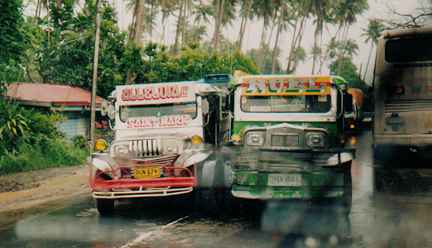
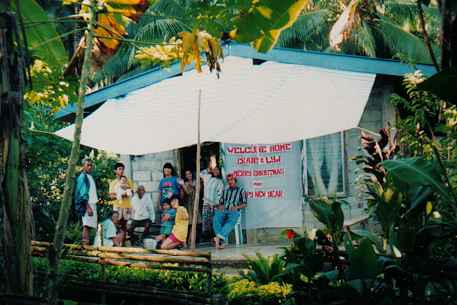
Then we headed down to Tubas in a rented Toyota Tamaraw, which seem almost as common now as the ubiquitous Jeepney. It took us six hours, at least an hour was added by the heavy traffic from the fiestas, although it was unusually light in Manila. Hour after hour we spent riding and the only break in the sequence of homes lining the highway was along one side when we reached the ocean at Gumaca. It was dark by the time we reached Tubas, but that didn't dim the celebration as they were waiting for us. A few firecrackers were exploded to honor our arrival. From the road, we started walking along a path where there looked to be just trees, but we immediately passed by one house before casting our eyes on Lyn's parents new home (or at least just two years old). There was a large banner welcoming us along with Christmas lights and people, many people. (Lyn's family, friends, godparents, friends, neighbors).
Although no fee had been prearranged with the driver, we were told that it was 2000 pesos (about $50). That seemed kind of high to me (I was later told that the average wage in the Philippines is about $4 per day), so I balked. A little later it was dropped to 1000 pesos.
|
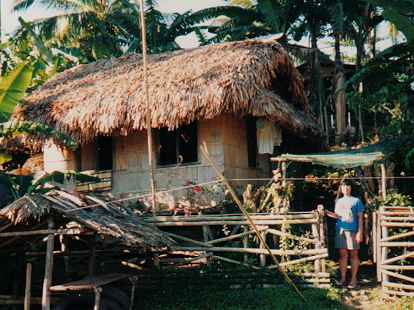
Typically, a house's roof is built first after erecting posts for the corners. Then a cement foundation can be poured and the walls added last. Water is carried over from a spring or stream load by load and deposited in a large plastic drum. Water from the drum can then be used for drinking, cooking, washing dishes and clothes, and for one more thing. The toilet looks similar to ours, except there is no seat and no tank. You simply squat over it, take care of business, then use a large ladle or "tabo" to toss some water into the toilet bowl to initiate the flush.
|
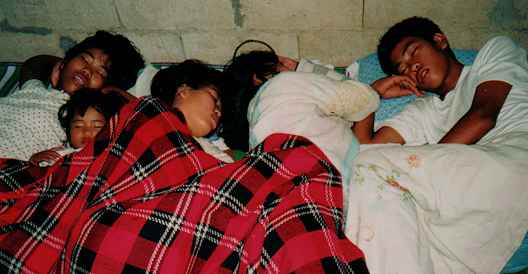
When I got up for my normal nocturnal visit to the "kubeta" (bathroom), I counted bodies. There were at least 17. Many were laid side by side on mats in the living room, with some limbs carelessly tossed over other people. In the dining room, there was a snoozer on each of the two benches (I hoped they wouldn't roll over). Several were on the other bed and I don't know how many were stretched out on the front porch. People had even been dropping off at different times during the evening, oblivious to the stereo and and the various conversations. I now understand how Lyn can sleep anytime, anywhere. But I don't understand, given the type of one room nipa hut Lyn grew up in, how Lyn's parents could have sired 9 children.
Lyn's father, or "Tatay" was still up, but he had his cold weather gear on which consisted of sweats and a warm cap with the ear flaps pulled down. Tatay thought I was going to catch a cold because I was just wearing shorts. After the kubeta trip, I returned to the bed, lifted up the mousquito netting hung over it and climbed back in. I noticed few mousquitos around there, a pleasant surprise.
|
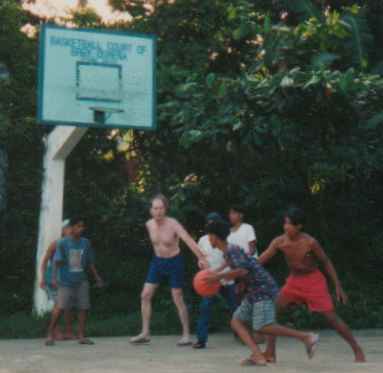
When I found out that Americans were allowed to participate in the basketball games, I made that an everyday event. They play in their thongs, so I did as well. They took a look at me and for some reason got cold feet. After much persuading, we finally played. They had little to be afraid of (I had a substantial height advantage). For one, it's been over a year since I played full court basketball and was therefore not used to all the running. Also, it was really hard getting used to the over-inflated, over-used (smooth) basketball and the netless rims. It took me a long time to get my shot back. Mainly, I concentrated on playing defense, rebounding, and passing. There was no pushing for position, but there was a lot of hacking. Given some time I could have gotten into their brand of basketball, but it was very foreign to me. I couldn't understand what they were saying and they said quite a bit. I didn't know who would be awarded the ball by the referee and for what reason. Yes, a referee; back in the states we never had a referee.
|
 Next
Next