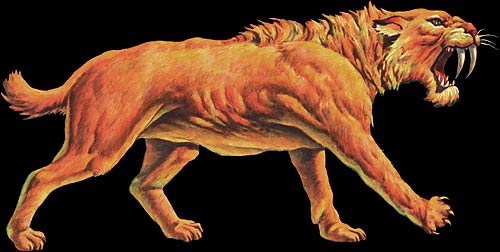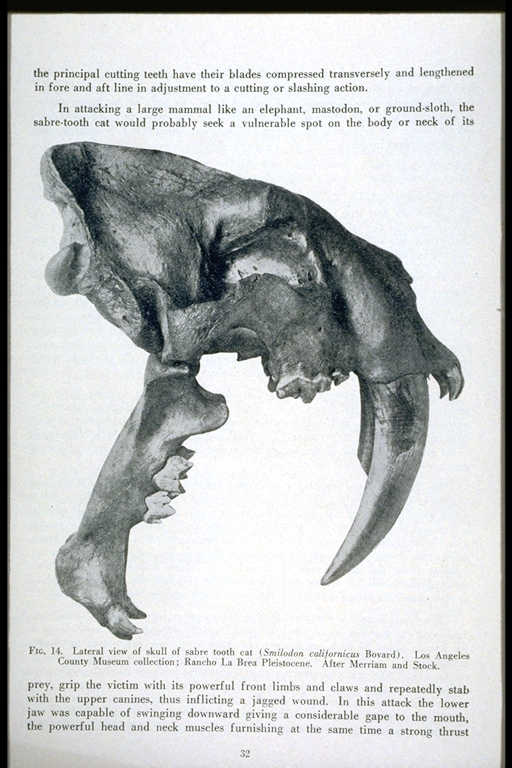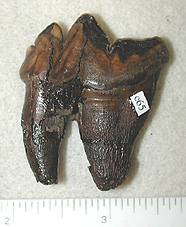
One of the earliest and most well known cats is the Smilodon, sometimes quipped the "sabertooth tiger", even though no Smilodons that walked the earth actually were tigers. Smilodon first appeared around 1.6 million years ago (durning the Pleistocene), and it was recorded to have died out about 11,000 years ago during the last Ice Age. The first fossil evidence of saber-toothed cats actually shows up in the Pliocene (5.2 million to 1.8 million years ago), but they were not seen to have flourished until the Pleistocene. There are three species of Smilodon that have been known to have existed, Smilodon fatalis(the most well known), Smilodon gracilis, and Smilodon populator.
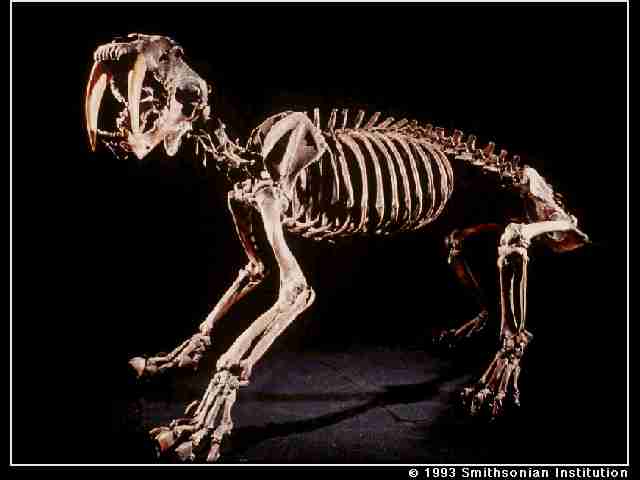
The Smilodon was equipped with a short and stubby tail, short and well-musceled legs, and long canine teeth. The Smilodon ranged from about four to five feet long and had an average height of three feet. It weighed on average around 440 pounds, and even though it is slightly smaller than the modern lion it weighs about 20 pounds more than the average male lion. It had a 12 inch long skull and its huge front canines were up to seven inches long. Also unlike today's lions, the Smilodon could open its mouth to a 120 degree angle whereas the average lion today can only open its mouth to a 65 degree angle.
One of the most mysterious things about the infamous Smilodon is its hunting habits. Because of the Smilodon's short and stocky figure it most likely was not effective at running down its prey as cats do today. It is more than likely that the strange cat would actually stalk its prey and ambush the prey from an extremely short distance. Also mysterious about the Smilodon is the way that it killed its prey. Obviously its two long canines were used in some fashion but they were not equipped to crush the windpipes of victims, as is the preferred killing fashion of cats today. These gargantuan teeth may have been used like knives to cut into the carotid artery or to gut the belly of the victims, but perhaps not. It is also interesting to note that these large teeth may have gotten in the way of the Smilodon when it was eating.
Ranges of Existance of Smilodon Species |
|---|
|
Scientific Classification: Smilodon |
|---|
|