Genetic disorder claims little girl: Family seeks awareness, funds for research.
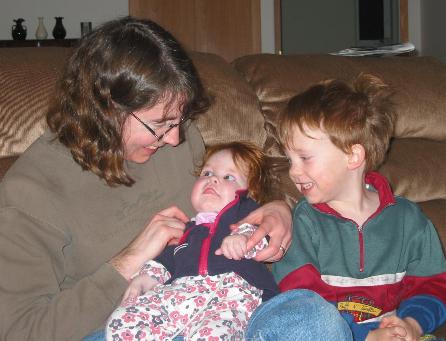
|
looks on in a photo taken early in 2003.
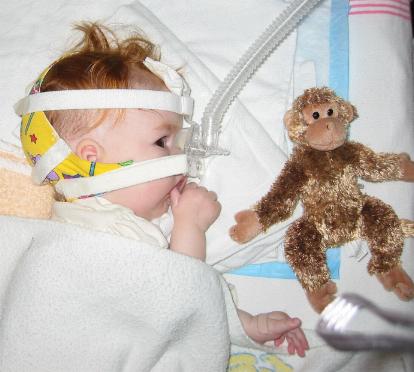
Hooked up: Sarah Staff during a stay at Vancouver Children's Hospital
- a facility she came to know very well.
The first time Lyn and Warren Staff saw the words "Spinal Muscular Atrophy" written on their daughter Sarah�s medical chart, the phrase was followed by a question mark.
The family were at Children�s Hospital in Vancouver, where their baby girl was being tested and examined.
It had become apparent she was not developing the strength she should have at her age, and doctors were searching for the cause.
The couple, who live in Salmon Arm, went home to wait for word on a diagnosis. But both - separately - looked up the condition they had seen on the chart through the Internet. Dismayed, they chose not to share what the found.
"We didn�t want to tell each other," Lyn says, sitting at her kitchen table and holding a photo of Sarah in a flowered frame.
In time the question mark would disappear, and they would find their red-haired little girl did in fact have SMA. Only then did the couple admit to each other they had investigated Sarah�s outlook on line.
In April of this year, the worst case scenario came true - Sarah died. She lived 15 months and three days.
Now the couple want others to know about their story and the little- known disease that has changed their lives forever.
Spinal Muscular Atrophy is a genetic disorder destroying the nerves controlling voluntary muscle movement.
There is no cure. One in every 6,000 babies is born with SMA. Of children diagnosed before age two, 50 per cent will die before their second birthday.
One in every 40 people carries the gene that causes SMA. The child of two carriers has a one-in-four chance of developing SMA.
In a cruel genetic lottery, both Lyn and Warren are carriers, but had no idea. Their first child, Ethan is SMA free.
There are five types of SMA, and three affect children. It was hoped Sarah had a form that would see her live until her teens, although she would be confined to a wheelchair.
With this in mind, the family did research and designed a new home that would accommodate Sarah�s special needs.
"We tried to be as positive as we could. We built this house for Sarah", she says, pointing out the wooden flooring and wide doorways that would allow easy access for a wheelchair.
The Staffs were not destined to have as long as they hoped with their daughter. She required increasing care and equipment, as her weak muscles made breathing and swallowing difficult. She had to be suctioned regularly to ensure saliva or formula did not run the "wrong way" down into her lungs.
But Lyn would be distraught if anyone thought Sarah�s life was simply filled with sadness. Her mind was clear and bright, and she smiled easily. The family - including her big brother - worked to find ways to keep her entertained. She loved the Baby Mozart series of videos.
"Sarah has such big eyes and they go right to the heart" she says, looking again at the photo on the table.
Lyn says the support from people in their life has been extraordinary. Family gave time and financial support. Warren�s employer, Forsite Consulting, was flexible and understanding about sudden trips to Vancouver to be with Sarah.
And she stresses the difference having support available in her home and in the community makes to the families dealing with these illnesses. Transporting Sarah was difficult, so nurses and other resources came into their home.
"We are so lucky here" she says.
Provincial resources also were important. The doctors and staff at Vancouver Children�s Hospital were life - changing.
Sarah�s final days were spent at Canuck Place hospice in Vancouver.
August is the official month to recognize SMA. It has prompted Lyn to reach out of her grief toward the community and share Sarah�s story.
First, she wants people to know about the little girl who lived in our community, that too few people got to know.
But she also wants to take action by raising funds. Lyn would welcome hearing from those who have experience in such endeavors.
Muscular Dystrophy Canada handles fund-raising for SMA. Marilyn Sakiyama, service director of the organization for B.C. and Yukon says there is a huge need for support and research. Donations can be designated specifically for SMA.
She also encourages communities to simply find out what specific families need.
"The best way to support is to ask, �how can I help?�"she says, adding many families feel isolated as they deal with their child�s illness.
She also encourages people to lobby health authorities and government to ensure parents have ready access to services and equipment.
"There is a big need for social action and families only have so much energy," she says.
To contact Muscular Dystrophy Canada, call 1-800-366-8166.