 |
|
|
|
|
|
|
|
|
|
|
|
|
|
|
|
|
|
|
|
|
|
|
|
|
|
|
The Dutch Grand Dukes |
|
|
|
 |
|
|
|
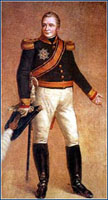
After the defeat of Napoleon, the great powers assembled in Vienna between 1814 and 1815 with the aim of reorganising Europe. The people of Luxembourg had hoped that the Grand Duchy would be returned to Austrian rule, under the Habsburgs, but the Congress of Vienna was keen to establish an independent kingdom in the Low Countries. |
|
|
|
Photo: Grand Duke Guillaume I, King of the Netherlands |
|
|
|
|
|
|
|
|
|
The Kingdom of the Netherlands was created and it was decided that the Netherlands and Luxembourg would share the same ruling house, the House of Orange-Nassau. They were to be two independent states, united through a common monarch. Unfortunately, Guillaume I (1815-1840) did not regard the small nation as the Netherlands' equal in terms of sovereignty, and he ruled Luxembourg as though it were a mere annexe to his Dutch kingdom.
In 1830, the people of the Southern Netherlands (present-day Belgium) rose up against Dutch rule, and Luxembourg joined them in the revolt against Guillaume I. As a result, the great powers met in London in 1839 to determine the future of the Netherlands. The independent Kingdom of Belgium was recognised, under the rule of Leopold of Saxe-Coburg, while Luxembourg was divided in two. The French-speaking half was annexed to Belgium, while the German-speaking half was granted full independence. It was simultaneously under a personal union with the Dutch royal house, whilst also being a member of the German Confederation. In signing the Treaty of London, Guillaume I accepted the division of Luxembourg, but also accepted the Grand Duchy's independence. |
|
|
|
 |
|
|
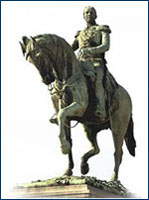
Guillaume II (1840-1849) went one step further, granting Luxembourg its own constitution. A keen reformer, he put in place the administrative structures that were necessary for the Grand Duchy to function as a truly independent state. The constitution of 1848 limited the royal prerogative of the Grand Duke and established the basis of a constitutional monarchy. |
|
|
|
|
|
Photo: Equestrian statue of Grand Duke Guillaume II in the centre of Luxembourg |
|
|
|
|
|
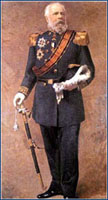
Succeeding his father in 1849, Guillaume III (1849-1890) found the confines of the constituion too liberal and "republican". In 1856, he replaced it with his own version, which provided for increased monarchical powers and the formation of a Council of State, nominated by the monarch. Guillaume III spent little time in the Grand Duchy and placed its daily governance under the control of his brother, Prince Henri, who became Luxembourg's first Lieutenant-Representative. Henri was keen to promote the Grand Duchy's independence and guided the country through the crisis of 1867, when Emperor Napoleon III of France tried to acquire Luxembourg as an extension of his empire. |
|
|
|
 |
|
|
|
Guillaume III died in 1890 without a male heir. The Netherlands, which was governed by a different law of succession, passed to his daughter, Queen Wilhelmina. In line with the requirements of the Nassau family pact of 1783, the Luxembourg throne could not be passed through the female line. As a consequence, Luxembourg had to pass to the senior branch of |
|
|
|
Photo: Grand Duke Guillaume III |
|
|
|
|
|
|
|
|
|
the Nassau family, the House of Nassau-Weilbourg. The throne was inherited by Adolphe of Nassau, the exiled Duke of Nassau, thus severing the personal union between Luxembourg and the Netherlands.
back |
|