 |
|
|
|
|
|
|
|
|
|
|
|
|
|
|
|
|
|
|
|
|
Grand Duchess Charlotte |
|
|
|
 |
|
|
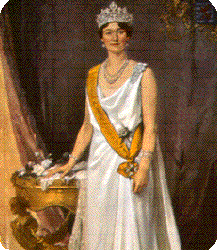
Princess Charlotte was born on 23 January 1896 at Berg Castle, the second daughter of Hereditary Grand Duke Guillaume and Hereditary Grand Duchess Marie-Anne. |
|
|
|
|
|
|
She succeeded as Grand Duchess of Luxembourg on 9 January 1919, following the abdication of her elder sister, Grand Duchess Marie-Adelaide. Support for the monarchy was at an all-time low and it was made clear that, if the monarchy were to survive at all, Grand Duchess Charlotte would have to remain above political affairs. She affirmed this as her intention in her accessional speech and, to reinforce the issue, the Constitution was amended, limiting the monarch's formal powers. These acts restored the reputation of the monarchy, and in a referendum on 28 September 1919, 77.8% voted in favour of retaining the monarchy as the form of government.
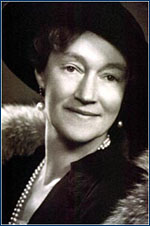
On 6 November 1919, Grand Duchess Charlotte married Prince Felix of Bourbon-Parma (1893-1970) at the Cathedral of Our Lady in Luxembourg. The couple had six children: Prince Jean (born in 1921), Princess Elisabeth (born in 1922), Princess Marie-Adelaide (born in 1924), Princess Marie-Gabrielle (born in 1925), Prince Charles (born in 1927) and Princess Alix (born in 1929). The family resided at Berg Castle. |
|
|
|
 |
|
|
|
During the first two decades of Grand Duchess Charlotte's reign, Luxembourg's position within Europe and the world seemed secure. In 1920 it joined the League of Nations (the forerunner of the United Nations) and in 1921 the Belgo-Luxembourg Economic Union was formed. However, the growth of Nazi Germany posed an increasing threat to the neutral and unarmed Grand Duchy, and on 10 May 1940 the German Army invaded. |
|
|
|
|
|
The Grand Duchess hurriedly went into exile with her family, determined to avoid capture by the Germans. They made their way through France and Spain to Portugal, and from there to North America. Whilst in the United States, Grand Duchess Charlotte toured numerous Luxembourg communities. She eventually settled in London, where the Luxembourg government was already operating in exile. Throughout the war years, the Grand Duchess maintained contact with her people through regular radio broadcasts on the BBC. On 14 April 1945, Grand Duchess Charlotte returned form exile to a rapturous welcome. The monarchy's position at the heart of Luxembourg society was assured. |
|
|
|
 |
|
|
The years following the war were marked by a period of reconstruction, during which the Grand Duchess symbolised the solidarity of the Luxembourg people. As the Grand Duchy participarted in the early stages of the European Community, Grand Duchess Charlotte made numerous official visits abroad, promoting her small nation's position on the international stage. During the 1950s, she sold off many of the family's properties in Germany, including Biebrich Palace in Wiesbaden and Hohenburg Castle in Bavaria, reinforcing Luxembourg's position as the permanent home of the grand-ducal family. |
|
|
|
|
|
|
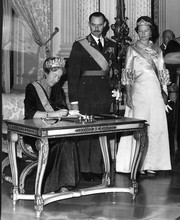
Photo: Grand Duchess Charlotte abdicates in favour of her son, Hereditary Grand Duke Jean, 12 November 1964 |
|
|
|
|
|
On 12 November 1964, Grand Duchess Charlotte abdicated in favour of her elder son, Prince Jean. Unlike the abdication of her sister, this even symbolised a natural progression in the history of the monarchy. When her reign had begun 45 years earlier, the grand-ducal family were still regarded as foreigners and the monarchy was teetering on the brink of collapse. By 1964, the monarchy was firmly established in the conscience of the Luxembourg people as a living symbol of their nation's stability and continuity.
The Grand Duchess retired to Fischbach Castle. She died on 9 July 1985.
back |
|