and
Especiallly in the vine and mountain areas farms are usually fully owned by the farmer, but in the coastal and dryland areas, where land consolidation has started taking place, rented land becomes more popular. The land tenure structure in Cyprus constitutes a major constraint for rural development. The main characteristics of this tenure is the small size and fragmentation of agricultural holdings and other features related to land ownership. The land fragmentation is a result of the land separation under the Turkish occupation during 1489 and 1571.
"…in most cases, the peasant found himself the proprietor of several different plots in various part of the village each plot being too small to be cultivated in an economic way" (Lanitis, 1994).
Land consolidation programmes have been undertaken with the aim to create economically viable holdings, increase land and labour productivity, improve the efficiency with which resources are utilised and solve problems of land ownership. (More about historic landownship see Lanitis)

Structure of agricultural holdings
The actual development potential of a region can be determined by its agricultural production structure, type and size of holdings, and capital and investment structure. As mentioned before the production factor land is one important variable for an economically viable holding. The utilised agricultural area includes annual cropland, permanent cropland, pasture, horticultural land, and fallow land. Thus the agricultural utilised area is 117257.9 hectare, which is about 5.9 % of the agricultural utilised area of the Netherlands. But one has to take into account that it is very difficult to determine the utilised agricultural area in mediteranean countries, because of abandoned pastures, scrubland etc, which might be used extensively by pastoralists and their sheep herds. A standard formula to calculate the average size of agricultural holdings as it also calcualted within the EU is the following:
Average size of agricultural holding = utilised agricultural area/Total number of agricultural holdings
In comparison with other EU member countries, the smallest farms can be found in Cyprus with an average size of 2.6 hectare UAA followed by Greece with 4.3 hectare. The table shows that since 1946 the farm size has continously declined and in 1974 the number of farms declined by 36.9 % and the agricultural land even by 53.6 %. In 1994 88.7 % of farms had an average size of less than 5 hectare, occupying in total 38.8 % of agricultural land. Due to high land fragmentation
"in all parts of Cyprus the land is badly fragmented".."it is impossible to apply modern systems of farming and modern techncal methods" (Land consolidation department, 1993)
and land availability the largest farms occur in the eastern dryland regions, where large areas are needed for annual crops and cereals to guarantee the viability of a farm. This farms were able to enlarge their areas through the land consolidation programme, joining land together and renting large amounts of their land. Also the division of full-time and part-time farms are related to the regional farm structure. Thus one can find larger full-time farms in the eastern dryland regions, but part-time farms still dominate, especially in the coastal regions around Lemesos, and Paphos, where a lot of part-time vineyards are found. Full-time farms still dominate in the Mountain areas, where farms are extremely small, and work on the margin of their economic viability. Especially in the regions Marathassa and Limassol Vines, more than 50 % of farms are still full-time farms.
(See map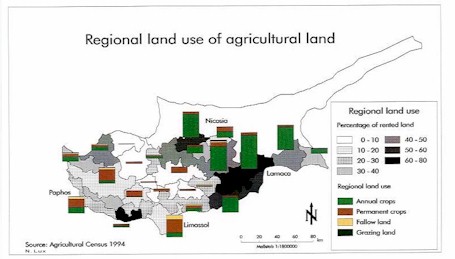 )
)
Overall there is a high tendency towards part-time farming, and in only 28.8. % of farms the farm holder and the entire family is full-time employed on the own farm, whereas 64 % of farm holders have a second occupation in the private sector or as civil servants. Although "a large farm is not necessarily more efficient in economic terms, although economics of scale are more important for certain enterprises. The relationship between productivity and size of enterprise is a complex one and dependent on many factors. However, the physical size of the farm remains important if for no other reason than the fact that more land provides the farmer with more options in terms of production choices (Fennell, 1997).
Structure of agricultural holdings
The EU distinguishes between 8 types of farming:
- Arable crops
- Horticulture
- Vineyards
- Fruit and permanent crops
- Dairying
- Dry stock
- Pigs or poultry
- Mixed crops and livestock
The classification depends on the main source of income or combination of income. For instance a poultry farms receives 2/3 of ist income from poultry. In Cyprus most farms are receiving their income from permanent crops (26 %). Around 14 % are solely vineyards. The regional specialisation varies with regional geographic differences, such as climate, soil types and availability of water. Thus most arable crop farms are located in the dryland regions, whereas most permanent crop farm are close to the coastline. Extensive livestock farms, which are independend on irrigation are also mainly found in the dryland areas.
 Back
Back Home
Home