
Case Study: Vietnam
Prepared by: Maury E. Bredahl and Nicole Lux
Trade in agricultural and food products
Despite substantial political and economic reforms from a command-based to a market-based economy agriculture is still the traditional backbone of the Vietnamese economy. In 1994 it provided employment for about 72 % of the economically active population.
Figure 1.

(Source: BFI 1995, p. 8)
Vietnams major agricultural export commodities are caoutchouc, peanuts, fish and coffee, for which Vietnam is the 8th biggest world exporting country, and 2nd largest Asian exporting country, and rice, for which Vietnam is the 3rd biggest exporter after USA and Thailand. Given the importance of rice exports, rice production dominates the whole country with almost 6.8 million hectares, out of total arable area of about 9.7 million hectares.
Figure 2: Main crops cultivated in Vietnam, 1995
Crops |
Area/1000 ha |
Production/1000 tons |
Rice |
6765.6 |
24963.7 |
Maize |
556.8 |
1177.2 |
Sweet potato |
304.6 |
1685.8 |
Cassava |
277.4 |
2211.5 |
Soybean |
121.1 |
125.5 |
Peanut |
259.9 |
334.4 |
Sugar-Cane |
224.8 |
10711.2 |
Tobacco |
27.7 |
27.7 |
Cotton |
17.5 |
12.8 |
Jute |
7.5 |
14.8 |
Mulburry |
24.0 |
169.3 |
Tea |
66.7 |
40.2 |
Rubber |
278.4 |
122.7 |
Coffee |
186.4 |
218.0 |
Coconut |
172.9 |
1165.3 |
Pepper |
7.0 |
9.3 |
Vegetables |
297.3 |
3282.6 |
Oranges |
27.6 |
163.8 |
Pineapple |
30.0 |
260.5 |
Bananas |
100.0 |
1379.0 |
Mango |
25.0 |
126.0 |
Figure 3: Composition of agricultural exports to the European Union in 1997

Source: Eurostat
The livestock sector in Vietnam is not very well developed. It comprises some 4 million cattle, 3 million buffalo, 18 million pigs and 155 million poultry and produces about 1.5 million tons of meat annually. The overall meat consumption per capita is about 20 kg. Livestock production provides about a quarter of farm incomes. Despite the undeniable fact that many difficulties exist in animal production, slaughter and processing, Vietnam hopes to increase livestock production and meat exports. Advantages in the future could be:
The goal is to double livestock production by 2005. Since feed costs are 30 to 40% higher in Vietnam than in other Asian countries, like Thailand, changes in government policies are needed to achieve anything close to that rate of growth.
SPS standards in Vietnam
Administrative responsibility for SPS measures is divided within the Government as follows:
Administrative organisation
The Government manages plant protection and quarantine, combining advanced techniques and traditional experiences, assuring the common social interests
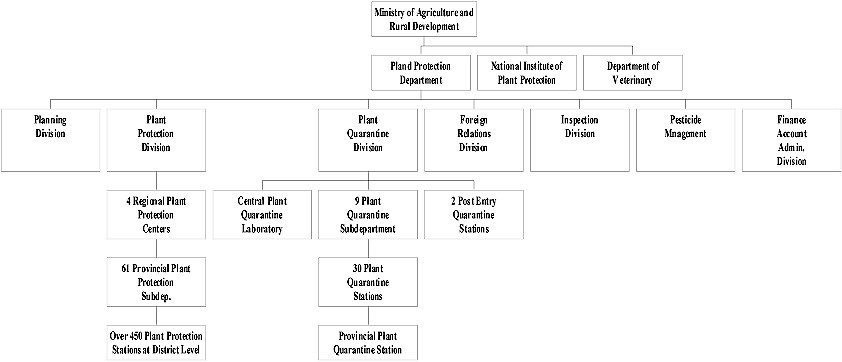
Plant health: The Plant Protection Department carries out: protective extension work; activities to prevent introduction and spread of domestic and exotic pests; and management of pesticides and regulations. It is divided into eight operating divisions, of which the Plant Quarantine Division maintains a Central (diagnostic) Laboratory and some 30 plant quarantine stations (at various ports of entry with a large concentration along the Chinese border) and 2 post entry quarantine stations. The largest division, Plant Protection maintains 4 regional centres, 61 provincial plant protection offices, and some 450 district stations.
Animal health: The basic organisational structure is similar to that for plant protection at the national, regional and local level. Imports of live animals and meat are inspected at points of entry.
Figure 4: Organisation chart:
General attitudes towards SPS measures and trade
Legally any organisation/individual is entitled to complain to either the specialised inspection office of plant protection and plant quarantine or the directly to the superior office for State management of plant protection and plant quarantine about the conclusions and the treatment which have been made through the process of inspection at its place.
The manufacturing, importing and exporting and distribution and usage of all plant protection chemicals are under a State unified management. A list of permitted plant protection and quarantine chemicals is defined and published by the Minister of Agriculture and Food Industry. The government supplies plant protection and quarantine chemicals in the whole country and different local areas.
Vietnam has a comprehensive sanitary and phytosanitary regulation. In the area of phytosanitary protection it started to harmonise its standards with the CODEX Alimentarius, whereas is the area sanitary standards regulations of the International Organisation of Epizootics are applied.
SPS issues
Overall, Vietnam has considerable technical expertise in plant protection, and that the infrastructure of detect entry of restricted pests is well developed. A well-documented, and contentious, case was the interdiction of the imports (by an NGO) of 25 tons of seed potatoes from Scotland. These potatoes were found to be infected with an organism restricted by Vietnamese law, and so the potatoes were sent back to Scotland.
Case study: Imported seed potatoes from the UK
In September 1997 the Vietnamese government inspected a shipment of seed potatoes from the UK, and found that 4 imported potato varieties were contaminated by Sprongospora Subterrantean Wall Lag (fungus). This fungus had been banned on the basis of the international convention of plant protection and quarantine. The Vietnamese government then suggested that the importer should follow the Custom Office’s decision to re-export the container before 8 September as officially informed by HCMC Custom Office. When the container was still not re-exported the Deputy Director-general of HCMC Custom Office charged a fine of VND 10 million $. The company claimed they were not directly responsible and the British Department needed sometime to arrange for money to be sent from UK. They also explained that the disease was only transmittable through movement in soil but not throughout the container.
Company case study: Fish exporting company
Fishery exports account for some $858 million of which 65% are frozen, 3% are fresh and chilled with remainder being dried fish products. Hong Kong, Singapore, Japan and South Korea are important markets. In 1998, about 11% of exports went to EU countries (up from 5.2% in 1995) and 9% went to the United States.
The second largest seafood production and exporting company in Vietnam has a market share of the seafood market of around 30 %. Like most other companies also this company is owned by the government, with its headquarters, including management and R&D in Hanoi and three other offices in major cities. The company relies on 18-20 processing plants in the coastal provinces in the north of Vietnam. These plants are mostly owned by the company itself and only very few are contracted. The company has a system for cold storage with a capacity of 2000MT and a great number of refrigerated trucks for transporting and preserving goods to Hai Phong port.
The major operating fields of the company are:
The main products include: Shrimps, squids, cuttle-fish, molluscs. On the other side the company has also imported machines, equipment, construction materials, furniture, chemicals fishing nets, consuming goods for fishery industry.
Between 1991 and 1996 the company exported most if its products to the EU, where they had contracts with buyers in Belgium, France, Italy and Spain. Since the EU had changed its regulations in 1994 and required compliance by 1997, Vietnamese companies were required to meet a new code and thus exports declined dramatically, because they have not yet been approved. The companies biggest export market now is Japan, which accounts for 60 % of the companies exports. Although prices are higher in Japan, the company considers the EU as a more stable market and therefore being a favourable trading partner. For the future development the company envisages to increase its total exports to the EU to 30 %. A competitive advantage is the still very low production and labour cost in Vietnam compared to other Asian middle-income countries. But before the company can export bigger amounts to the EU again some plants need to be changed in order to meet the special sanitary requirement of the EU. The costs involved are paid by the company itself, government aid and ODA.
Commodity case study: exports of fish and crustaceans
In 1997, shipments of five firms were rejected by France, and in 1998, shipments from two companies were rejected by Italy. Italy banned all imports from the two Vietnamese firms that originated the exports. Although representing only one side of the story, the French rejections based on presence of faecal coliforms was questioned because it is a practical impossibility to produce fish free of this contamination. In the Italian case, the rejections were claimed to based on parameters that could not be found in EU regulations, and for which test had not been conducted in Vietnam. This contention was disputed in other interviews, and it seems that EU regulations covered these organisms but they were not a focal point of regulations. The Vietnamese also claimed that they had not been able to find evidence of contamination in their tests of the rejected lots.
In July 1998 Italian authorities found a contamination of frozen octopus by Vibro para haemoliticus in one shipment of a Vietnamese company and another shipment of black tiger shrimps contaminated with V. cholerae. The result was the immediate suspension of exports. The Vietnamese government considered this to be an unjustifiable action and pointed out that products were controlled and met Italian standards according to the list published by the FAO in 1989. According to this list Vibro testing is not required for Italy and other EU countries. Moreover Vibro was not be found present in the harvesting area and thus the contamination can not be explained. It is supposed that the infection occurred due to the loss of temperature control during transportation or loading at the port of Ho Chi Minh City to Genova, Italy. As a result the affected company improved its health conditions in transportation and preserving and introduced a HACCP-based check program.
Other EU complaint so far were:
1997, frozen sole fish with high levels of faecal coliforms and high total aerobic counts
The EU maintains a list of so-called harmonised countries and non-harmonised countries. The health and safety standards of harmonised countries are deemed to be of a level equivalent to that within the EU. Harmonised countries propose fishery establishments, which are certificated to meet EU (stringent) requirements. Only competent EU officials can take actions against firms from countries on the harmonised list. Non-harmonised countries are, of course, deemed to lack the level of safety and health standards to meet EU requirements. These countries can propose firms as meeting EU requirements and those firms can freely export. However, the competent authorities of national governments, as well as the EU Commission, can place bans of fishery imports of these firms. NAFIQACEN reported that 27 firms (11 private and 16 public) out of about 175 total, are approved for export to the EU. Taking the request of Vietnam to be on the list of harmonised countries into consideration it seems to be realistic that these list will include only 4-5 establishments.
Company case study: Meat exports
Two years ago the Ministry of Agriculture and Rural Development established a very large parastatial that is responsible for all facets of red meat and poultry production and processing in Vietnam, as well as import and export of meat products. Administrative offices are maintained in HCM City and Da Nang, with the head office located in Hanoi.
At present, out of several dozen slaughterhouses, only three have been certified for export to Russia and Hong Kong. Duck meat is exported to South Korea. An approved joint venture between Japanese and Vietnamese firms, with support from both governments, is presented as the model for future development of the livestock industry. This fully integrated project is to produce "garden chickens" for the Japanese markets. Garden chickens are a cross between a large domestic breed and an "industrial" breed, and are grown in what seems to be a free range fashion with minimum space provided for each bird, and with close attention paid to use of veterinary medicines. This project is to start production in mid to late 1999, and will initially produce 12 million birds for export. At full production, about 25 million birds will be produced and exports.
Hong Kong, Russia and some Eastern European countries are seen as export markets for pork. Three slaughterhouses (all new or totally renovated with new equipment) have been approved and certified for production to those markets. All plants operate with HACCP systems in place, but have not been ISO 9000 certificated. None of the pork exports from these plants, nor of duck meat exports to South Korea have been rejected for sanitary reasons.
While noting some difficulties with exports to all markets, special concerns were expressed about difficulties of exporting to the European Union. EU requirements, which deal not only with product characteristics but with production processes, were described as very difficult to satisfy. The growth of exports to the EU (Netherlands, Belgium, Germany and Italy are top four markets) has led to concerns within the EU of sanitary conditions in Vietnam.
Whether EU regulations are too rigorous is, of course, a matter for debate, but it can not be denied that the regulations of major developed importing countries vary with significant costs to potential suppliers. A case in point is the appropriate wash water characteristics, which can include fairly high level of chlorine in the United States and Japan, but only very low levels for the EU. EU specifies that unchlorinated hot water be used. US and Japanese regulations were described as much simpler than EU regulations.
Government initiatives
Quality assurance: The National Fishery Inspection and Quality Assurance Centre was established in 1994. NAFIQACEN is a "national competent authority" for control of quality and hygiene assurance in fishery production and trade. Headquartered in Hanoi, it maintains five branches in key fishing areas of Vietnam including Hai Phong, Da Nang, Nha Trang, Ho Chi Minh City and Ca Mau.. The fishery quality and hygiene assurance programme involves the whole production chain from capture/aquaculture to handling, processing, transportation, export, import, and distribution in domestic market. It carries out inspection and certification of fishery establishments, provides assistance, training and advice to firms, and co-operates with similar organisations in international forums.
The main responsibilities are:
It has an administrative and technical staff of about 200, NAFIQACEN has 135 officers including 61 fishery inspectors, 32 laboratory analysts, and 42 persons involved in administrative work.
NAFIQACEN has developed a list of firms approved and certified to meet EU standards, including quality and safety control programs based on good manufacturing practices and HACCP. The laboratories currently operate with good laboratory practices and will, soon be certificated for ISO 9002. NAFIQACEN laboratories have the equipment and capability of organoleptic assessment and analysing all common quality and safety parameters of seafood, They are also analysing certain special parameters such as residues of heavy metals, veterinary drugs, pesticides, histamine, biotoxins etc. The laboratories were assessed as very good by Canadian exporters in 1997.
The first EU inspection team visited NAFIQACEN and selected plants in February 1997 to inspect if the health conditions for fishery production is equivalent to the Council directive 91/493/EEC. After receiving a complaints report NAFIQACEN undertook immediate actions including the improvement of equipment, facilities etc.. With help from the EU Commission and DG VI a monitoring program for bivlave mollusc harvesting area and for hygienic production conditions in seafood processing plant was also established. Another EU inspection team visited Vietnam in October 1998 to ascertain its capabilities relative to EU standards. Their report has been returned to the Vietnamese for comment, after which a decision will be made as to its membership on the harmonised list of countries. In 1998, only four out of 23 establishment met EU standards.
In 1998 the Minister of Fisheries issued legal regulation and legal technological procedures which were already equivalent to the EU’s and fishery industries applied EU related regulations such as:
Awareness of SPS Agreement
The Vietnamese officials were well aware of the content of the SPS Agreement, noting that regulations must be based on science and be transparent. Risk analysis was acknowledged as very difficult and time consuming. They reported that representatives of Australia and New Zealand had provided some technical assistance in risk analysis.
Administrative responsibility for SPS Agreement
The government shall also provide the implementation of international conventions for plant protection and quarantine. The state management includes also: watching, discovering and identifying pests, granting, revoking business licenses for plant protection, plant protection chemicals and chemicals for disinfecting plant quarantine objects, permit and certificate of plant quarantine, checking and inspecting the implementation of regulations on plant protection, plant quarantine, plant protection chemicals and treating violation of these regulations and procedures, settling disputes complaints etc.
Participation in SPS Agreement and international standards organisations
The Multilateral Trade Policy Department which is attached to the Ministry of Trade handles all relations with multilateral organisations (such as ASEAN) and agreements (such as the WTO). The department is directly involved in the WTO accession process. After achieving observer status in 1994,Vietnam formally initiated by submitting a memorandum of accession to the WTO Secretariat in August 1995. Vietnam is in the "fact finding" phase of its application to the WTO. The Working Party on Accession reviewed the application and submitted over 1000 questions to the Government of Vietnam. Many of these questions had to do with SPS measures and barriers to trade.
Vietnam sought membership in the WTO because it was changing from a command-based economy to a market economy. Prior to the dissolution of the former Soviet Union, Vietnam had been a member of COMECON, and most of its trade had been with the Soviet block. In addition to seeking WTO membership, it is an active participant in ASEAN, and other multilateral organisations, such as CODEX, but within its manpower and financial limitations.
The questions from the Working Party on Accession raised a number of questions about the SPS regime in Vietnam and about its compatibility with WTO membership. According to a study, financed by the EU, that evaluated agricultural policies, including SPS measures, it was concluded that only a small gap existed between Vietnam regulations and the WTO.
Constraints to participation in SPS Agreement
Operation of the SPS Agreement
Plant protection activities are based on the Decree of Plant Protection and Quarantine, which was issued in February, 1993. The regulations were claimed to be based on the International Plant Protection Convention (of 1977), regional plant protection agreements and on Vietnamese law. Codex standards were used for maximum pesticide residues. It was noted that standards of the International Standards Organisation were also used.
Conclusions
References
 Back
Back Home
Home