|
What's going on: a rough guide....
This comes
courtesy of Colston Crawford (Derby Storm & Derby Evening
Telegraph):
Basketball is, in
theory, a wonderfully simple game. In practice it works out as a fairly
simple game. The basics can be picked quickly by new supporters, the
skills and excitement can be enjoyed straightaway. Adapted from notes
supplied by the authorities, this article introduces the basic rules and
goes a little further towards explaining why the whistle blows and what
will happen when it does. Like any spectator sport, there are times when
only the referee knows why he (or she( blows, or when spectators
strongly disagree with what the referee tells us has happened. If you're
baffled by a decision, the hand signals will at least tell you what's
going a ref's mind.
Teams: Five
players on court at any one time. Up to five others can be named,
substitutes occur as often as the coach decides.
Games: 40
minutes, played in fur 10 minute quarters (although National Cup matches
and those in other divisions are still played in two 20 minute halves).
Teams play one way for two quarters, the other way for the next two. Two
minutes between quarters, ten minutes for half-time (15 at Chester -
Ed.). Coaches can call two one-minute time-outs per half for tactical
discussions.
The clock stops when the referee's whistle blows, stays stopped if free
throws are being taken and starts again when the ball touches a player
on court - so you get a full 40 minutes of actual play.
When a team has the ball it must advance into the opponents' half within
10 seconds, making a shot within 30 seconds - hence the timers in the
corners (shot-clocks) counting down from 30 all the time. If you don't
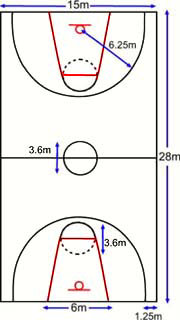
have the player, but your team does, you can stay in the rectangular
area (the key) under the basket for three seconds.
Scoring:
Two points for a normal basket, three for one scored from outside the
6.25m line - the large semi-circle. One point each for a free throw.
Fouls:
Basketball is theoretically a non-contact sport ( a fact that is always
a source of amusement for new fans). Referees will call a foul against
any player responsible for contact they consider could have been avoided
- then they'll look at whether the contact was deliberate or not.
Technical fouls can be called for "unsportsmanlike behaviour"
and the coaches can fall foul of these too, should they suggest that the
referee has left his guide dog at home or something similar.
Free throws:
A player fouled while shooting gets free throws. If he was attempting a
two point shot, it's two free throws, a three point shot, three throws.
But if the shot was successful he gets the points and one free throw.
Non-shooting fouls result in possession handed to the opposition, unless
they're called as deliberate or technical fouls - these are two free
throws. When a team has committed four fouls in a quarter, all defensive
fouls result in two free throws for the player fouled.
Fouled out:
Any player committing five fouls in a game can take no further part
although a substitute can be used. That's why you'll sometimes see one
of a team's sitting it out for a while - he may have clocked up a couple
of quick fouls and the coach has to make sure he doesn't lose the player
altogether at too early a stage.
Violations:
These are minor rule breaks resulting in possession going to the
opposition, They include running with the ball (travelling), illegal
dribbling, kicking or punching the ball or sending it out of play,
failing to make a shot within 30 seconds and other time violations as
listed above.
Jump balls:
Start each quarter and also may be called by the referees if they decide
opposing players have equal hold of a trapped ball or if they've stopped
the game because of something like an injury that needs attending to.
|