Born in the USA (Father: Canadian) |
||||||
| Basketball was born in late December 1891 (probably the 21st) in the gym of the YMCA training school in Springfield, Massachusetts. Two teams of nine each from the Secretarial Department class of 18 students played the first experimental match of a sport invented by their teacher at the school - Dr. James A. Naismith. Thirty-year old Canadian Naismith had once been a hard-drinking lumberjack and later a star of McGill University's football team. He arrived in Springfield in 1890 as a general teacher and athletics instructor and late in the following year was asked to come up with a Winter game that would keep his students active between the baseball and football seasons. | 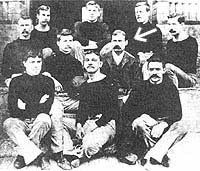 one of the two original teams, pictured with the game's inventor James Naismith (arrowed) |
|||||
|
Naismith's boss, Luther Gulick, had given him just 14 days to come up with a brand new game and Naismith tried out combinations of football, lacrosse and other sports before hitting the jackpot. The new game was to be played indoors so it must avoid the mayhem of other sports whilst combining their best elements. He came up up with the basic idea of a non-contact ball-handling game with players required to pass the ball, rather than run with it. But how would a score be made? He remembered a childhood game called Duck on a Rock which involved lobbing small stones in an attempt to dislodge a softball-sized rock perched on a boulder. So, the target would be elevated - but what would it be? JM asked the school caretaker "Pop" Stebbins if he had any boxes that could be nailed up. "No" said Pop, " - but I do have a couple of peach baskets...". These were fixed to the balcony of the gym's elevated running track - which happened to be ten foot from the floor. Having established the basics, Naismith returned to his office to draw up the rules and a couple of hours later, with only minutes left of the 14th day, he pinned them up on the college notice board. Although much added to and amended over the years, the original 13 rules remain as the basis of the game. |
|
|
The first games were very different from today's fast-action, time driven matches. There could be between five and nine players on a team - depending on the size of the playing area - and they could hang around in their own half - or under the opponents' basket - for as long as they liked. No dribbling, no jump-shots, no time limits, no subs. If the ball went out of play then possession went to the player who reclaimed it ( a non-contact sport?!). If a goal was scored - and this was rare with single digit scores the norm (the first "proper" game in March 1892 ended 5-1 to the Springfield students vs. teachers) - then someone ("Pop" Stebbins in the first game) would climb a step-ladder and fish the ball out of the basket. As the game grew in popularity, so the rules were refined and new techniques introduced. Here's a quick time-line through the major developments: 1893 Metal
hoop are introduced with closed mesh basket attached. Backboards
(originally a massive 6' by 12') are put up to prevent spectators
interfering with the ball. |
| 1913 Until now baskets have been closed and there are various contraptions on the market that allow "quick-release" of the ball . In this year the game's ruling committees allow what has been an unofficial practice for years - open baskets. Just as well - can you imagine a slam-dunk into that thing on the right? |
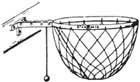
|
|
1920 The
backboards are moved two feet away from the end-line to prevent players
using the wall to reach the basket. |
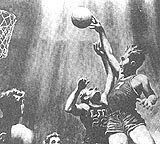
| 1936 Until now, most shots have been made with both hands from a standing position - the set shot. On December 20th 1936, at Madison Square Garden, Stanford University's Hank Luisetti demonstrates the one-handed shot that he has been perfecting during the Fall of that year and changes the game forever. Players everywhere adapt the shot and this, as well as the new time rules, raise basketball game scores dramatically (right: detail from a painting of Luisetti held in the Basketball Hall of Fame, Springfield MA). |
|
|
1937 Games
have previously re-started after a score with a jump-ball at the centre
circle but now, in another rule change that speeds up the game, the
re-start is to be from a pass from the end-line.
"Goal-tending" is disqualified. This was the practice of
interfering with the ball or the basket as a shot was about to go
through or bounce off the rim. |
|
Pro ball - from wire cages to big wages The game originated in the US YMCA movement and took off like wildfire with regional YMCA championships established within a year or so of the game's invention. The early games were rough-house affairs and within five years the YMCA tried to distance themselves from the sport and it was dropped in many areas. The bug had bitten by then though and the players didn't want to stop - and the fans didn't want them to. Many players dropped off the YMCA circuit and formed pro teams who played wherever they could be booked - gyms, dance-halls, theatres - with the players (five a side by now) often having to play around support poles and other furniture - often within a wire mesh "cage" put up by the promoter to protect the punters (some of whom would jab the players with hat-pins as they crashed against the wire). The first-ever pro game is reckoned to have taken place in 1896 at the Masonic Hall in Trenton, New Jersey. The players received $15 each and the game was on its way to multi-million salaries and Air Jordans. |
|
| Those early pro sides played in a multitude of local leagues with little exposure outside their locality but just after World War 1 a team came along that revolutionised the game of professional basketball. The Original Celics were a New York side that had grown out of a pre-war social club. Promoted by a young NY sports reporter called Ed Sullivan (never a man to miss the main chance, his TV show was the first to book the Beatles 40 plus years later) the Celtics barnstormed the Eastern states, playing 200 games a year. As well as introducing brand new plays, the Celtics were the first "franchise" to offer exclusive contracts and guaranteed salaries. In 1923 the Celtics played 215 games - and lost 11. | 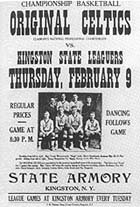 |
|
The Celtics were eventually forced to join the American Basketball League. The ABL was the first real attempt at an organised US national league and was formed in 1925 along with the NFL. The ABL folded in 1931 and was followed by various bits-and-pieces leagues as WWII approached (five members of the Celtics were meanwhile touring the country in a second-hand Pierce-Arrow on a guaranteed $125 a game..). A year after D-Day the Basketball Association of America (BAA) was formed with one of the founder members a side from Boston - the Celtics. The BAA promoters ran other sports too and there was competition from the still-existing pre-war leagues. In 1949 Maurice Podoloff, President of the BAA, persuaded the big-city team owners that the profitable way forward was to merge the leagues and the NBA was born with 17 teams from the the major cities. The NBA gradually expanded over the years, due mainly to the short-lived ABL and ABA of the 60's/70's. These leagues gave smaller cities the chance to grab a franchise and also introduced some great innovations like the three-point shot. The ABA folded in the late 70's but not before its better teams had been absorbed into the NBA ( along with - eventually - the three-pointer) which continues to expand to this day. The game suffered a slump in popularity in the early 80s but was rescued by the emergence of superstars like Boston's Larry Bird, The LA Lakers' Earvin "Magic" Johnson and Chicago's Michael Jordan, who picked up $100 million in 97/98.. |
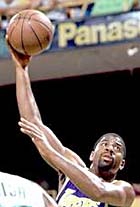 From the State Armory to the Dream Team, the game's come a long way. Magic Johnson was one of the 80s superstars who propelled basketball to its current world-wide success. |
|
While all this had been going on the game had been taken up as a college sport , the first game, on April 4th 1895, ending in a 9-3 win to Hamline, St Paul's over the Minnesota Agricultural School. College ball grew in parallel with the pro game and played its part in developing the sport (Stanford U's Hank Luisetti's one-handed shot, for example), although the rules differed a little over the years. A big difference, to this day, is in defence: the zone defence - each player defending a section of the court rather than marking a specific opponent - is OK in college but a no-no in the NBA. College basketball quickly became a route into the pro game (although only for white players until 1950 - see Black and White, below) and the colleges are a vital part of the game in the USA, providing the NBA with its annual intake via the "draft picks". |
|
Black? - sorry, son.... Incredible athough it seems now, when the NBA was founded in 1949 the 17 founder teams didn't feature any black players on their rosters. Basketball had quickly spread through the black high schools, colleges and athletic clubs, just as it had through the white, but the two colours mainly kept apart - black vs. white college games just didn't happen. The coaches at de-segregated colleges had a big problem: they knew that black athletes who took up the game tended to excel at it - but the mainly white crowds wouldn't tolerate more than a couple or so black guys on a roster, even if ten deserved to play. The cynical rule amongst coaches at the time about black players was: "Play one at home, two away - and three if you're losing" ( although it took until the early 1970s before some Southern colleges put their first black players on the team.) |
|
| The only way into pro ball for a black player before WWII was to join either the New York Renaissance or the Harlem Globetrotters. The "Rens" had formed in 1924 and were named after the Renaissance Club in Harlem where they played their home games. They played across the country against amateur black teams and often against pro white clubs (these games would draw upwards of 12,000 and usually saw the Rens run out winners). | |
| The Globetrotters got going in 1926 after promoter Abe Saperstein noticed the pulling power of the Rens and signed up black college players to form the Savoy Big Five, playing as part of the entertainment at Chicago's Savoy Club. Abe's scheme went belly-up when the Savoy replaced his team's spot with ice-skating but, never a man to give up on a possible dollar, Abe put the team on the road under the Globetrotters tag - adding Harlem as shorthand for "black". The Trotters were 101-7 in their first season and went on to win the so-called "World Championship" in 1940, beating Chicago Bruins 31-29 (they'd also beaten reigning champs, the Rens). After WWII, with the only worthy opposition , the Rens, gone, the team went into show-biz, playing dazzling exhibition games across the world - but they did take a break from showmanship in 1948 to stun a 20,000 crowd with a 61-59 win over the all-conquering Minneapolis Lakers. | 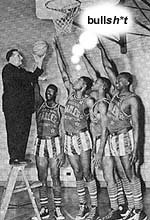 AbeSaperstein and some of the Trotters in a cheesey promo shot. (thought bubbles not on original..) |
| The
first black player to sign for an NBA side was Chuck Cooper who joined
Boston Celtics in the Summer of 1950. The first to actually play was
probably Earl Lloyd, drafted by the Washington Capitols whose season
started a day before the Celtics. At Detroit in 1972 Lloyd went on to
achieve a first of a different kind in when he became the first black
coach to be fired!. Black players gradually entered the game during the
'50s and the last all-white team to win the NBA championships were the
57/58 St Louis Hawks. To complete a 60 year transition, the first black
player to lead a season's scoring (37.6 ppg 59/60) was the legendary 7'
2" Wilt "The Stilt" Chamberlain, who had once been the
Harlem Globetrotters' point guard (that's right - point guard). You might think it's not necessary to have this item in the history of a sport where, nowadays, race is just not an issue - but the game was born and grew in a society where it most definitely was. top |
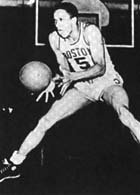 Chuck Cooper, the first black player to join an NBA team |
|
The game spread across the world at fast-break speed, mainly due to the YMCA. As dozens left its training schools for jobs around the world, they took the Doc's game with them and, as early as 1909 an American touring team was playing in Russia. The game was included in th 1904 Olympics (all the teams were American) as a demonstration sport and again at Paris 1924, when the Gold Medal was won by the UK's London Central YMCA. Basketball finally made it to full Olympic status at the notorious 1936 Berlin games where the games inventor, Dr James Naismith (who was to die three years later) presented the Gold medal to the USA. In the same year the English Basketball Association (EBBA) was founded and Hoylake YMCA beat London Polytechnic 32-21 to win the first National Championships. It was to be another 24 years before the first national league was set up in 1960 with nine teams. This had fallen to five by 1963 and the league folded six years later. The EBBA appointed a full-time administrator and the current National Basketball League set-up got going in 1972 with six teams from London, Liverpool, Leicester, Sheffield and... the Royal Air Force. The NBL continued to grow, with sponsorship playing a vital role and there are now around 70 clubs playing in national men's and women's leagues at senior level. In 1987 the Basketball Leage was set up (initially sponsored by Carling, later by Budweiser) to run the Premier League on a franchise basis. The league comprised 15 teams and the 87/88 title went to Portsmouth, with Livingston winning the Championship play-offs, beating Portsmouth 81-72 in the final. Livingston also won the first National Trophy - again beating Portsmouth in the final - but lost out in the National Cup to Kingston. None of these teams feature in the current Premier League which reflects how the league has changed over the years. Kingston continued to dominate the league in the early '90s but Worthing and Thames Valley took over mid-decade before teams from London, Sheffield and Birmingham stepped up. The league really took off in 1996/97 with a new rule allowing a club to sign four work-permit players instead of two. Sponsorship has also grown hugely and TV coverage increases each season. The Premier League clubs are currently split between the rich and the relatively poor. The salary cap is intended to even things out but is easily worked around and the top-flight league is in danger of becoming a branch of show biz, with half a dozen super-clubs sharing a pay-to-view TV pot. Time will tell... Mike Jones, August
1998 |
|
|